Demeter, the Mother Goddess: Love, Grain, and the Living Earth

Before bread reaches the table, a seed must meet the earth. Someone must keep it safe, place it in a dark furrow, wait for rain and the first green shoots, tend the growing crop, and let the grain ripen.
Within a single loaf lies an entire relationship between human beings and the earth that feeds them.
In the Greek world, this life-giving presence has a name: Demeter.
Golden ears of wheat rest in her hands. Her presence is felt in the weight of ripe grain, the generosity of a harvest, and the soil opening to receive a seed. She knows how much care it takes for something so small to become food for a family.
Behind her stands an older lineage.
Her grandmother is Gaia, the Earth herself: the primordial mother from whom mountains rise and gods are born. Gaia holds the depths of the earthly world—stone, underground waters, dark caverns, the vast body beneath our feet.
Her mother is Rhea, the ancient maternal power who gives birth to the Olympian gods. She knows the joy of bringing life into the world, and the terror of having her children taken from her.
These older mothers carry the immense powers of beginnings. Their generosity is boundless; their anger can be terrifying. In their presence, human life seems small within the greater life from which it emerges.
Demeter carries that ancestral power closer to our everyday world.
Gaia holds the depths. Rhea embodies the great force of divine motherhood. Demeter meets us in the fertile soil we can touch: the ground where roots take hold and wheat begins to grow.
The ancient Great Mother unfolds into many goddesses, each carrying a part of her original wholeness. Demeter holds the powers of nourishment, cultivation, fertility, and the bond between a mother and the life she brings forth.
The older power still lives within her.
She who gives the harvest can also withhold it. She who feeds the world knows the power of hunger. And when her love is taken for granted, she can make the whole world stop and listen.
The Daughter Taken from Her Mother
When Demeter is born, her mother already knows what to fear.
Cronus, Rhea’s husband, has heard a prophecy: one of his children will overthrow him. From that moment, every newborn seems to carry a threat.
He swallows their first daughter, Hestia.
Then Rhea gives birth to Demeter. Once again, she barely has time to hold her child before Cronus takes the baby from her. Demeter disappears into his body, where her older sister is already imprisoned.
Hera, Hades, and Poseidon follow.
Again and again, Rhea is left with empty arms. Her body brings children into the world, and her husband swallows them. The home that should be filled with their voices falls silent.
When another birth approaches, Rhea seeks help from Gaia and Uranus. Following their counsel, she travels to Crete and gives birth to Zeus far from Cronus.
The baby is hidden.
For her husband, Rhea prepares a different bundle. She wraps a stone in swaddling cloth and places it in his hands. Eager to remove another threat, Cronus swallows it without looking.
At last, Rhea has a secret she can protect.
Zeus grows up. In time, with the help of wise Metis, he gives his father a potion that forces him to release the children he has swallowed.
Demeter emerges with her brothers and sisters.
Her life opens into the world through a return: out of darkness, into light; out of confinement, into open space. Her mother receives back the children who have been taken from her.
One day, Demeter will search for a stolen daughter of her own. First, she learns what a mother’s determination can set in motion.
A World Divided Among Brothers
The freed children rise against Cronus. After a long struggle, the Titans lose their power, and the age of the Olympians begins.
Three brothers divide the realms.
Zeus receives the sky, Poseidon the sea, and Hades the underworld. The earth remains common ground, though Zeus gradually extends his authority over it as well.
Demeter enters this newly ordered world carrying a different kind of power.
Her brothers have kingdoms. She holds the force that allows the soil to nourish life. Beneath her care, seeds awaken, roots reach into darkness, and grain grows heavy in the ear.
She walks the fields and feels the ground beneath her feet. Here, life asks for attention: warmth, nourishment, patience, protection.
And here, among the earthly things she loves, love finds her.
Love in the Thrice-Ploughed Field
Evening settles over Crete.
A cool breeze comes in from the sea, but the soil still holds the warmth of the day. The plough has crossed the field three times, leaving deep, dark furrows. The air smells of damp earth and freshly broken roots.
Demeter loves that scent.
The field is ready for seed. Long shadows gather in the furrows. Along its edge, Iasion walks beside her.
He is mortal. The marks of work remain on his hands. As she listens to him, Demeter wishes the path were longer and the evening slower to fade.
Iasion stops.
He touches her hand, and she answers his touch.
Soon her golden hair brushes the dark soil. Earth clings to her clothing. The open field receives their love, and the goddess of fertility gives herself to the same living power she awakens in everything around her.
But Zeus sees them.
Lightning tears through the sky and strikes Iasion.
Where Demeter has just felt the warmth of her lover, there is suddenly stillness. Her hands rest on his body. She can fill an ear of wheat and bring fruit to ripeness, yet she cannot call his breath back.
Another life is already beginning within her.
Demeter gives birth to a son, Ploutos, the god of wealth and abundance. His father is mortal; from his mother, he receives divine life.
He grows, and eventually sets out across the land and the wide sea.
Where Ploutos comes, prosperity follows. Households grow stronger. Stores fill. People begin to have enough to keep something for tomorrow and offer something to a guest.
His gifts carry his mother’s generosity.
They smell of harvest. They mean grain in the storehouse, food for children, seed for another planting. They offer the quiet reassurance of being able to live through the months between one harvest and the next.
Demeter gives fertility. Her son brings the abundance that grows from it.
Iasion’s name remains with the Cretan field. Their son travels far beyond its borders, carrying the life born of their meeting into the homes of others.
Another love awaits Demeter now—the love through which a mother begins to know the world by her child’s breathing.
The Cry Among the Flowers
Demeter’s daughter by Zeus is called Kore, the Maiden.
With her, the goddess can forget her grandeur. She can listen to a young girl’s chatter, straighten a flower caught in her hair, and watch her face change as she grows. However tall Kore becomes, Demeter remembers the small hand that once fitted entirely within her own.
One day, the girl goes out with her companions to gather flowers.
Among the colours of the meadow, she notices a narcissus of extraordinary beauty. She wanders a little farther, bends, and reaches for it.
The earth opens.
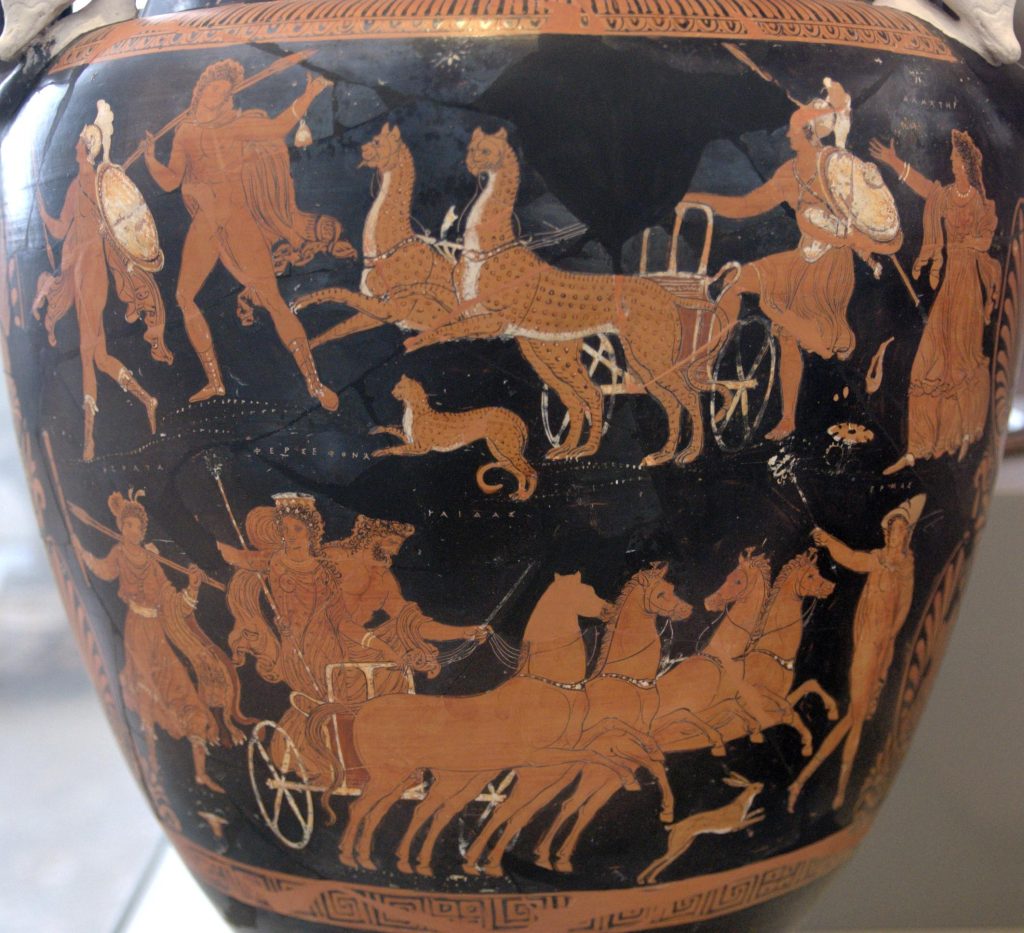 Hades’ chariot bursts from the depths. The girl cries out. Flowers slip from her fingers as the lord of the underworld seizes her and carries her away.
Demeter hears her daughter’s voice.
She rushes towards it, but the meadow is already empty. The earth has closed. She drops to her knees and touches the ground, as though her hands might find the place where her child has vanished.
Then the searching begins.
For nine days and nights, she walks with torches. Every distant voice makes her pause. Every dawn seems to promise news.
On the tenth day, Hecate approaches her. She too has heard the cry. Together, they turn to Helios, the sun, whose gaze reaches across the earthly world.
He names Hades.
He also tells her that Zeus has consented.
Then he tries to comfort her: her daughter has a powerful husband, the ruler of a vast kingdom.
Demeter listens and understands that no one intends to search for Kore. The decision has already been made. They are waiting for her to accept it.
She leaves Olympus.
A Stranger Beside the Well
By evening, Demeter reaches Eleusis.
People are returning home, calling to their children, carrying water. Supper is being prepared behind the walls, and the smell of woodsmoke drifts across the road.
At the well, the goddess stops.
She has asked so many roads for news of her daughter that she has begun to dread the next answer—or the next silence. She sits, rests her hands in her lap, and feels how tired she is.
An old woman’s face looks back at her from the water.
Demeter studies it without surprise. This face is easier to wear now. She can sit beside a stranger’s well without anyone asking her for a good harvest.
Here, the daughters of King Celeus find her.
At first, they pass. Then one turns back and asks where she comes from and whether she knows anyone in the town.
Demeter calls herself Doso. She says she is looking for work. She knows how to care for children.
The girls brighten. They have a little brother, and their mother needs a nurse.
That evening, the goddess enters a human home.
Metaneira, the children’s mother, welcomes her. For a moment, as the stranger stands in the doorway, she seems to shine. Metaneira instinctively steps aside, then offers her a seat and asks for something to drink.
A baby’s voice comes from the next room.
Demeter turns.
Once, her own daughter called like that—with her whole small being, certain that her mother would come.
The goddess lowers her eyes.
Baubo Makes the Goddess Laugh
Baubo, busy nearby, notices the movement. She pushes a cup towards the guest and begins to talk.
There is scarcely an answer.
So she tells a funny story—the sort of household tale women laugh at even when they have heard it ten times before.
Demeter remains silent.
Baubo tries again. She teases, adds an indecent detail, and laughs at her own joke. The stranger sits with her fingers tightly clasped. The cup remains untouched.
Then Baubo takes a step back and suddenly lifts her clothing, exposing her belly and her vulva.
Demeter looks up.
There stands a grown woman, thoroughly pleased with her own outrageous behaviour, waiting.
There is so much mischief in her face that the goddess lets out a small snort. She tries to contain herself.
Then she laughs.
Baubo immediately joins in.
Demeter covers her mouth. Tears gather in her eyes. She wipes her cheek, shakes her head, looks at Baubo—and starts laughing again.
When she finally catches her breath, Baubo silently offers the cup.
This time, Demeter takes it in both hands. She tastes barley and the coolness of mint. Then she drinks again.
Baubo sits beside her. Now they can be quiet together.
The daughter is still far away. No one in this house can bring her back. Yet this woman has reached the goddess for a few precious moments.
Through her body, her boldness, and her laughter, Baubo reminds the Earth Mother of life: breath, taste, warmth, and the possibility of pleasure even within great sorrow.
Soon Metaneira brings in the baby.
Demeter holds out her arms.
The Secret of the Night Fire
Demophon quickly grows accustomed to his new nurse.
He settles in her arms, sleeps deeply, and grows stronger each day. Metaneira watches her son with delight and blesses the chance that brings this woman to their well.
By day, everything seems ordinary. The nurse carries the child, walks through the house, and lays him down to sleep.
At night, something else begins.
When the household falls silent, Demeter anoints the boy with ambrosia. She bends over him and breathes upon him. Then she approaches the hearth and places him in the fire.
The flames receive him.
He lies peacefully in their warmth. Night after night, beneath the goddess’s care, his mortal nature begins to fall away.
Demeter is preparing immortality for him.
But one night, Metaneira wakes.
She wants to look at her son. Quietly, she approaches the doorway.
Her baby is lying in the fire.
The cry escapes before she can understand anything more.
Demeter looks up and lifts the child from the flames. As she does, Metaneira sees the old nurse change.
Her bent body straightens. Age leaves her face. Golden hair falls over her shoulders, fragrance fills the room, and light pours from her presence.
Demeter reveals what she intends for the boy.
Now the work is interrupted. Demophon will live and receive special honour because he has rested in divine arms, but he will remain mortal.
Metaneira holds him against her chest, feeling his warmth and his breath. A moment ago, she believes she is saving him. Now she glimpses the gift she has been too frightened to recognise.
The goddess commands the people to build her a temple.
Eleusis learns whom it has welcomed.
And Demeter’s arms are empty once more.
Demeter the Furious
The hospitable house is one shelter along the goddess’s wandering path. On another road, she must seek protection herself.
Poseidon sees her and desires her.
Demeter refuses. She is searching for her daughter; now she must also escape his pursuit.
Ahead, a herd of horses moves across the land.
She takes the form of a mare and slips among them. Warm bodies surround her. She hears their breathing and the grass brushing beneath their hooves. Here, perhaps, she can disappear into the herd.
Poseidon recognises her.
He becomes a stallion and rapes her.
The goddess who gives life experiences violence against her own body. The one to whom people pray for fertility cannot make her refusal respected.
Fury rises within her.
She is called Erinys—the Furious One. The name carries a power reaching down into the ancient depths of her lineage. Before this Demeter, no one can casually hold out a hand and ask for another gift.
From the assault are born the mysterious goddess Despoina and the extraordinary horse Areion.
Demeter’s own path continues through the pain.
One day, she enters a river.
The water is cool. Slowly, she lowers herself into it and lets the current touch her skin. Her clothing lies on the bank. Here, no one asks for a harvest, a smile, or her acceptance of what has happened.
She washes and gradually returns to herself.
The name of the Furious One remains with her.
The generous Earth Mother has a body and a will of her own.
The Field Falls Silent
Within her temple at Eleusis, Demeter withdraws.
People do not yet understand that something they have always relied upon is disappearing. They go out to their fields, prepare the soil, and sow.
Days pass.
Nothing grows.
A farmer kneels beside a furrow and opens the earth with his fingers. The grain is still there, lying in darkness, without roots.
He tries the next furrow. Then another.
At home, they ask about the harvest. At first, he says they must wait. Later, he says less. Last year’s grain remains in the storehouse, and each morning there is a little less of it.
The same conversations unfold in many homes. People measure flour carefully, count their remaining supplies, and look at their children.
Demeter does not release the crops from the earth.
The gods begin to worry as well. Offerings diminish. The human world approaches famine, and the order Olympus considers eternal begins to tremble.
Zeus sends Iris. Other immortals follow, offering honours and gifts, urging Demeter to return.
She asks for her daughter.
At last, everyone begins to understand how much life depends upon her consent.
Hermes is sent to Hades.
When Persephone appears before the temple, Demeter runs to her. She embraces her, touches her face, and feels the reality of her daughter’s presence.
Only after a moment does she remember to ask: has the girl eaten anything in the underworld?
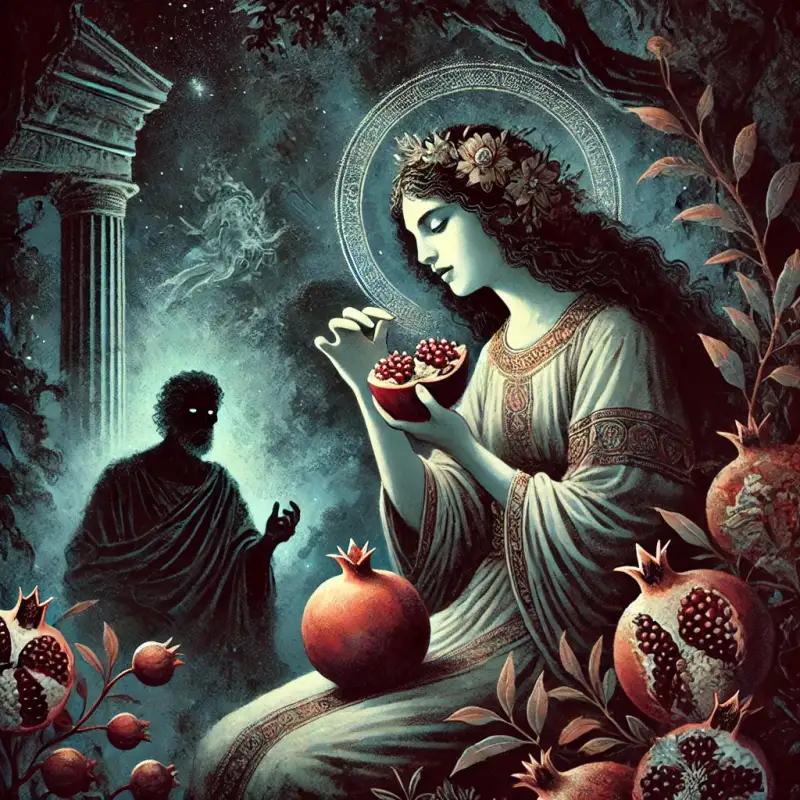 Persephone tells her about the pomegranate seeds.
Demeter becomes still. The daughter in her arms is already bound to another realm.
Then Rhea comes.
The mother who wins her own children back from captivity helps establish a new arrangement: Persephone will spend one-third of the year with Hades and two-thirds with Demeter.
The goddess agrees.
And one morning, a farmer walks out to his field and sees green.
He bends and touches the first shoot. Then he calls his family.
Soon they are standing together beside the furrows, looking at the tender stems.
They can speak of the future again.
The Man Who Can Never Have Enough
After such a time, it seems people should remember forever who gives them bread.
Yet one day, Erysichthon enters Demeter’s sacred grove.
Men carrying axes follow him. He wants timber, and the goddess’s trees seem suitable.
The grove is cool. Branches meet high overhead; the ground is soft beneath his feet. These trees have been growing here long before he decides what to do with them.
The first blow falls.
Demeter appears in the form of a priestess. She warns him and tells him to stop.
Erysichthon dismisses her. Here is a woman interfering with his work. He is accustomed to obedience.
Then the priestess’s appearance falls away.
The men with axes find themselves before the goddess.
Demeter condemns Erysichthon to hunger.
Before long, he orders a meal. He sits, eats everything, and asks for more.
The servants bring more food.
He eats, but relief never comes. His thoughts turn towards the next mouthful before he has swallowed the last.
The storerooms empty. His possessions are sold to buy food. Everything that once makes him wealthy disappears across the table.
Eventually, there is nothing left to pay with.
Erysichthon searches everywhere. He picks up scraps he would once have passed with disgust. He devours refuse and remains hungry.
The man for whom a living grove is never enough can no longer find enough anywhere.
The Earth Mother reveals her power over nourishment. He can command a tree to be cut down. He cannot command his body to feel satisfied.
Today, this story makes me look more closely at our own world.
We, too, arrive with axes—now far more powerful. We take forests, exhaust the soil, and pollute water. Our demands grow, while our sense of having enough slips farther away.
In my spiritual understanding, volcanoes, earthquakes, and floods become a stern reply from the living Earth. I hear in them the voice of a Mother angered by the way we treat her body.
For me, Demeter remains alive in this relationship. Her generosity continues to feed us. Her anger reminds us that our relationship with the Earth carries consequences.
How Demeter Gives Wheat to the World
In the sacred grove, one man raises an axe.
In an Eleusinian field, another bends towards the soil and waits to learn from the goddess.
This is Triptolemus, the son of Celeus.
Demeter places a handful of wheat in his palm. The grains are small and firm. He studies them as she lifts one between her fingers.
A single grain can become an ear of wheat. Grain saved from that harvest can become a field. The crop will feed a household, while part of it will be kept for another sowing.
Triptolemus listens.
Then the work begins. The soil must be prepared, the furrow opened, the seed placed in the ground. He must learn to wait for the shoots and care for them, recognise the ripening grain, and gather and store the harvest.
Demeter teaches him the rhythms of the land. There is a time for labour and a time for waiting, a time to reap and a time to let the soil rest.
It is Demeter who gives wheat to humanity and teaches people to grow it for food. Through her gift, grain becomes flour, flour becomes dough, and the smell of bread begins to rise from the hearth.
Triptolemus learns to look at the earth with greater attention. In a dark furrow, he can now see the promise of green shoots. In a handful of seed, he sees food for many people.
Then comes the day to carry this knowledge farther.
The goddess gives him grain and leads him to a chariot drawn by winged dragons.
Triptolemus climbs aboard. The dragons spread their wings, and Eleusis falls away beneath him.
Ahead lie valleys, mountains, and unfamiliar settlements. He brings people seed and the knowledge to care for it. Where wheat is not yet cultivated, he stops to teach.
Behind him, new fields begin to grow.
Families go out to watch the first shoots. Children learn from parents who learn from the goddess’s messenger. Demeter’s gift passes from hand to hand.
Within it lives the wisdom of a caring mother.
A hungry person needs food today. Then they need seed, knowledge, and help with the first steps towards growing food themselves.
Such care has a future. In time, the person who receives it becomes able to support someone else.
And the mother’s generosity continues its journey.
Bread on the Table
Demeter knows the value of life.
She knows what it is to hold a lover and feel that he no longer breathes. To search for a daughter, listening for her in every voice. To laugh again when sorrow seems to have filled every space within her.
She remembers captivity in her father’s body and Rhea’s determination. She remembers the child beside the hearth, the cool river, and the scent of the Cretan soil.
Within her, the ancient power of Gaia and Rhea draws close to our homes.
The Earth Mother comes inside, sits beside us, and accepts a cup. Then she walks into the field and teaches us how to care for what is growing.
At Eleusis, she offers another gift: the sacred Mysteries. There, Persephone and Hecate stand beside her, and beyond the fertility of the fields opens a deeper encounter with life, death, and return.
That doorway leads to another story.
For now, the wheat bends beneath the weight of ripening grain.
Below it lies the dark soil, holding the seed, feeding the roots. Above it move air, rain, and changing light.
People gather the harvest, grind the grain, and knead the dough. Someone lights the hearth.
Soon, the smell of bread fills the rooms.
Children come to the table. A chair is moved to make room for a guest. Hands break open the warm loaf and offer the first piece to the person sitting nearby.
There is enough food in this house today.
And in that generous movement of a hand, Demeter lives on.
Literary foundations: Jean Shinoda Bolen, Goddesses in Everywoman; Galina Bednenko, Greek Goddesses: Archetypes of Femininity. An AMOREI literary retelling and interpretation.