Hera in Greek Mythology: The Great Queen of the Gods, Sacred Marriage, and Feminine Power
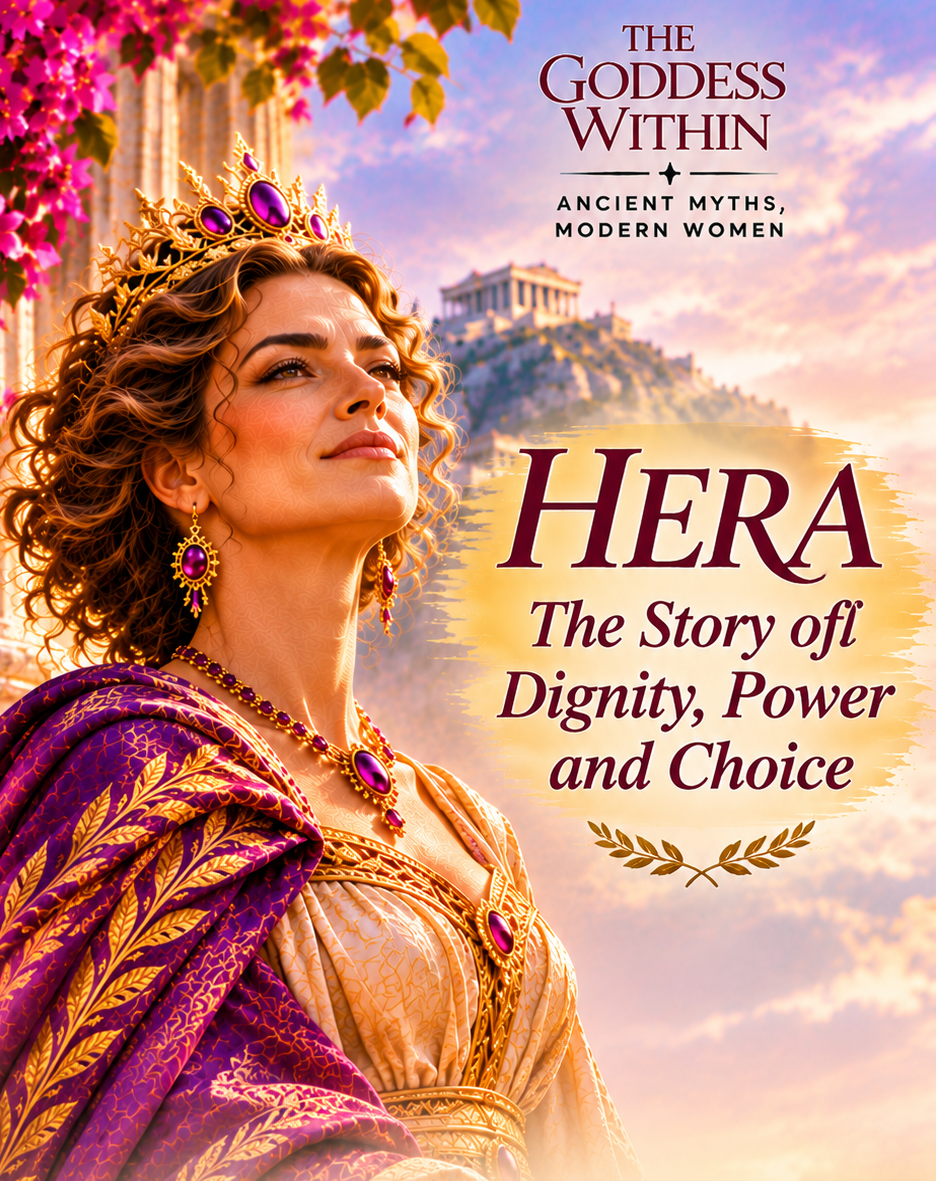
The story of a goddess whose greatness lies hidden behind legends of jealousy
When we hear the name Hera, the image that most often comes to mind is that of an angry woman pursuing the many lovers of her unfaithful husband, Zeus. She is jealous, she takes revenge, she punishes, she interferes in the destinies of others, and she seems almost never to be happy.
Yet long before these stories become known throughout the world, Hera is already one of the greatest goddesses of ancient Greece.
Magnificent temples rise in her honor. People worship her as the Queen of Heaven, the protector of women, sacred marriage, and the divine order. Solemn ceremonies take place before her images, offerings are brought to her altars, and prayers are addressed to her for marriage, childbirth, and the well-being of families.
She is called the ox-eyed goddess, a title that evokes her large, beautiful eyes. She wears a royal diadem upon her head and carries a scepter and a pomegranate in her hands. Her very presence commands respect, even among the immortal gods.
Hera is both the sister and wife of Zeus, but her divine dignity does not begin with marriage. She belongs to an ancient generation of gods who inherit the powers of Earth and Heaven themselves.
To discover the true Hera, we must travel far beyond Olympus, into the time when the world is still taking shape and power over creation is passing from one generation of immortals to another.
Daughter of Rhea and Cronus: The Birth of a Future Queen
Hera is born into the family of the Titans Rhea and Cronus.
Her grandmother is Gaia herself, the primordial Earth from whom mountains, seas, gods, and all living beings emerge. Rhea, Hera’s mother, belongs to the ancient generation of great divine mothers. She embodies the power of birth and the continuation of life, the force that brings new generations into existence and passes its inheritance to them.
But the birth of children in the family of Cronus is overshadowed by a terrible secret.
Cronus knows a prophecy: one day his own child will take away his power, just as he once overthrew his father, Uranus. His fear of losing his kingdom proves stronger than his love for his children. And so, whenever a child is born, he immediately swallows it.
Hestia, Demeter, Hera, Hades, and Poseidon disappear into their father’s body.
Only the youngest son, Zeus, escapes this fate.
Rhea gives Cronus a stone wrapped in swaddling clothes instead of the newborn child, while hiding the baby on the island of Crete.
When Zeus grows up, he forces his father to release the children he has swallowed. The brothers and sisters emerge into the world once more, and soon a great war begins between the young gods and the Titans.
After the Olympians achieve victory, power over the world passes to a new generation.
Zeus becomes Lord of the Sky and supreme ruler of the gods. Poseidon receives the seas, while Hades takes dominion over the underworld. Demeter becomes the guardian of fertility and earthly harvests, and Hestia protects the sacred fire of the home.
Hera is destined to become Queen of Olympus.
But before we enter the story of her marriage to Zeus, it is worth discovering how this goddess appears to the people who worship her on Earth.
Great Hera: The Goddess Honored with Temples and Royal Devotion
In Argos, Samos, and other regions of the Greek world, magnificent sanctuaries rise in Hera’s honor.
Her temple on Samos is among the most celebrated sacred buildings of antiquity. Enormous columns reach toward the sky, while pilgrims bring precious jewelry, vessels, figurines, and other offerings to the goddess.
In Argos, Hera is revered as the powerful protector of the land and its people. Here she occupies a special position among the immortals, and her worship is deeply woven into the life of the entire city.
Hera embodies royal dignity. Her authority extends over sacred order, marriage, women’s lives, and the public recognition of the marital union.
Within her image, the majesty of the heavenly queen is united with the strength of the earthly woman who becomes a wife, mistress of her household, mother, and guardian of the family lineage.
Among Hera’s sacred symbols are the cow, the cuckoo, the pomegranate, and, in later imagery, the peacock.
The cow represents fertility, motherhood, and abundance. The cuckoo announces spring and the awakening of nature. The pomegranate contains countless seeds, symbolizing life, fertility, and the continuation of generations. The peacock, with its magnificent plumage, becomes an emblem of her royal splendor.
Yet Hera possesses another quality that gives her image extraordinary depth.
In Stymphalus, she is worshipped in three states: as the Maiden, as the Fulfilled One—the married woman—and as the Widow. These three forms encompass an entire cycle of feminine life, from youth and marriage to the loss of a former identity and the beginning of something new.
Hera is not the goddess of only one stage of a woman’s existence. Her ancient image contains the movement of time, the changing nature of destiny, and the possibility of renewal.
And yet the most famous event in her divine life is her union with Zeus.
The Cuckoo and the Beginning of Sacred Marriage
Zeus is Lord of the Sky, master of thunder and lightning, and the most powerful of the Olympian gods. Yet even he cannot immediately win Hera’s love.
Hera is proud and does not readily accept his advances.
One day, Zeus sees her upon a mountain and devises a trick.
The sky darkens. A cold wind rises, and a storm begins. Amid the rain and gusts of wind, a small cuckoo appears. The bird trembles from the cold and seems utterly helpless.
Hera feels compassion for it.
She takes the little bird into her hands, shelters it beneath her clothing, and presses it against her breast to keep it warm.
And at that very moment, the cuckoo transforms into Zeus.
Thus the Lord of Heaven succeeds in approaching the proud goddess who has resisted his persistent courtship.
Soon they become husband and wife, and their marriage becomes one of the greatest sacred unions in the Greek world.
Olympus celebrates their wedding. The immortal gods gather to welcome their new king and queen. Gaia presents Hera with a miraculous tree bearing golden apples, which is planted in the distant Garden of the Hesperides.
The golden apples become a symbol of the divine gift associated with their marriage and later find their place in other great myths.
The union of Zeus and Hera is known as hieros gamos, the sacred marriage.
Within it, heavenly authority and feminine sovereignty come together. For the ancient Greeks, it represents marriage blessed by divine power.
Yet this sacred union has one essential condition that Zeus violates again and again.
Fidelity.
Hera becomes the protector of lawful marriage, while her own husband repeatedly enters into relationships with goddesses and mortal women.
And here the most dramatic part of her story begins.
When the Queen Leaves Olympus
One day, Hera’s patience reaches its limit.
She leaves Zeus and descends to Earth, abandoning the magnificent palaces of Olympus and the husband who is accustomed to treating his will as law for all immortals.
Zeus can command thunder, summon storms, shake the Earth, and demand obedience from the gods. But he cannot force Hera to return through power alone.
And so the Lord of Olympus resorts to cunning.
He announces that he is going to marry again.
A splendid carriage is prepared for the new wedding. Inside it, a wooden statue of a woman is dressed in beautiful bridal garments. A veil conceals the bride’s face.
Zeus sets out with the wedding procession, while those accompanying him joyfully proclaim the approaching marriage.
The news quickly reaches Hera.
Is Zeus truly preparing to replace her with another queen?
The furious goddess rushes toward the procession. She approaches the carriage and tears the veil from her rival’s face.
And suddenly she stops.
Before her sits a wooden doll.
Zeus has arranged an entire performance to provoke her jealousy and persuade her to return.
Hera bursts into laughter.
Anger gives way to amusement. The divine spouses reconcile, and the wooden bride is burned. The memory of this event lives on in the ancient festival of the Daedala, celebrated at Plataea.
There is something remarkable about this story.
Here the mighty Zeus appears as a man who does not wish to lose his wife. He stages an elaborate performance to bring her back, while Hera, so often portrayed as stern and unforgiving, suddenly laughs.
Their relationship contains more than jealousy and a struggle for power. There is also a particular bond that repeatedly draws them back toward one another.
But reconciliation does not bring an end to their conflicts.
Hera Against Zeus: The Struggle for Power on Olympus
Hera possesses a will of her own and is not afraid to oppose her husband openly.
One day, she joins other Olympian gods in a conspiracy against Zeus.
Tired of his absolute authority, they decide to bind the Thunderer and deprive him of the ability to resist. Among the conspirators are Hera, Poseidon, and Athena.
But the plot fails.
The sea goddess Thetis summons Briareus, the hundred-handed giant, to help Zeus. His mere appearance is enough to make the conspirators abandon their plans.
Zeus retains his throne.
Yet another, even more brutal conflict arises between the divine spouses, this time involving Heracles.
Golden Chains Between Heaven and Earth
Hera cannot reconcile herself to the existence of Heracles, the son of Zeus and the mortal woman Alcmene. She pursues him from birth and seeks to prevent the fulfillment of his heroic destiny.
One day, as Heracles is returning by sea after one of his adventures, Hera decides to destroy him.
She calls upon Boreas, the North Wind, and raises a terrible storm. Enormous waves crash against the hero’s ship, the wind tears its sails, and the sea carries Heracles far from his intended course, toward the island of Kos.
But Zeus discovers what has happened.
He saves his son and turns his fury upon Hera.
By the Thunderer’s command, her hands are bound with unbreakable golden chains, while two heavy anvils are fastened to her feet.
And Hera is suspended high between Heaven and Earth.
Below her stretches the world of mortals. Above her rises Olympus. Clouds drift around her, while the Queen of the Gods hangs in the vastness of the sky, unable to free herself.
The immortals watch her suffering with indignation, yet none dares approach.
Zeus threatens to cast down from Olympus anyone who attempts to help his wife.
Thus the mighty queen, worshipped by mortals and honored by gods, becomes the prisoner of her own husband.
This is one of the darkest episodes of their marriage.
Hera attempts to destroy Zeus’s son because she cannot forgive the child’s father for his infidelity. Zeus responds to her cruelty with an even greater act of cruelty.
Their conflict becomes a struggle in which both possess immense power, yet neither finds a path toward love and mutual understanding.
The golden chains become a remarkably expressive symbol. Even gold, the emblem of royal dignity, can become a prison.
And even the Queen of Heaven can lose her freedom when her life becomes consumed by conflict with the one she loves.
Eventually Hera is released. She returns to her throne on Olympus, but the struggle between the divine spouses continues.
This story invites us to reflect upon the nature of power in relationships. Power can compel, punish, and conquer, but it cannot create love. When two powerful beings begin fighting each other, their strength becomes a source of mutual suffering.
That is why the myths of Hera remain so recognizable even today.
Yet Hera’s struggle extends far beyond her marriage. She is the Queen of Olympus, and her pride, dignity, and desire for recognition reach into the affairs of both gods and mortals. It matters to her that her greatness be acknowledged not only by the immortals but also by human beings.
And one day, an ordinary golden apple becomes the cause of a dispute involving the honor of three great goddesses, the destiny of a beautiful woman, and the future of an entire kingdom.
The Golden Apple and the Judgment of Paris
The Olympian gods gather to celebrate the wedding of the mortal hero Peleus and the sea goddess Thetis.
The celebration is magnificent. Yet one goddess receives no invitation: Eris, the goddess of discord.
Offended, she appears among the guests and throws a golden apple bearing the inscription, “To the Fairest.”
Three goddesses immediately begin to argue over who deserves it: Hera, Athena, and Aphrodite.
Zeus refuses to settle their dispute and entrusts the judgment to Paris, a prince of Troy.
Each goddess offers him a gift.
Hera promises dominion over great kingdoms.
Athena offers wisdom and victory in battle.
Aphrodite promises the love of the most beautiful woman on Earth.
Paris chooses Aphrodite.
The golden apple goes to the goddess of love, while beautiful Helen, the wife of the Spartan king Menelaus, becomes the center of the conflict that leads to war between the Greeks and Trojans.
Hera does not forgive Paris for his decision.
She takes the side of the Achaeans and does everything in her power to bring about the defeat of Troy.
What makes this myth particularly interesting is that each goddess offers a human being the very power she herself embodies.
Aphrodite offers love.
Athena offers wisdom and the art of war.
Hera offers royal authority.
And yet Paris chooses love.
He places it above the power of kingdoms and the glory of military victories. His choice brings tragedy upon himself and an entire people, but it also reveals something deeply human: the longing for love can be stronger than the desire for power and wealth.
Every person chooses what holds the greatest value for them. One seeks achievement and recognition, another knowledge and victory, while a third longs for love.
And Paris, standing before three great goddesses, chooses love.
Yet another story lies hidden within this choice. Aphrodite promises him the most beautiful woman, but love cannot be received as a prize or possessed like a kingdom. Paris’s decision sets in motion events in which the desire to possess a beloved woman brings suffering to countless people.
The myth of the golden apple therefore reveals more than the differences among three goddesses. It also opens the door to one of the deepest mysteries of love itself.
We explore the nature of Aphrodite, the power of attraction and desire, and the love that can transform human life in the article “Aphrodite: Goddess of Love, Beauty, and Creative Power.”
For Hera, however, losing the judgment to Aphrodite means far more than wounded pride. Paris rejects her gift of royal power and, with it, the recognition of her greatness. Now Hera seeks not only a Greek victory over Troy but also the restoration of her own supremacy. She intends to demonstrate that the will of the Queen of Olympus can determine the fate of even the mightiest earthly kingdoms.
And to achieve this, Hera is prepared to challenge Zeus himself.
Hera and the Trojan War: The Queen Who Outsmarts Zeus
During the Trojan War, Zeus supports first one side and then the other, seeking to fulfill his own designs.
But Hera stands firmly with the Greeks.
When Zeus begins helping the Trojans, she decides to distract him.
Hera approaches Aphrodite and asks to borrow her magical girdle, which possesses the power to awaken love and desire.
Then the goddess adorns herself with magnificent garments and precious jewels and goes to meet Zeus.
At the sight of his wife, the Thunderer is overcome by such powerful desire that he forgets what is happening on the battlefield.
While Zeus enjoys his intimacy with Hera, Hypnos, the god of sleep, casts him into a deep slumber.
Poseidon takes advantage of this moment to help the Greeks.
When Zeus awakens and discovers what has happened, his anger is terrible.
But Hera has already achieved her purpose.
She uses beauty, desire, cunning, and the assistance of other gods to change the course of events.
The interaction between Hera and Aphrodite is especially revealing.
Hera, the guardian of marriage, turns to the goddess of passion to capture her husband’s attention and accomplish her own design.
For a moment, two different divine powers work together.
And here another important dimension of feminine nature reveals itself: fidelity and passion, constancy and desire, marriage and sensuality can exist within the same woman, enriching one another.
Hera: Mother of the Gods and an Independent Creative Power
Hera is the mother of several Olympian deities.
From her union with Zeus come Ares, the god of war; Hebe, the goddess of youth; and Eileithyia, the protector of childbirth.
But the story of Hephaestus’s birth is particularly unusual.
When Zeus independently brings Athena into the world, emerging fully armed from his head, Hera is deeply offended.
She decides to prove that she, too, can give birth without the participation of her husband.
And so Hephaestus comes into existence, destined to become the god of fire and the divine forge.
Yet the birth of her son does not bring Hera the joy she expects. Seeing that the child is born with physical differences, she rejects him and casts him down from Olympus.
Hephaestus survives.
Sea goddesses care for him, and in time he becomes the greatest craftsman among the immortals.
He creates extraordinary jewelry, weapons, palaces, and magical mechanisms.
When he grows older, Hephaestus decides to take revenge upon his mother.
He fashions a magnificent golden throne and sends it to Hera as a gift.
The queen admires her son’s craftsmanship and sits upon the throne.
But at that very moment, invisible bonds close around her.
Hera becomes a prisoner of her own throne.
None of the gods can free her. Only Hephaestus knows the secret of his creation.
At last, Dionysus succeeds in bringing the divine craftsman back to Olympus, and Hephaestus releases his mother.
This story reveals one of Hera’s harshest qualities.
She can give life, yet she is not always able to accept her own creation.
The proud queen, striving for perfection, rejects a son who does not meet her expectations.
And this very son eventually creates some of the most magnificent works of divine art.
Hidden within this myth is a story that continues to repeat itself in human families.
Parents dream of their children, imagine their futures, and fill those dreams with their own hopes and expectations. But a child enters the world with a nature of their own, their own abilities, character, and destiny.
When love becomes dependent upon expectations, the child begins to feel that acceptance must be earned. Instead of discovering who they truly are, they struggle to become who others want them to be.
Hephaestus does not resemble the beautiful and seemingly perfect Olympians. Yet an extraordinary creative power lives within him.
His mother fails to recognize this power because she sees her son through her own image of perfection.
Nevertheless, Hephaestus transforms the experience of rejection into creativity. Through fire, metal, and the mastery of his hands, he creates beauty admired even by the gods.
This myth opens an important theme that we explore in “The Hera Archetype: Sacred Union, Feminine Dignity, and the Shadow Side of Expectations.”
There we examine how the longing for an ideal marriage, an ideal husband, or ideal children can obscure the ability to love and accept another person as they truly are.
For love begins where the need to conform to someone else’s idea of perfection comes to an end.
Hera and Heracles: Why the Greatest Hero Bears the Name of His Persecutor
Among all the children Zeus fathers outside his marriage, Heracles faces an especially difficult destiny.
His mother is the mortal woman Alcmene, and his father is the Lord of Olympus himself.
But Hera is furious even before the child is born.
Zeus announces that a descendant of Perseus will soon be born and is destined to rule a great kingdom. Hera takes advantage of his promise and arranges for another child, Eurystheus, to be born before Heracles.
The kingdom therefore passes to Eurystheus, while Heracles is destined to serve his weaker relative.
When Heracles is born, Hera sends two enormous serpents into his cradle.
But the infant possesses extraordinary strength. He seizes the snakes in his hands and strangles them.
Thus begins the story of a hero who will one day accomplish twelve great labors.
And here a remarkable mystery arises.
Why does a man persecuted by Hera from the moment of his birth become known by a name meaning “the glory of Hera”?
As a child, the hero is called Alcides. He receives the name Heracles later, when his destiny becomes bound to terrible trials following a tragedy that destroys his family.
Hera sends madness upon the hero. Having lost his reason, he commits a dreadful crime: he kills his own children.
When his mind returns, Heracles is overwhelmed by horror and remorse. He travels to Delphi to discover how he can atone for what he has done.
The Pythia commands him to serve Eurystheus and undertake great labors.
It is then that Alcides becomes Heracles.
His new name combines the name of Hera with the Greek word kleos, meaning glory.
Heracles is the one whose glory is connected with Hera.
And therein lies one of the most extraordinary paradoxes of Greek mythology.
Hera seeks to obstruct the hero, yet the very obstacles she creates become the source of his greatness.
Without these trials, Heracles would not have accomplished his famous labors. He would not have defeated the Nemean Lion, overcome the Lernaean Hydra, faced countless dangers, or descended into the underworld to bring back the three-headed Cerberus.
Every trial demands that he discover new strength within himself.
Hera tries to stop the hero, yet she unknowingly participates in his becoming.
Their destinies are connected far more deeply than a simple story of hatred between a goddess and her husband’s son.
And so it is in life: sometimes those who oppose or persecute us become our most important teachers, unknowingly pushing us toward acts of courage and achievements we might never otherwise have attempted.
Even the Milky Way reminds us of this extraordinary connection.
One day, the infant Heracles is placed against the breast of the sleeping Hera. The child begins drinking her divine milk, but the goddess awakens and pushes him away.
Her milk spills across the heavens, becoming a luminous river of stars.
Thus Hera herself, who rejects the hero, leaves an eternal trace of their encounter upon the sky.
After a long earthly life filled with heroic deeds and suffering, Heracles attains immortality and is welcomed onto Olympus.
And there, reconciliation takes place.
Hera ceases to persecute him. Her daughter Hebe, the goddess of eternal youth, becomes the wife of Heracles.
The hero takes his place among the immortals, while his name forever preserves the glory of the goddess.
This story reveals one of the deepest mysteries of the human journey.
Sometimes what appears to be an obstacle becomes the very force that helps us discover our strength. A person passes through difficulties, encounters injustice, overcomes fear, and discovers abilities they never knew they possessed.
But there is another possibility hidden here.
If even the hostility between Hera and Heracles ends in reconciliation, then a story that begins in hatred does not have to remain a story of hatred forever.
Heracles does not remain a victim of persecution. He rises beyond the circumstances of his birth, follows his own path, and attains immortality.
And Hera becomes capable of accepting the one she once rejected.
Io, Leto, and Semele: Why Hera’s Anger Falls Upon Women
Yet not every story of Hera’s anger ends in reconciliation.
She is particularly cruel toward the women Zeus desires.
Beautiful Io, a priestess of Hera, attracts the attention of the Thunderer. To conceal her from his wife, Zeus transforms the young woman into a white cow.
Hera demands the animal as a gift and places the many-eyed Argus in charge of guarding her.
When Hermes kills Argus at Zeus’s command and frees Io, Hera sends a gadfly to torment the unfortunate woman, driving her to wander across the Earth.
Io travels through many lands before finally finding peace.
Another beloved of Zeus, Leto, is expecting twins: Artemis and Apollo.
Hera prevents her from finding a place to give birth. Leto wanders for a long time until she finally reaches the island of Delos, where her children enter the world.
Semele, a mortal woman loved by Zeus, also becomes a victim of Hera’s anger.
The goddess appears to her in the form of an old woman and plants a seed of doubt: is her lover truly the Lord of Olympus?
Semele asks Zeus to reveal himself in the fullness of his divine glory.
He grants her request, but the mortal woman cannot withstand the brilliance of his lightning and perishes.
Zeus saves the unborn Dionysus by sewing him into his own thigh until the time of his birth.
These stories reveal the darkest side of Hera.
The goddess who protects sacred marriage directs her anger toward the women who become involved with her husband.
But why does she pursue them?
After all, it is Zeus who violates their marriage vows. He possesses the power, he chooses new lovers, and he repeatedly causes suffering to his wife.
Yet Hera’s anger most often falls not upon him but upon those who are far less powerful.
Here we approach one of the most painful patterns of human relationships.
When someone feels betrayed, rejected, or humiliated, their pain can turn into a desire to punish the person they believe responsible for their suffering.
But when the true source of that pain is too powerful, too beloved, or too important to confront, anger is often redirected toward someone else.
Hera does not want to lose Zeus. Her position as Queen of Olympus is inseparably connected with their marriage. Every new relationship of her husband feels like a threat not only to love but also to her own dignity.
Behind her royal pride lies the fear of being replaced.
This is the tragedy of a goddess who possesses immense power yet does not feel secure within the relationship that matters most to her.
She can punish mortal women, interfere with the birth of children, and alter the destinies of heroes. But no punishment can force Zeus to become a faithful husband.
And no victory over a rival can restore her inner peace.
An important question arises: what happens to love when it becomes a struggle for the exclusive right to possess another person?
Hera seeks to preserve the sacred union, but her fear of losing it generates destruction.
This is where the shadow side of her divine power reveals itself.
In our article on the Hera archetype, we explore why even a strong, successful, and outwardly independent woman may experience profound insecurity in love, why she sometimes directs her anger toward a rival rather than her partner, and how she can free herself from this repeating pattern.
For jealousy often conceals not a lack of love for another person, but a loss of connection with one’s own worth.
And the path toward freedom begins with restoring that connection.
Hera and Jason: The Goddess Who Helps Heroes
Jason sets out on a dangerous journey in search of the Golden Fleece.
He must cross seas, encounter monsters, overcome trials, and recover the precious treasure.
But before his adventure begins, Jason performs a simple act that determines how Hera will regard him.
One day, he meets an elderly woman beside a river. The current is strong, and she cannot cross.
Jason lifts her into his arms and carries her to the opposite bank.
During the crossing, he loses one of his sandals.
But the old woman is no ordinary mortal.
Hera herself is hidden beneath her appearance.
The goddess recognizes the young hero’s kindness and decides to become his protector.
From that moment, she helps Jason on his journey, guides events, and works to ensure that he reaches his goal.
Her favor becomes one of the powers accompanying the Argonauts.
Here we encounter an entirely different Hera.
She recognizes nobility in a simple human action.
Jason does not know that he is helping a goddess. He sees an elderly woman in need and does what he believes is right.
And the Queen of Olympus responds with her divine protection.
This myth reminds us that true nobility reveals itself not only through great heroic deeds and victories.
Sometimes it appears in the simplest gesture, when one person helps another without expecting anything in return.
And the great goddess, capable of influencing the destinies of heroes, recognizes the power of the human heart.
The Sacred Spring of Kanathos: Hera’s Secret of Eternal Renewal
Among the ancient legends of Hera, one story stands apart from the turbulent events of her marriage to Zeus.
Near Nauplia lies the sacred spring of Kanathos.
Every year, Hera comes to its waters and bathes.
Afterward, she becomes a maiden once again.
This remarkable ritual reveals an entirely different dimension of the goddess.
Hera, whom we are accustomed to seeing as the eternal wife of Zeus, returns to the state that exists before marriage.
She renews herself.
The water washes away what has been lived, and the goddess regains her maiden freshness and strength.
This image contains a profound mystery of feminine nature.
A woman passes through different stages of life. She becomes a beloved, a wife, a mother, a guardian of the home. She experiences love, happiness, disappointment, loss, and change.
Yet none of these roles encompasses the entirety of her being.
Beyond them all, the woman she was before becoming someone’s wife or mother continues to exist.
It is to this original wholeness that Hera returns in the sacred waters of Kanathos.
The goddess of marriage becomes a maiden once again, year after year.
And here lies one of the most beautiful paradoxes of her mythology.
The possibility of renewal belongs to every woman, regardless of how many years she has lived, how many times she has loved, how many disappointments she has experienced, or what trials she has endured.
And every woman has her own source of renewal.
She does not necessarily need to seek it in distant lands, sacred waters, or ancient temples. This source exists within her own being. She only needs to find her way to it.
Sometimes the path toward this inner source opens through a special space where a woman can temporarily step away from her familiar roles, reconnect with her divine nature, and experience her own wholeness once again.
It is this journey of self-discovery that inspires the women’s retreat “I Am Goddess — The Goddess Within” in Costa Rica, a space dedicated to awakening, expression, and the renewal of feminine nature.
Hera’s sacred bathing becomes an image of feminine restoration, inner purification, and rebirth.
At any moment in her life, a woman has the power to renew her own nature and begin a new story.
Can a Myth Be Rewritten? Hera and the Birth of a New Story
We have traveled through many stories of Hera.
We see her as the daughter of the ancient Titans and Queen of Olympus, a proud bride and powerful wife, a mother of gods and an opponent of Zeus.
We encounter her in anger and cruelty, watching as she pursues women and heroes and interferes in the destinies of entire nations.
But we also discover the goddess who protects Jason, reconciles with Heracles, laughs at Zeus’s clever trick, and returns each year to her original divine nature.
And here I would like to share another understanding that opens an entirely different perspective on ancient myths.
Myths do not belong only to the past. They continue to live through us.
For thousands of years, human beings tell stories about gods and goddesses, pass them on to future generations, write them down, reinterpret them, and embody them in their own lives.
Every storyteller perceives the divine through the lens of their own consciousness, culture, and understanding of love, power, justice, and human relationships.
In this way, stories are born that gradually become part of humanity’s collective unconscious.
And then people begin living these stories themselves.
A woman who endlessly struggles to secure her husband’s fidelity is living one of Hera’s stories.
A man who searches for love but cannot give up his endless conquests is living his own story of Zeus.
A child rejected for failing to meet parental expectations recognizes the story of Hephaestus within their own life.
And a person who passes through difficult trials and gradually discovers their strength may recognize an extraordinary resemblance between their journey and the story of Heracles.
Thus ancient myths continue to manifest in human life.
But here the most important question arises.
Are we obliged to repeat their original stories?
If Hera remains a jealous wife throughout thousands of years of storytelling, must every woman in whom her archetype manifests experience betrayal, humiliation, and a struggle for love?
If Zeus is portrayed as a powerful man who is permitted to violate marital fidelity, must a man who possesses power repeat the same pattern?
And if the story of Hephaestus begins with maternal rejection, does this mean that the love between parents and children must inevitably pass through pain?
I see in myths not only the memory of the past but also the possibility of creating a new future.
Every person has the power to change the story they are living.
First, however, they must become conscious of it.
They must recognize the forces directing their actions, the beliefs that cause them to repeat old mistakes, the fears they mistake for love, and the suffering they continue to create through their own choices.
With awareness comes the possibility of choosing differently.
A woman living Hera’s story can stop fighting rivals and direct her strength toward restoring her own dignity.
She can leave relationships in which her love repeatedly turns into suffering.
Or she can create an entirely different union with the man she loves, one founded upon mutual respect, freedom, fidelity, and conscious love.
A man living Zeus’s story can discover that true power lies not in endless conquest and possession, but in the ability to love, create, and remain faithful to his own choice.
A mother living the story of Hera and Hephaestus can recognize in her child not an extension of her expectations, but an independent divine being who has entered the world with a unique nature.
And then the ancient story begins to change.
First within one person.
Then within their relationships.
Then in the lives of their children, loved ones, and everyone they touch.
And gradually, within the shared field of human consciousness.
This is how I understand the possibility of rewriting myths.
One does not need to become a writer or invent new legends. It is enough to begin living consciously, choosing love where fear once ruled, acceptance where judgment once prevailed, and creation where generations of people repeated destructive patterns.
But when a person understands precisely which myth is manifesting through their life, this process takes on a special depth.
They become a conscious co-creator of a new story.
This is also one of the purposes of my “Maharani’s Magical Tales.”
They are born from the desire not only to tell stories about the divine, but also to create new possibilities for its manifestation in the human world.
Stories in which love no longer needs to be accompanied by suffering.
In which strength does not require domination.
In which the divine masculine and feminine can unite in harmony without losing their freedom or individuality.
In which life on Earth gradually frees itself from the endless repetition of pain and becomes a space of love, creativity, and grace.
And when we return to Hera, a beautiful possibility opens before us: to recognize her myth as a living story whose continuation is still being created.
The Golden Age can begin right now, at the moment when a person stops unconsciously repeating ancient stories and begins creating their own life in love and writing their own stories.
We are not obliged to live myths exactly as our ancestors told them. We can become conscious of them, transform them, and write a new continuation.
And this is what the gods await from us.
Not the endless repetition of their ancient tragedies, but a new manifestation of divine nature through human life.
Thus Hera’s story becomes more than an account of a great goddess.
It becomes an invitation to create a new myth, the story of a woman who remembers her greatness, knows her own worth, and chooses love without losing herself.
We explore how this power manifests in modern women, what gifts the Hera archetype brings, and what challenges arise when its luminous nature becomes hidden in its own shadow in “The Hera Archetype: Sacred Union, Feminine Dignity, and the Shadow Side of Expectations.”
Mythological and Literary Sources
- Hesiod. Theogony.
- Homer. The Iliad, especially Books I, XIV, and XV.
- Pausanias. Description of Greece, Books II, VIII, and IX.
- Apollonius of Rhodes. Argonautica.
- Pseudo-Apollodorus. The Library.
- Diodorus Siculus. Library of History, Book IV.
- Jean Shinoda Bolen. Goddesses in Everywoman.
- Galina Bednenko. Greek Goddesses: Archetypes of Femininity.