Hecate — The Many-Faceted Great Mother Goddess
The ancient Goddess whose power extended across the earth, the sea, and the starry heavens
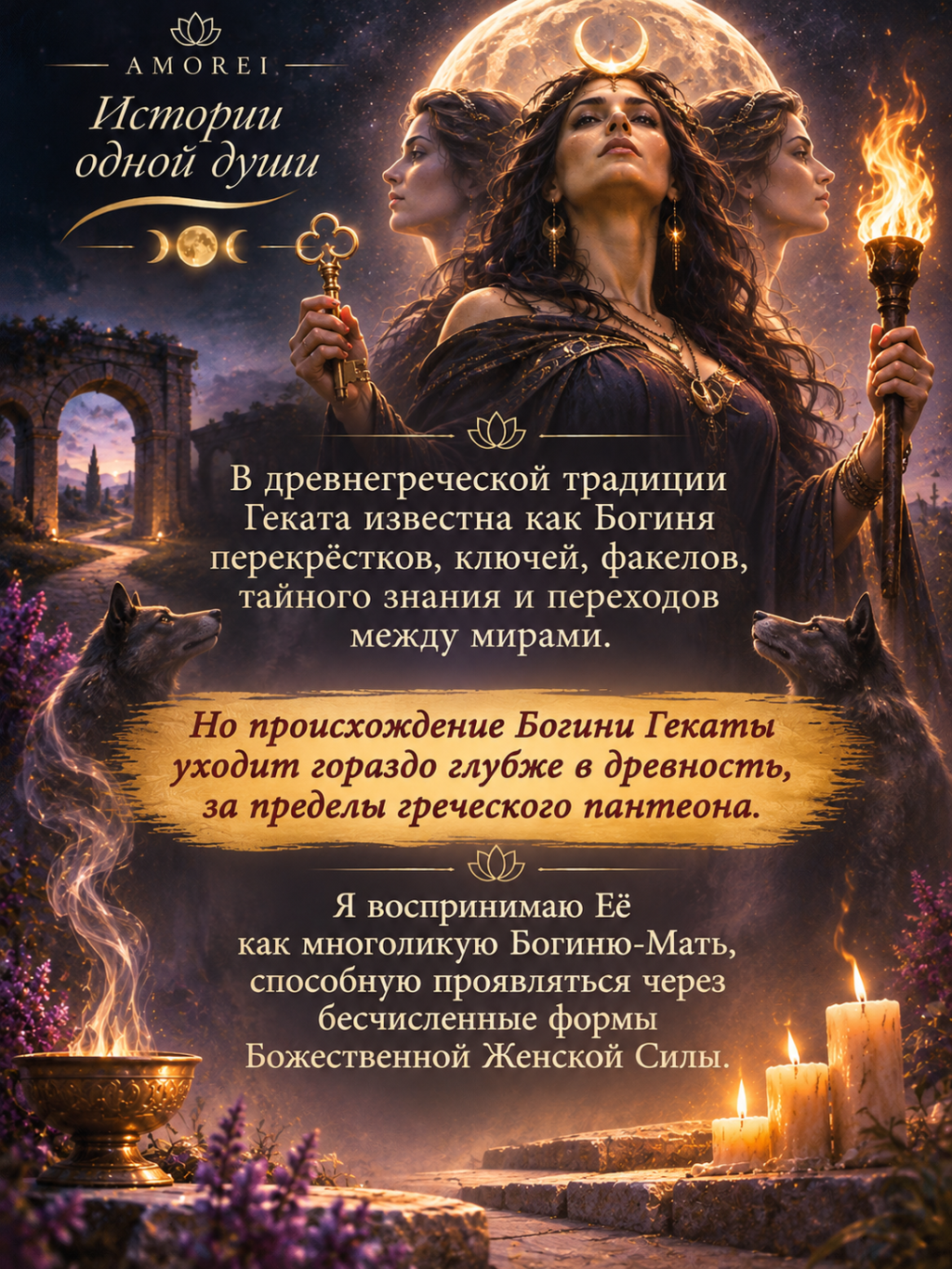
Today, Hecate is most often imagined as a mysterious three-faced Goddess standing at a crossroads, holding torches in her hands. Her name is associated with the night, magic, secret knowledge, spirits, and invisible worlds. In modern esoteric traditions, she has become one of the most recognizable goddesses, invoked for protection, initiation, and the awakening of hidden human potential.
Yet when we turn to ancient Greek mythology, a far more complex and fascinating image emerges.
Hecate protected the birth and upbringing of children, assisted sailors and warriors, brought prosperity to families, and supported fertility and abundance. People called upon her in many different circumstances of human life. Her authority extended over the earth, the sea, and the starry heavens, and her position among the immortal gods was so unusual that even Zeus, after establishing his sovereignty over the cosmos, preserved her ancient honors.
How did a Goddess with such extensive powers become known primarily as a ruler of nocturnal mysteries? Why was she depicted with three faces? And what aspects of the ancient understanding of Hecate allow us to recognize in her the qualities of the Great Mother Goddess?
To explore these questions, we must return to a time when her image had not yet become surrounded by the interpretations familiar to us today.
An Ancient Goddess Whose Origins Remain a Mystery
Hecate belongs to that group of ancient deities whose origins cannot be established with complete certainty. Her worship was already present in the Greek world during the Archaic period, although certain features of her cult suggest that its roots may have extended beyond mainland Greece.
Her name is particularly closely associated with Caria, an ancient region in southwestern Asia Minor, in what is now Turkey. For centuries, Greek and local Anatolian religious traditions interacted here, influencing one another.
One of the most important sanctuaries dedicated to Hecate was located at Lagina, near the ancient city of Stratonicea. It was a major religious center where the Goddess held an important place in public life as well as in personal devotion.
She was honored as a protector of the city and its inhabitants. Ceremonies and processions were held in her honor, and her sanctuary was closely connected with the political and religious life of the surrounding communities. The temple itself was decorated with sculptural representations of mythological scenes.
What is particularly interesting is that Hecate was not necessarily depicted here in the triple form so familiar to us today. She could appear as a single majestic female figure, possessing her own divine authority.
This reminds us that the image most commonly associated with the Goddess today represents only one expression of her identity, developed over the long history of her worship.
Was Hecate originally an Anatolian deity who later entered the Greek pantheon? Or did her cult develop within Greek religious culture, gradually incorporating elements of local traditions? Both possibilities remain subjects of scholarly discussion.
Yet in one of the earliest surviving works of Greek mythology, Hecate already occupies an extraordinary position among the gods.
The Goddess Whose Power Was Preserved by Zeus
In Greek mythology, the divine world passes through several generations of rulers. The primordial cosmic forces give rise to the Titans, struggles for sovereignty follow, and eventually Zeus defeats Cronus and becomes the supreme ruler.
The establishment of this new order involves the distribution of powers and honors among the immortals. Each deity receives a particular sphere of influence and a recognized place within the structure of the cosmos.
Hecate belongs to an older divine lineage.
Her father was the Titan Perses, and her mother was Asteria, daughter of the Titans Coeus and Phoebe. Through her mother’s family, Hecate was related to Leto, the mother of Apollo and Artemis, since Asteria and Leto were sisters.
Hecate therefore belonged to a divine generation preceding the birth of many Olympian gods.
But the most remarkable part of her story comes after Zeus establishes his rule.
In Hesiod’s Theogony, Zeus does not take away the honors and powers that Hecate had possessed before his reign. On the contrary, he grants her exceptional respect and confirms her share in three great realms of existence: the earth, the sea, and the starry heavens.
Within the ancient Greek understanding of divine order, this was highly significant. The powers of the gods determined their participation in the life of the cosmos, and the preservation of Hecate’s earlier honors represented recognition of the position she had held before the Olympian order was fully established.
Hecate could favor human beings in many different circumstances.
She assisted kings and judges in making decisions, granted individuals respect among their communities, supported warriors in battle, and favored athletes seeking victory. Sailors could hope for her protection at sea, while shepherds called upon her to increase their flocks.
She participated in the distribution of prosperity and natural abundance, possessing the power to increase wealth or diminish it.
And here we encounter one of the most fascinating aspects of her ancient character.
Hecate was not confined to a single dimension of human existence. Her presence extended into public affairs, the natural elements, human labor, family prosperity, and the continuation of life itself.
Such an extraordinary range of powers suggests that her many-faceted nature has much deeper foundations than the familiar image of three female faces.
The Many Faces of Hecate: Why Was the Goddess Depicted in Triple Form?
The triple image of Hecate became increasingly prominent in Greek art during the Classical period.
Ancient tradition associates one of the famous triple representations of the Goddess with the Athenian sculptor Alcamenes, who lived in the fifth century BCE.
In these sculptures, three female figures were joined back to back, facing different directions. Such representations, known as hekataia, were placed near entrances, roads, and crossroads.
The form itself was remarkably expressive.
A person standing at a crossroads can see only part of the surrounding space. Some roads stretch ahead, others lie behind, and still others disappear around a bend. The triple Goddess seems to encompass all directions within her presence at once.
Such an image was especially appropriate for a deity associated with the protection of roads and boundaries.
Over time, Hecate’s three faces acquired numerous interpretations.
They were associated with heaven, earth, and the underworld; with the three phases of the Moon; and with the past, present, and future. In modern spiritual traditions, another widespread interpretation connects her triple form with the three stages of a woman’s life: maiden, mother, and crone.
These interpretations, however, developed in different historical periods and did not belong to a single ancient doctrine. The maiden-mother-crone interpretation, in particular, became widely known much later than classical antiquity.
For understanding ancient Hecate, what matters more is the Goddess’s ability to be present in several realms of existence.
In some religious traditions, she was associated with the earth and natural abundance; in others, with celestial powers; and elsewhere, with the protection of boundaries and places where human beings encountered the unknown.
Her many-faceted nature became a way of expressing the breadth of her divine functions.
And yet Hecate possessed far more than three manifestations.
Her ancient epithets reveal her as a protector, nurturer, guardian of roads, bearer of light, keeper of entrances, and savior. Each title emphasized a particular aspect of her power that became especially meaningful to people in specific circumstances of life.
The triple image of Hecate can therefore be understood as a symbol of her multidimensional nature, but it would be difficult to confine the entirety of the Goddess to three familiar representations.
Hecate — The Great Mother Goddess
One of the most intriguing aspects of Hecate is her maternal nature.
For someone accustomed to seeing her primarily as a mysterious Goddess of the night, it may come as a surprise that the earliest Greek sources describe her as a protector of young beings, birth, and the continuation of life.
In the Theogony, Zeus grants Hecate a special role in caring for those who have come into the light after birth.
In ancient Greek religion, such a function was expressed through the term kourotrophos — a nurturer, guardian, and protector of children and the young.
In those times, childbirth and the early years of life involved considerable danger. Divine protection of infants, mothers, and young beings therefore occupied an important place in religious life.
But Hecate’s maternal functions extended beyond the protection of children.
She supported natural abundance, the growth of herds, and the prosperity of households. Human labor and family well-being could depend upon her favor.
In this image, the maternal principle emerges as a power that sustains life in its many expressions.
Yet among the ancient gods, the ability to bestow blessings was often accompanied by the ability to withdraw them. Hecate could encourage prosperity, but she could also diminish abundance. Her favor was never considered something that human beings could command according to their own wishes.
This reflects an ancient understanding of nature as a powerful reality upon which human existence depends, yet which remains beyond human control.
The earth gives life to plants, nourishes animals and human beings, but the same natural processes also include decline, destruction, and death. Everything that exists passes through birth, development, transformation, and eventual dissolution.
Within a spiritual and philosophical understanding, the image of the Great Mother Goddess may encompass this entire cycle.
Nevertheless, we must distinguish such an interpretation from the historical evidence.
In ancient Greek religion, Hecate was not the only Mother Goddess. Gaia was revered as the Earth and the ancestor of many beings, Rhea as the mother of the Olympian gods, and Demeter as the Goddess of fertility and agriculture.
Hecate possessed her own divine nature and functions, some of which overlapped with those of other goddesses.
Her maternal aspect was expressed primarily through protection, care for young life, and participation in natural prosperity.
Yet it is precisely the combination of these qualities with her exceptionally broad cosmic authority that allows us to recognize in Hecate the image of a Divine Mother whose power extends far beyond the ordinary human understanding of motherhood.
How Hecate Became Associated with Night and Magic
The image of Hecate evolved alongside the religious culture of the ancient world.
Already in antiquity, she was associated with roads, crossroads, entrances to homes, and places understood as special boundaries between safety and the unknown.
Over time, her connections with nocturnal rituals, spirits, the underworld, and magical practices became increasingly prominent.
But it would be misleading to describe this history as a simple transformation of a benevolent Goddess into a dark and terrifying one.
Different aspects of her nature existed simultaneously.
Hecate could protect a home and its inhabitants, be present in rituals connected with prosperity, and at the same time inspire reverence and fear as a Goddess associated with forces beyond the familiar human world.
In ancient religious consciousness, divine power was not necessarily divided into good and evil in the modern sense.
The gods could favor human beings, protect them, and grant prosperity, but they could also express anger, demand respect, and remind people of the existence of forces beyond human control.
As Greco-Roman culture developed, Hecate appeared increasingly in literature and magical texts alongside sorceresses, nocturnal rituals, and beliefs concerning invisible powers.
Her association with Medea became particularly well known. Ancient literature portrays Medea as a powerful sorceress skilled in the mysteries of herbs and magical arts.
Yet even these later representations did not erase the other dimensions of Hecate’s worship.
In different regions of the ancient world, she continued to be revered as a protector, patron of communities, and Goddess to whom people turned for assistance.
Her history reveals how a multidimensional divine presence can be perceived differently according to the time, culture, and needs of human beings.
Some approached her for the well-being of their families, others sought her protection along dangerous roads, while still others regarded her as a guardian of secret knowledge and invisible worlds.
Each of these images became part of the long and complex history of Hecate.
The Many-Faceted Goddess
When we bring together the ancient testimonies concerning Hecate, an image emerges that is far broader than her modern reputation.
She belongs to an ancient divine lineage, retains her honors under Zeus, possesses authority over the earth, the sea, and the heavens, participates in human prosperity, cares for young life, and protects homes and roads.
She was represented both as a single female figure and in triple form. She was honored in civic sanctuaries and at the thresholds of homes. Her presence belonged to public religion as well as to secret rituals.
The diversity of these manifestations reveals how difficult it is to confine the nature of an ancient deity to a single definition.
In my own spiritual understanding, Hecate is the many-faceted Great Mother Goddess, a conscious Divine Power capable of manifesting through numerous qualities and forms.
Her ancient images allow us to recognize certain aspects of this nature, yet no representation, name, or religious definition can encompass her completely.
Perhaps this is why Hecate continues to attract attention after thousands of years. Within her, maternal care, cosmic power, protection, mystery, and the ability to be present where the familiar human world comes to an end are united in an extraordinary way.
And among her many manifestations, one deserves particular attention: Hecate as the guardian of boundaries, accompanying those who approach the unknown.
It is this aspect of her nature that opens the next chapter of our exploration of the Goddess — Hecate, Guardian of Worlds and Guide of Souls.
Sources and References
- Hesiod. Theogony, lines 404–452.
- Pausanias. Description of Greece, Book II, 30.2.
- Strabo. Geography, references to Caria and Stratonicea.
- Berg, William. Hecate: Greek or “Anatolian”? Numen, 1974.
- Herring, Amanda. Hekate of Lagina: A Goddess Performing Her Civic Duty. 2022.
- Johnston, Sarah Iles. Hekate Soteira: A Study of Hekate’s Roles in the Chaldean Oracles and Related Literature. 1990.
- Orphic Hymn to Hecate.
- Romanova, Maryana. The Black Book of Hecate: Rituals of Initiation and the Awakening of Power — a modern esoteric interpretation.