Persephone – From Maiden to Queen of the Underworld
The Goddess Within – Ancient Myths, Modern Women

Mythology · Symbolism · Psychological Transformation
There are journeys that carry us across mountains and oceans, and there are journeys that lead us into the hidden territories of our own being.
The ancient story of Persephone belongs to both.
She is remembered as the daughter of Demeter, the young goddess who disappeared beneath the earth and whose return brought renewal to the living world. Yet her story reaches far beyond the changing seasons. It carries questions about love and power, the bonds between mothers and daughters, the awakening of an independent identity, and the mysteries that lie beneath the surface of human awareness.
Above all, it is the story of a maiden who enters the Underworld and becomes its queen.
And perhaps the greatest mystery is whether, somewhere along that journey, Persephone discovers a kingdom that she already recognizes as her own.
The Daughter of the Living Earth
 Persephone grows up in the world of her mother, Demeter, the great goddess of grain, fertility, and the harvest.
Demeter nourishes the living earth. Through her divine gifts, seeds awaken, fields become abundant, and the rhythms of cultivation sustain human life. She is a powerful expression of the maternal principle: the force that gives life, protects it, and provides what is necessary for growth.
Her daughter belongs to this world of sunlight and flowers.
Persephone is also known as Kore, the Maiden, a title that evokes the freshness of youth and the period of life before a woman has fully discovered the breadth of her own nature.
One day, Persephone wanders through a meadow gathering flowers with her companions. Among the blossoms she notices a magnificent narcissus, so extraordinary that she reaches toward it in wonder.
At that moment, the earth opens.
From the depths emerges Hades, lord of the Underworld, driving his chariot through the opening. He seizes Persephone and carries her beneath the earth.
Her cries rise toward the heavens, but the ground closes above her, and the world of sunlight disappears.
The ancient account tells us that Zeus, Persephone’s father, has permitted Hades to take her as his wife. Neither Persephone nor Demeter has been consulted.
This detail reveals another dimension of the myth.
The agreement between Zeus and Hades can be read against the long history of patriarchal power, in which male authority determines the lives and choices of women. Some interpretations of ancient religion see the rise of the Olympian order as part of a transformation of older traditions centered on powerful feminine divinities, including forms of the Great Mother.
The historical relationship between these traditions remains a subject of scholarly debate. Yet the arrangement between Zeus and Hades presents a striking image of male authority: two gods decide the fate of a goddess without seeking her consent, or even that of her mother.
Demeter herself is a powerful deity, capable of withholding the fertility of the earth. Nevertheless, she is excluded from the decision concerning her own daughter.
The myth therefore raises questions that remain recognizable in human societies: who possesses the authority to make decisions, whose wishes are considered, and what happens when those affected by a decision are denied a voice?
Persephone’s descent begins within this struggle over power.
What unfolds beneath the earth, however, introduces another mystery.
The Kingdom Beneath the Earth
The Underworld of Greek mythology is a vast and mysterious realm.
It is a place of shadows, ancient rivers, hidden passages, and souls who have crossed beyond the world of the living. Its laws differ from those of the earth above. Hades governs this kingdom, and Persephone comes to share its throne.
For the young goddess who has known the brightness of Demeter’s fields, the descent carries her into an existence entirely unfamiliar.
The sunlight, the flowers, the open sky, and the protective presence of her mother are suddenly beyond her reach.
Before her lies a world whose mysteries cannot be understood from the meadows above.
Ancient myths can also be approached as symbolic maps of human experience. Their landscapes, divine figures, and extraordinary events offer images through which we may contemplate the hidden processes of personal development.
In this psychological reading, Persephone’s descent becomes a journey into the depths of the human psyche.
The Underworld can symbolize the vast territory beyond ordinary conscious awareness. Within this symbolic landscape, we may distinguish the personal subconscious mind, where forgotten memories, concealed desires, fears, emotional patterns, and unrecognized aspects of ourselves continue to influence our lives.
Beyond this personal territory, we may also contemplate a wider dimension of the unconscious, associated in different psychological and spiritual traditions with archetypal patterns and forms of knowledge that extend beyond individual experience.
These are contemporary ways of approaching the myth, rather than explanations supplied by its ancient authors.
Yet the image is remarkably powerful.
Much of what determines our choices remains hidden from our everyday awareness. We may know our history, our preferences, and the roles we occupy, while remaining unfamiliar with the deeper motives that shape our relationships and decisions.
Sometimes an unexpected event opens a passage into this inner territory.
A loss, a separation, an encounter, a disappointment, or a profound change in circumstances may reveal aspects of ourselves that we have never consciously recognized.
The familiar world no longer provides all the answers.
We are compelled to look beneath its surface.
Persephone enters the Underworld without choosing the circumstances of her descent. But what she discovers there, and how she eventually relates to that kingdom, open a different dimension of her story.
For entering an unfamiliar inner world and learning to understand it are two very different experiences.
Demeter: The Light and Shadow of the Mother
While Persephone remains beneath the earth, Demeter searches desperately for her daughter.
Carrying burning torches, she wanders across the world, grieving and refusing to abandon her search.
When she learns that Zeus has permitted the abduction, her sorrow becomes anger.
Demeter withdraws from Olympus and withholds her gifts from the earth.
Seeds remain dormant. The fields become barren. The harvest fails, and humanity faces starvation.
The goddess who nourishes the world reveals the immense power of her absence.
Demeter’s grief is the grief of a mother whose daughter has been taken from her. Her resistance also confronts the authority of Zeus and the injustice of a decision made without her consent.
Yet the maternal archetype contains more than one dimension.
The same power that nurtures and protects life can also become possessive. The desire to preserve a child from suffering may gradually turn into the desire to direct that child’s life.
A mother may love her child profoundly and still struggle to accept the child’s independence.
Demeter’s relationship with Persephone allows us to explore this shadow of the maternal principle.
As goddess of the harvest, Demeter possesses the power to nourish the earth or withhold its fertility. In the myth, her withdrawal brings the living world to the edge of destruction.
Psychologically, this image raises a difficult question: what happens when a mother’s love becomes inseparable from her need to remain necessary?
A mother who has devoted her life to her children may experience their independence as a loss of purpose. She may continue to see an adult daughter as a little girl who requires protection, or an adult son as someone whose choices must remain subject to her approval.
Sometimes this control is expressed openly. More often, it takes subtle forms: disappointment, anxiety, guilt, emotional dependence, or the unspoken expectation that a child should organize life around a parent’s needs.
An adult man may struggle to choose a partner because he fears his mother’s disapproval.
A woman may postpone marriage, travel, or a meaningful career because she feels responsible for her mother’s loneliness.
Another person may spend decades pursuing a life that satisfies the family while quietly suppressing desires that belong to an entirely different path.
These patterns are not limited to women, nor do they arise only from controlling mothers. They can develop in many kinds of family relationships, often without anyone consciously intending harm.
But they reveal how difficult psychological separation can become.
In Jungian psychology, the process of individuation involves the gradual development of a more integrated and distinct identity. Part of that process may require recognizing which beliefs, expectations, and emotional loyalties have been inherited from the family, and which truly express one’s own nature.
This separation need not destroy love.
A mature relationship can preserve affection, gratitude, and closeness while allowing each person an independent life.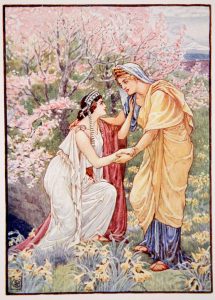
Yet achieving such independence sometimes requires confronting painful truths.
The daughter may have to acknowledge that her mother cannot approve of every choice she makes.
The mother may have to recognize that the child she loves has become a person whose life she cannot govern.
And both may have to accept that love does not grant ownership over another person’s destiny.
Persephone’s journey raises precisely this question.
How does a daughter develop her own identity and claim the freedom to make decisions that her mother may never fully understand?
The Pomegranate: A Secret Between Two Worlds
Eventually, Zeus recognizes that the earth cannot remain barren.
He sends Hermes into the Underworld to bring Persephone back.
But before she leaves, Hades gives her the seeds of a pomegranate.
In the ancient Homeric Hymn to Demeter, Persephone later tells her mother that Hades compelled her to eat the seeds. Because she has tasted the food of the Underworld, she cannot remain permanently in the world above.
The pomegranate binds her to the kingdom beneath the earth.
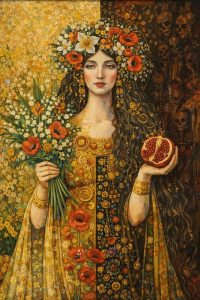
This moment has become one of the most recognizable symbols associated with Persephone. She is frequently depicted holding the fruit, its deep red seeds suggesting mysteries of life, fertility, death, and return.
Yet the pomegranate also presents a question.
What did Persephone know when she tasted it?
The ancient account describes an act of coercion. But a symbolic interpretation can explore another possibility without claiming to replace that account.
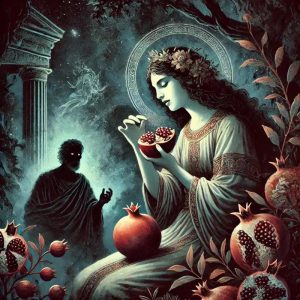 What if Persephone understood the significance of the fruit?
What if she already knew that tasting its seeds would bind her to the Underworld?
And what if, during her time beneath the earth, she had discovered something that made her want to return?
Perhaps the kingdom had begun to reveal dimensions of her own nature that could never have awakened in the protected world of her childhood.
Perhaps she had encountered her own shadow.
In Jungian psychology, the shadow refers to aspects of ourselves that remain unrecognized, rejected, or concealed because they do not fit the identity we have learned to present to the world.
Our shadow may contain anger, jealousy, fear, ambition, forbidden desires, and painful memories.
Yet it also conceals strength, creativity, independence, and capacities that we have never permitted ourselves to express.
A woman raised to be agreeable may discover anger that has never found a voice.
Someone taught to place others’ needs first may encounter a powerful desire for independence.
A person who has always identified with innocence and kindness may discover a more complicated inner nature, one capable of conflicting feelings and difficult choices.
To recognize and accept these dimensions requires honesty.
We may resist what we find because it challenges the image we have created of ourselves.
Yet what remains unacknowledged will continue to influence our lives from beneath the surface.
Perhaps Persephone’s time in the Underworld allows her to begin recognizing this hidden territory.
She encounters darkness, and within it she may discover qualities that belong to her as surely as the sunlight and flowers of her earlier life.
She begins to understand that her identity is larger than the role of Demeter’s beloved daughter.
And perhaps she recognizes that the kingdom below has become part of her destiny.
If Persephone knowingly tastes the pomegranate, the act takes on a profound psychological meaning.
It becomes a choice to preserve her connection with a world in which she has discovered her own power.
But how could she explain such a choice to Demeter?
Her mother has searched for her, suffered for her, confronted the gods, and withheld the fertility of the earth to secure her return.
How could Persephone tell her that she might wish to return to the very kingdom from which Demeter has struggled to rescue her?
How could she explain that she loves her mother deeply, yet no longer wishes to live entirely within her mother’s world?
Perhaps she cannot.
Perhaps she allows her mother to believe that the decision has been made for her.
There is something deeply human in this possibility.
We do not always reveal our true intentions to those closest to us. Sometimes we conceal a decision because we fear causing pain, provoking anger, or disappointing someone whose love matters profoundly.
And sometimes we find it easier to attribute our choices to circumstances than to acknowledge that we have chosen something another person may not understand.
This interpretation does not establish what Persephone actually intended in the ancient story. It offers a way of contemplating the psychological complexity of her transformation.
The deeper question may concern the relationship between freedom and truth.
Did Persephone already know that she wanted to return to the Underworld?
Or did she simply recognize that she could no longer belong entirely to the world she had left behind?
Perhaps she did not yet understand everything about her emerging identity.
But perhaps she knew enough to recognize that something within her had changed.
And the pomegranate became the secret she carried between two worlds.
The Return to the Living Earth
When Persephone returns, Demeter embraces her daughter, and joy returns to the living earth.
But the reunion cannot be permanent.
The pomegranate has established a bond between Persephone and the Underworld. A division of the year is arranged: she will spend one-third of the year below and the remaining two-thirds above.
Her movement between the realms becomes associated with the rhythms of nature, the withdrawal of life into the earth and its renewal.
Yet her return also offers an image of psychological transformation.
We sometimes emerge from a difficult period and discover that the familiar world no longer feels quite the same.
We return to our homes, our relationships, and our responsibilities, but we bring with us experiences that have changed our understanding of ourselves.
The world may appear unchanged, while something within us has grown.
Persephone returns to Demeter, but she has crossed a threshold that her mother cannot cross on her behalf.
She has encountered another realm.
And she carries its knowledge with her.
This is one of the challenges of individuation: returning to familiar relationships without surrendering the identity that has emerged through our own experience.
We may continue to love our parents, our partners, and the people who have shaped our lives, while recognizing that they cannot define every dimension of who we are becoming.
The ability to remain connected without losing our independence is part of psychological maturity.
Persephone’s life between two worlds offers a beautiful image of that possibility.
When the Inner World Becomes a Place of Suffering
The descent into the Underworld can also evoke experiences of psychological darkness.
There are periods when a person feels separated from the vitality of ordinary life. Work loses its meaning, relationships become difficult, and the future seems to offer little possibility of renewal.
Sometimes these experiences arise from disappointment, grief, prolonged emotional conflict, or the painful recognition that the life we have built no longer reflects who we are.
At other times, a person may become trapped in familiar patterns of fear, regret, or attachment, returning repeatedly to the same thoughts without finding a way forward.
Such experiences can resemble a descent into an inner Underworld.
The world above continues to exist, yet the person feels increasingly distant from its light.
This metaphor can overlap with experiences of depression, although depression cannot be explained simply as an encounter with the shadow.
The psychological meaning of Persephone’s story lies in the possibility of developing a different relationship with our inner darkness.
We cannot always choose when painful experiences arise. Nor can we transform suffering merely by deciding to do so.
But we may gradually learn to recognize what we feel, understand the patterns that shape our reactions, and seek the support and conditions that allow us to reconnect with life.
The danger of becoming absorbed entirely in our inner world is that reflection can turn into endless repetition.
We revisit the same wounds, fears, and disappointments without finding a way to integrate what we have discovered.
Persephone’s story reminds us of the importance of movement between the two worlds.
She descends, but she also returns.
She knows the darkness, yet she remains connected to the living earth.
The symbolic journey toward wholeness involves both capacities: the willingness to explore our inner depths and the ability to return to the world of relationships, creativity, responsibility, and action.
We need the courage to encounter what lies within us.
And we need the vitality to live.
Persephone, Queen of the Underworld
Persephone’s story does not end with her return to the sunlight.
In the ancient Greek myths, she is also a formidable queen whose authority extends throughout the realm of the dead.
Her power inspires awe even among the greatest heroes.
When Odysseus journeys to the threshold of the Underworld and encounters the souls of the departed, he fears that Persephone may send a terrifying apparition against him.
This is the goddess whose presence commands respect in a kingdom beyond the reach of ordinary human life.
The maiden who once gathered flowers in her mother’s meadows now possesses a throne beneath the earth.
From a psychological perspective, her queenship offers a profound image of inner sovereignty.
What does it mean to become queen of the Underworld?
If the descent represents an encounter with the hidden dimensions of the psyche, Persephone’s sovereignty can symbolize the growing ability to understand and inhabit one’s own inner landscape.
 She has encountered darkness and become familiar with a realm that was once unknown.
She has learned to recognize the complexity of existence beneath its visible surface.
And she has discovered a form of authority that arises from this knowledge.
In our own lives, such authority develops through self-awareness.
We begin to recognize our fears without allowing them to determine every choice. We acknowledge desires that we may previously have concealed, even from ourselves. We become more attentive to the emotional patterns that shape our relationships.
We discover that our shadow contains aspects of our nature that deserve understanding and acceptance.
Accepting the shadow does not mean surrendering to destructive impulses or excusing harmful behavior. It means becoming sufficiently honest with ourselves to recognize what is present, so that we can take responsibility for how we act.
As this awareness grows, we may also become more capable of recognizing the darkness in others without responding automatically with fear or condemnation.
We understand that human beings contain contradictions.
Compassion becomes possible without abandoning discernment.
And our own identity becomes less dependent on maintaining an image of perfection.
This is a form of inner strength that cannot be given to us by another person.
It develops through experience, reflection, and the willingness to encounter ourselves with increasing honesty.
Persephone’s inner kingdom symbolizes this growing sovereignty.
Her throne stands in a realm that she has come to know.
Yet Persephone is more than a psychological symbol.
For those who experience the goddesses as living divine presences, the archetype is only one dimension of a much greater relationship.
A goddess may be understood as a conscious divine being whose qualities can be recognized and awakened within human experience.
Through this recognition, a person may experience a deeper connection with the divine presence that the archetype expresses.
In this spiritual understanding, the relationship is not confined to intellectual interpretation. It may be encountered through contemplation, devotion, ritual, dreams, and direct personal experience.
The goddess remains a goddess.
And the human journey becomes an opportunity to recognize the qualities of consciousness through which we may feel connected to her.
Persephone and the Eleusinian Mysteries
For centuries, Persephone and Demeter stand at the heart of the Eleusinian Mysteries, among the most revered sacred rites of ancient Greece.
These ceremonies are associated with the great mysteries of life, death, renewal, and the possibility of existence beyond physical mortality.
The details of initiation remain largely unknown, protected by the secrecy surrounding the rites.
Yet ancient testimonies speak of the special hope associated with initiation and suggest that those who participated could approach death with a transformed understanding of its meaning.
The mysteries offered more than an explanation of the seasons.
They concerned the relationship between the visible world and the unseen, between the life we know and the great threshold that awaits every mortal being.
Persephone occupies a central place within this sacred understanding.
She knows the path into the Underworld.
She also knows the path of return.
Her passage between the two realms offers an image of continuity across a boundary that ordinarily separates the living from the dead.
The precise spiritual experiences of the initiates are not available to us. But the enduring reverence surrounding these mysteries suggests how deeply the relationship between Demeter and Persephone touched ancient questions about mortality and renewal.
In a contemporary spiritual reading, Persephone’s journey may also invite us to contemplate the possibility that consciousness extends beyond the limits of our ordinary perception.
And psychologically, her passage reminds us that some of the most important transformations in life cannot be understood through explanation alone.
There are truths we discover only through experience.
We must enter unfamiliar territory, encounter what it reveals, and gradually learn how to bring that knowledge into our lives.
The Woman Who Knows Both Worlds
Each spring, Persephone returns to the sunlight, and the earth welcomes her presence.
Each year, she also descends into the kingdom beneath the roots of mountains and forests.
Above, she is Demeter’s beloved daughter.
Below, she is Persephone, Queen of the Underworld.
Her life belongs to both realms.
And perhaps this is one of the most important dimensions of her archetype.
Wholeness does not require us to remain forever in the light.
Nor does it emerge from an endless descent into our own darkness.
A person who lives entirely through external achievements, social roles, and the expectations of others may remain unfamiliar with the hidden forces shaping their choices.
But a person who becomes absorbed entirely in inner exploration may lose connection with the world in which life must actually be lived.
We need both dimensions.
We need to understand our subconscious patterns, recognize our shadow, and develop an honest relationship with our inner landscape.
And we need to return to the living world, where we love, create, work, make decisions, and allow our understanding to find expression through action.
The inner journey becomes meaningful when its discoveries begin to transform the way we live.
Persephone’s two kingdoms offer a beautiful image of this integration.
She can know darkness without losing her love of light.
She can preserve her connection with Demeter while developing an identity that extends beyond her mother’s world.
She can encounter the mysteries beneath the earth and still return to the flowers.
Her sovereignty arises through the widening of her experience and the deepening of her self-knowledge.
She is no longer defined solely by the circumstances that carried her into the Underworld.
She has become a Queen.
The Pomegranate and the Truth We Tell Ourselves
And so we return to the pomegranate.
Across centuries of art and storytelling, Persephone appears with this extraordinary fruit in her hand.
Its seeds connect her with the Underworld. Its presence recalls the mystery of her descent, her return, and the kingdom that remains part of her destiny.
Yet perhaps the pomegranate is more than a symbol by which we recognize the goddess.
Perhaps it is a question.
When we look at Persephone holding the fruit, what do we believe happened within her?
Do we see a young goddess who did not understand the consequences of what she was given?
Or do we imagine a woman who had already begun to recognize her own desires, who understood the bond she was accepting but could not yet reveal her choice to her mother?
The ancient story allows us to contemplate the mystery without requiring every reader to arrive at the same interpretation.
And our responses may reveal something about the questions we bring to the myth.
How do we understand freedom?
How do we recognize responsibility?
What do we believe about the relationship between love and independence?
And how honestly are we willing to examine our own motives?
There are moments when we know more about ourselves than we are prepared to acknowledge.
We may recognize that a relationship has reached its end, yet continue to tell ourselves that circumstances prevent us from leaving.
We may know that a familiar role no longer reflects our identity, yet hesitate to step beyond it because we fear disappointing others.
We may sense the direction in which our lives are calling us, while searching for reasons to postpone a decision that would require courage.
Humanity’s greatest difficulty lies in admitting the truth to ourselves.
We are not required to reveal every private thought or desire to the people around us. Our inner lives deserve boundaries, and not every truth must be shared with everyone.
But self-knowledge asks something different.
It asks us to recognize what we genuinely feel, what we truly desire, what we fear, and what responsibility we carry for our choices.
We may not always understand our motives completely. Some truths emerge slowly, through experience and reflection.
Yet the willingness to look honestly within ourselves is an essential part of developing inner sovereignty.
Perhaps this is the final gift of Persephone’s story.
She reminds us that the journey into darkness can reveal dimensions of ourselves that remain invisible in the sunlight.
She shows us a goddess who belongs to two worlds, whose power reaches beneath the surface of life, and whose presence carries the mystery of death and renewal.
And she leaves us with a fruit whose meaning cannot be exhausted by a single explanation.
Did Persephone know what she was choosing when she tasted the pomegranate?
And what truth about ourselves might we discover when we ask that question?
The pomegranate remains in her hand.
The mystery remains open.
And the journey toward knowing ourselves continues.
A Note on Myth, Psychology, and Spiritual Interpretation
This article draws primarily on the Homeric Hymn to Demeter, an ancient poem traditionally attributed to Homer but composed by an unknown author, together with the portrayal of Persephone’s authority in Book XI of the Odyssey.
The psychological interpretation of the Underworld as a symbol of the subconscious, Demeter’s controlling shadow, Persephone’s individuation, and the possibility that she knowingly accepted the pomegranate are contemporary readings and personal visions of the author. They are not presented as established intentions of the ancient authors.
The article also explores a spiritual perspective in which goddesses may be understood as conscious divine presences whose significance extends beyond their psychological archetypes.
These perspectives offer different ways of contemplating the same ancient story while preserving the distinction between its traditional narrative and the meanings we discover within it today.
The Goddess Within – Ancient Myths, Modern Women
AMOREI – Consciousness, Self-Discovery & Human Development