Athena as an Archetype: From Intellectual Power to the Wisdom of a Whole Being
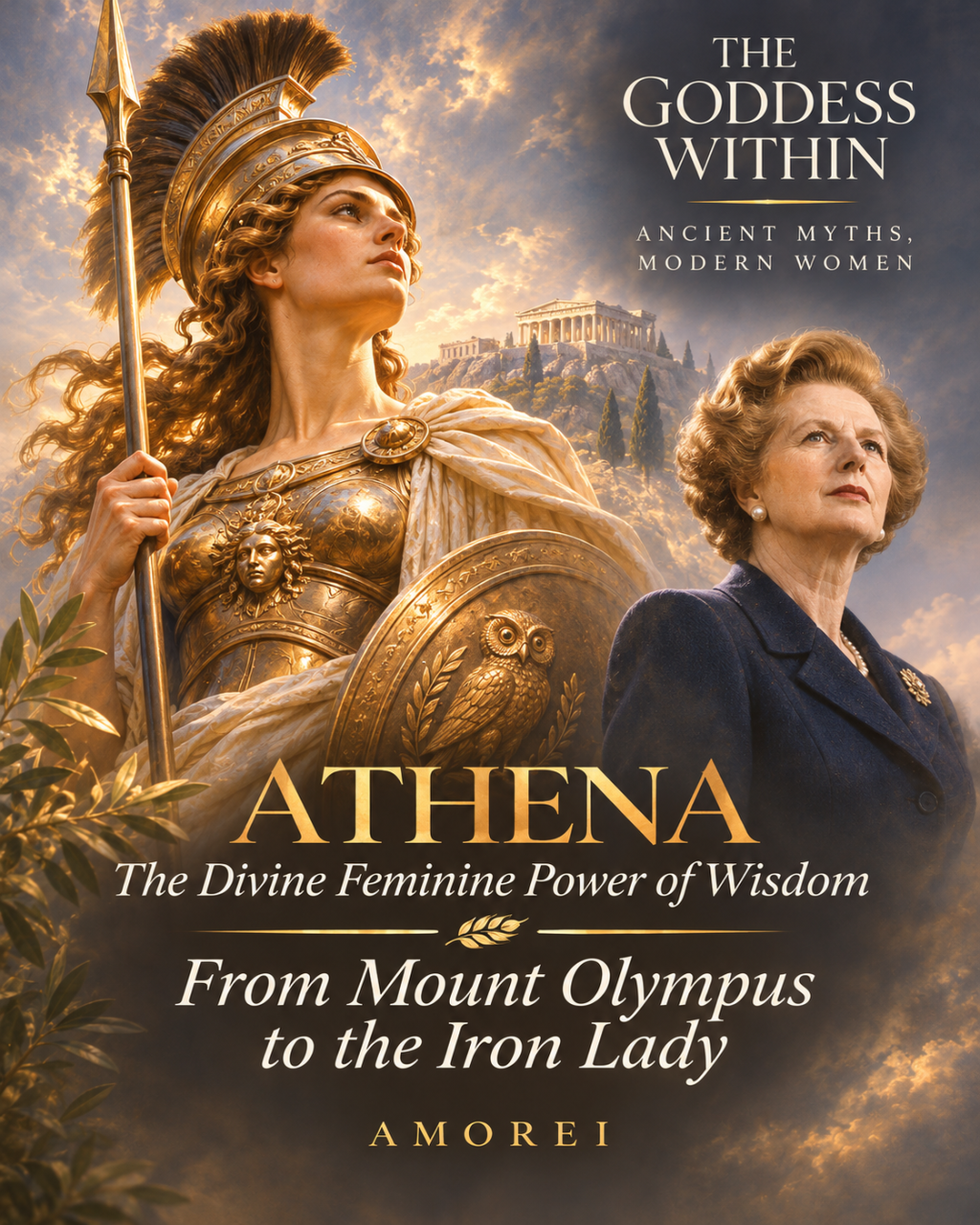
One of the most fascinating mysteries of Athena lies in the story of her birth.
Fearing a prophecy that his offspring might one day surpass him, Zeus swallowed his wife Metis, the goddess of wisdom. Yet the divine power contained within him continued to grow until he could no longer hold it.
For Athena to come into the world, Hephaestus had to split open the head of the supreme god.
Thus begins the story of a goddess who would become one of her father’s most devoted protectors.
There is a remarkable paradox in this event. Athena’s very existence begins with breaking through the boundaries of the consciousness whose interests she will later defend.
Perhaps this is where we can discover the key to the evolution of a woman in whom the Athena archetype is active. She must learn to understand the world, find her place within it, master its possibilities, and eventually move beyond her inherited understanding of life to begin creating a reality of her own.
Athena as an Expression of the Divine Feminine
For centuries, society has shaped our understanding of what it means to be a woman. Femininity has traditionally been associated with tenderness, sensuality, receptivity, love and nurturing. Logical thinking, business acumen, leadership and independence have often been regarded as masculine qualities.
Even today, a successful businesswoman may be told that she carries too much masculine energy and needs to change in order to reconnect with her femininity.
Yet thousands of years ago, the ancient Greeks worshipped a goddess who embodied these very abilities.
Athena was the wise adviser of Zeus, a brilliant strategist, the patroness of craftsmanship and the protector of cities. Gods and mortals sought her guidance, and legendary heroes relied on her support.
Her existence invites us to reconsider our understanding of feminine nature.
The ability to reason, analyse, organise, invent, anticipate consequences and make decisions belongs naturally to the divine feminine. A woman can recognise these qualities as an integral part of her own nature and develop them to their fullest potential.
Like Artemis and Hestia, Athena belongs to the group of virgin goddesses. In an archetypal sense, this represents inner autonomy: the ability to maintain one’s individuality, interests and direction in life regardless of relationship or marital status.
A woman can love a man, raise a family and dedicate a significant part of her life to a vocation that is entirely her own.
Athena and the Art of Manifestation
What do the art of warfare and the art of weaving have in common?
A weaver creating an intricate pattern must hold the image of the entire design in her mind while working with each individual thread. A strategist follows a similar principle, understanding how every decision may influence the unfolding of future events.
Athena possesses the remarkable ability to bring many different elements together into a coherent whole. This is why we find both a spear and a spindle among her symbols.
Her presence can be felt in a woman creating beautiful embroidery, designing a building, conducting scientific research, managing a household or leading a company. She comes alive wherever craftsmanship, knowledge and the ability to translate an idea into tangible form are required.
In a broader sense, Athena can be understood as one of the great forces of manifestation.
Ideas, images, desires and dreams continuously arise within our consciousness. Bringing them into physical existence requires knowledge, resources and the ability to create the right conditions.
Here we can see the beauty of the relationship between Athena and Aphrodite.
Imagine a woman dreaming of creating a magnificent garden. She can already sense the fragrance of the flowers, see sunlight filtering through the leaves and imagine how people might feel when they enter this place.
This is Aphrodite at work.
The woman then needs to understand the climate, study the soil, learn about the plants, design an irrigation system and organise the work.
Athena now comes into play.
Through their collaboration, something that once existed only in the woman’s imagination becomes part of the physical world.
Athena’s presence is therefore invaluable to almost every other goddess. She helps give tangible expression to the creative energies they awaken within us.
The Awakening of Athena
In some women, Athena becomes active during early childhood. These girls explore the world with curiosity, ask endless questions, devise their own solutions and take genuine pleasure in discovering how things work.
For others, the goddess awakens in response to life circumstances.
A woman who has always relied on her partner’s decisions may suddenly find herself responsible for supporting herself and her children. She begins learning new skills, understanding finances and making important decisions independently. In the process, she discovers abilities she never knew she possessed.
Athena can awaken at any age. Her emergence may be inspired by the desire to start a business, pursue an education, learn a new profession or finally realise a long-forgotten dream.
Her presence is particularly valuable to women whose lives have become centred almost entirely around their relationships with others.
Athena helps Demeter discover fulfilment beyond motherhood. She supports Hera in developing independence within marriage, teaches Persephone to make conscious choices about her future and gives Aphrodite the practical means to realise her creative visions.
Her Father’s Daughter: Athena and the World of Power
Athena was a beloved daughter of Zeus. She shared his interests, defended the order he had established and occupied a privileged position among the Olympian gods.
A similar connection with the father may develop in the life of a woman with a strong Athena archetype.
A young girl who admires her father may enjoy listening to his stories, learning about his work and participating in adult conversations. When he encourages her curiosity and independence, a deep bond can develop between them.
Through him, she discovers the wider world.
Along with his knowledge, however, she also absorbs his understanding of success, power, money, social structures and human relationships. She may identify so strongly with his values that she gradually distances herself from her mother and begins to see other women through her father’s eyes.
Later in life, she may feel particularly drawn to men who possess authority, professional distinction, financial resources and influence.
Athena knows how to navigate this world. She understands the mechanisms of power and is perfectly capable of attaining a position of authority herself.
Yet this is also where one of the greatest challenges of this archetype emerges.
A woman may become so loyal to the system within which she has achieved success that she gradually loses sight of the injustices it perpetuates. She defends the interests of those who belong to her social or professional circle, rationalises their actions and comes to regard their prosperity as evidence that the system itself is functioning well.
Imagine a woman involved in the development of a major commercial project. She recognises its economic potential, understands the prospects for profit and successfully navigates every obstacle.
But does she take an interest in the lives of the people who will be affected by the project? Does she consider its impact on nature and future generations? Would she be willing to abandon a highly profitable opportunity if she discovered that its consequences would be destructive?
Such decisions require professional competence alongside compassion, ethical maturity and an awareness of the interconnectedness of life.
Athena’s loyalty to the masculine world is particularly evident in the myths of Medusa and the trial of Orestes. Both stories invite reflection on the goddess’s identification with male interests, even when the circumstances raise profound questions about justice.
Similar attitudes can be found in contemporary society. A woman who has achieved success in a predominantly male environment may become one of the strongest defenders of the very rules that limit opportunities for other women.
She may look dismissively upon emotional expression, underestimate the value of motherhood or regard vulnerability as a sign of weakness.
Admiration for a particular man may also compromise her ability to evaluate his actions fairly. She can find convincing explanations for behaviour that causes suffering to others.
When a person becomes disconnected from the heart and the spiritual dimension of existence, achieving an objective may gradually become more important than the consequences of achieving it.
Artemis can help Athena recognise injustice and find the courage to challenge established structures. Demeter awakens compassion, while Hestia creates the inner stillness necessary for recognising one’s own truth beyond the influence of admired authorities.
Through this process, a woman can develop the freedom to decide for herself which values she wishes to uphold, what kind of world she wants to serve and what reality she wishes to create.
Athena and the Heroes in Her Life
In Greek mythology, Athena played an important role in the lives of many legendary heroes. She helped them discover their abilities, overcome obstacles and accomplish tasks that physical strength and courage alone could not achieve.
A woman expressing this archetype may possess an extraordinary gift for recognising a man’s potential. Sometimes she sees his future possibilities long before he becomes aware of them himself.
She can become an exceptional adviser, collaborator, business partner or wife with whom a man builds something meaningful.
Occasionally, however, a woman becomes so deeply invested in creating his future that she neglects her own.
We may recognise this expression of Athena in the devoted executive assistant who dedicates many years of her life to the work of a man she admires.
She knows every detail of his projects, helps him solve problems, protects his interests and genuinely celebrates his achievements. She may be deeply in love with him, expressing her affection primarily through her dedication to his work.
He values her abilities, trusts her judgement and considers her indispensable. Meanwhile, he builds his personal life with another woman.
Years pass. His enterprises grow, his children grow older and his opportunities expand. She continues to invest her life energy in a world that revolves around him.
At some point, she may need to ask herself how fully she is participating in her own life.
Artemis can help her rediscover ambitions and dreams that belong to her alone. Aphrodite awakens sensual desires, the longing for reciprocal love and the pleasure of her own existence. Hera reveals the possibilities of a partnership in which both people are genuinely invested in each other’s happiness and development.
She may continue to support the man she admires while beginning to write a story of her own.
After all, the very abilities that made her indispensable in his life still belong to her.
Love, Marriage and Sexuality
One of the most fulfilling experiences for Athena may be meeting a man she deeply admires, someone with whom she can explore life’s mysteries, exchange ideas and create meaningful projects.
Such a relationship offers wonderful possibilities for mutual growth.
Imagine, however, two people who have successfully organised their lives. They share interests, enjoy financial stability, make plans for the future and support each other’s professional endeavours.
What happens when the work is finished, the conversations about practical matters come to an end, and they are simply alone together?
Here Athena may discover unfamiliar territory.
Love opens us to experiences that involve the body, the heart and the deeper dimensions of consciousness. Sexual intimacy invites us to become fully present, to experience sensations and allow feelings to unfold naturally.
Yet a woman with a dominant Athena archetype may find herself analysing her partner’s reactions, evaluating her own responses and observing the experience almost from the outside.
To awaken her sensual nature, she can invite Aphrodite to become a constant companion throughout her life.
Sensuality develops through everyday encounters with the world: the pleasure of touch, fragrance, music, movement, dance and an appreciation of one’s own physical beauty. A woman gradually becomes more aware of her desires, learns to express them and allows her sexual energy to flow more freely.
Emotional openness is equally important. It may be difficult for Athena to tell a man that she misses him, longs for tenderness, needs to be held or fears losing him.
Demeter helps her give and receive affection, accept care and cultivate emotional intimacy. Through Persephone, she learns to understand her inner states, trust her feelings and remain open to experiences she cannot anticipate.
For a lasting relationship, Hera’s presence is particularly valuable. She helps a woman recognise the relationship itself as something worthy of time, attention and energy. Shared life becomes an ongoing, conscious investment in the connection between two people.
As these goddesses come together within Athena, her experience of love becomes richer. She can discover passion, tenderness, emotional intimacy, sexual pleasure and profound mutual understanding while maintaining her individuality and independence.
Athena as a Mother
Although Athena never gave birth in Greek mythology, she became the protector of Erichthonius, raised him and prepared him for his future role as a ruler of Athens.
A woman with an active Athena archetype can be a wonderful mother, capable of sharing knowledge, nurturing her children’s talents and teaching them to think independently.
She enjoys introducing them to new possibilities, answering their questions, helping them develop skills and preparing them for life.
Sometimes, however, a child simply needs the warmth of a mother’s embrace and the reassurance of being loved through every fear, mistake and imperfection.
The awakening of Demeter allows Athena to connect with her child’s emotional world and experience the pleasure of simply being close.
Persephone, meanwhile, helps her rediscover the little girl within herself — a girl who may have had to grow up too soon.
Through her children, a woman can return to the world of play, fairy tales, imagination and delightful discoveries. She learns to take pleasure in simple things, while Aphrodite brings joy and affection to the time they spend together.
Motherhood can thus become a deeply personal journey towards emotional wholeness.
Removing the Armour and Returning to the Body
Athena came into the world fully armed.
Imagine someone who spends an entire lifetime wearing armour. It protects against blows, creates a sense of security and provides confidence in dangerous situations.
Yet how fully can this person experience the world? Can they feel the warmth of sunlight on their skin, the gentle touch of the wind or the tenderness of another person’s embrace?
The very armour that protects them from pain also limits their ability to experience many of life’s most beautiful sensations.
A woman with a dominant Athena archetype may create similar protection through the activity of her mind.
When something painful happens, she searches for its causes, makes decisions and continues moving forward. People admire her composure, often unaware of the depth of feeling concealed beneath it.
Understanding the reasons for emotional pain does not mean that the experience has been fully processed.
Athena needs to allow her feelings to find expression. She can give herself permission to cry, share her experiences, ask for support and receive love from others.
Persephone helps her explore her inner world. Demeter teaches her to treat herself with tenderness and compassion. Hestia provides the stillness in which she can truly listen to herself.
Removing the armour also means restoring a loving relationship with the body.
A woman may spend hours in front of a computer, completely absorbed in her work and barely aware of her physical existence. Even caring for her health can become another project, complete with schedules, objectives and measurable results.
But what does it mean to truly love one’s body?
Through it, we can touch someone we love, feel the warmth of water, enjoy fragrances, dance, experience sexual pleasure and discover the beauty of the physical world.
Our body offers us an extraordinary opportunity to experience life on Earth. Appreciating this gift is a natural expression of self-love.
Aphrodite helps Athena awaken physical sensitivity through dance, massage, aromatic oils, conscious touch and other sensual practices. Artemis reconnects her with nature and the freedom of movement. Hestia teaches her to inhabit her body consciously, becoming aware of her breathing and internal processes.
Through Persephone and Hecate, she can explore deeper dimensions of consciousness and the spiritual nature of her existence.
This is how she begins to restore the unity of Body, Mind and Spirit.
Life reveals an entirely different richness when her whole being participates in the experience.
The Shadow of Athena
On Athena’s aegis was the head of Medusa, whose gaze could turn living beings to stone.
This mythological image invites us to reflect on the influence we have on those around us.
Imagine someone who has recently discovered a creative ability. Their skills are still developing, yet they are filled with excitement about what they have found within themselves.
They show their work to a woman with extensive experience in the field. She immediately notices numerous mistakes and begins explaining what needs to be corrected.
She may be entirely right about every detail. But can she also recognise the beautiful process taking place within the person who created it?
A new possibility of self-expression is being born.
An excessively critical response may bring this process to a halt, extinguishing the person’s inspiration and desire to continue. Here we can recognise the symbolic gaze of Medusa.
Aphrodite helps Athena appreciate the beauty of the creative process itself, while Demeter enables her to recognise the vulnerability of something newly born and nurture its development.
The same applies to her relationship with herself. She needs to allow herself to be a beginner, make mistakes, experiment and enjoy the discovery of new possibilities.
Arachne: Mastery, Pride and the Loss of Awareness
The story of Arachne reveals another important aspect of Athena’s shadow.
This mortal woman possessed an extraordinary talent. Her weaving reached such a level of mastery that she eventually decided to challenge the goddess herself.
Here we encounter a profound question about the relationship between human beings and divine entities.
Within our understanding, each individual can be a point through which a vast divine being finds expression. We are part of its nature, and its presence exists within us. Its energy, knowledge, abilities and creative power can find expression through our lives.
Yet no individual encompasses the entirety of a divine being.
Recognising this relationship allows us to appreciate our abilities with gratitude and remain aware of the magnificence of the source with which we are connected.
Pride arises when we begin to regard the power available to us as evidence of our superiority over others, or even over the very source of that power.
At the end of her story, Arachne is transformed into a spider destined to weave endlessly.
We can discover another layer of symbolism in this transformation.
A person may become so completely identified with an activity that they begin to function almost like a zombie, automatically repeating the same patterns of behaviour.
One project follows another. Every achievement immediately gives rise to a new objective. Work that once brought genuine pleasure gradually occupies the entirety of life.
What is the purpose of this endless activity? What is happening to the person’s consciousness? How are they evolving through everything they do?
Hestia helps Athena interrupt these automatic patterns and return to conscious presence. Aphrodite restores her love of creating, while Hecate reveals possibilities beyond the boundaries of her existing knowledge.
Mastery can once again become a path of personal and spiritual evolution.
Athena Within a Man
If Athena represents one of the expressions of the divine feminine, we must remember that this principle is also present within men.
The mythological encounters between Athena and legendary heroes can be interpreted as symbolic representations of processes unfolding within masculine consciousness.
Consider Bellerophon, who needed to tame the winged horse Pegasus. Athena gave him a golden bridle, enabling him to guide the extraordinary power of this creature.
In a similar way, Athena’s presence within a man helps him find constructive expression for his energy, understand the consequences of his actions and bring his visions into reality.
She may reveal herself through a moment of insight, an intuitively discovered solution or the ability to perceive a situation from a broader perspective.
By recognising his connection with the divine feminine, a man can discover previously unexplored aspects of his nature and move towards a greater sense of wholeness.
Athena’s Second Birth: Returning to Metis
At the beginning of our story, Athena had to break through the boundaries of her father’s consciousness in order to come into existence.
Yet even after emerging from him, she continued to carry his world within herself.
A woman with a dominant Athena archetype may accomplish remarkable things throughout her life. She acquires knowledge, achieves professional recognition, creates material prosperity and develops the ability to influence the world around her.
One day, however, she may find herself asking very different questions.
Who determined the direction I have been following? Whose understanding of life has shaped my decisions? How fully am I present in the reality I am creating?
Perhaps the time has come for her second birth.
This time, she must move beyond the boundaries of the structure of consciousness she has spent her entire life building within herself.
And here we return to Metis.
Before Athena came into existence, there was already a great goddess of wisdom. She was Athena’s mother, whose presence became concealed within Zeus.
Perhaps Athena’s further evolution involves rediscovering this source, restoring her connection with the maternal principle and experiencing the fullness of her own feminine nature.
Through encountering the other goddesses within herself, she reclaims the extraordinary diversity of human and spiritual experience that once remained beyond the reach of her attention.
She removes her armour, opens her heart and begins to experience life with her entire being.
Her knowledge and abilities acquire a greater purpose: the conscious creation of reality from a state of love.
Perhaps this is Athena’s ultimate journey — from extraordinary intellectual power to extraordinary wisdom.
References and Sources
- Jean Shinoda Bolen. Goddesses in Everywoman: Powerful Archetypes in Women’s Lives.
- Galina Bednenko. Greek Goddesses: Archetypes of Femininity.
- Hesiod. Theogony.
- Homer. The Iliad and The Odyssey.
- Ovid. Metamorphoses.
- Aeschylus. The Eumenides.
- Original philosophical interpretation of divine archetypes and the evolution of consciousness developed within the AMOREI Consciousness Project.