
Athena in Real Life: Scarlett O’Hara, Margaret Thatcher and Hedy Lamarr
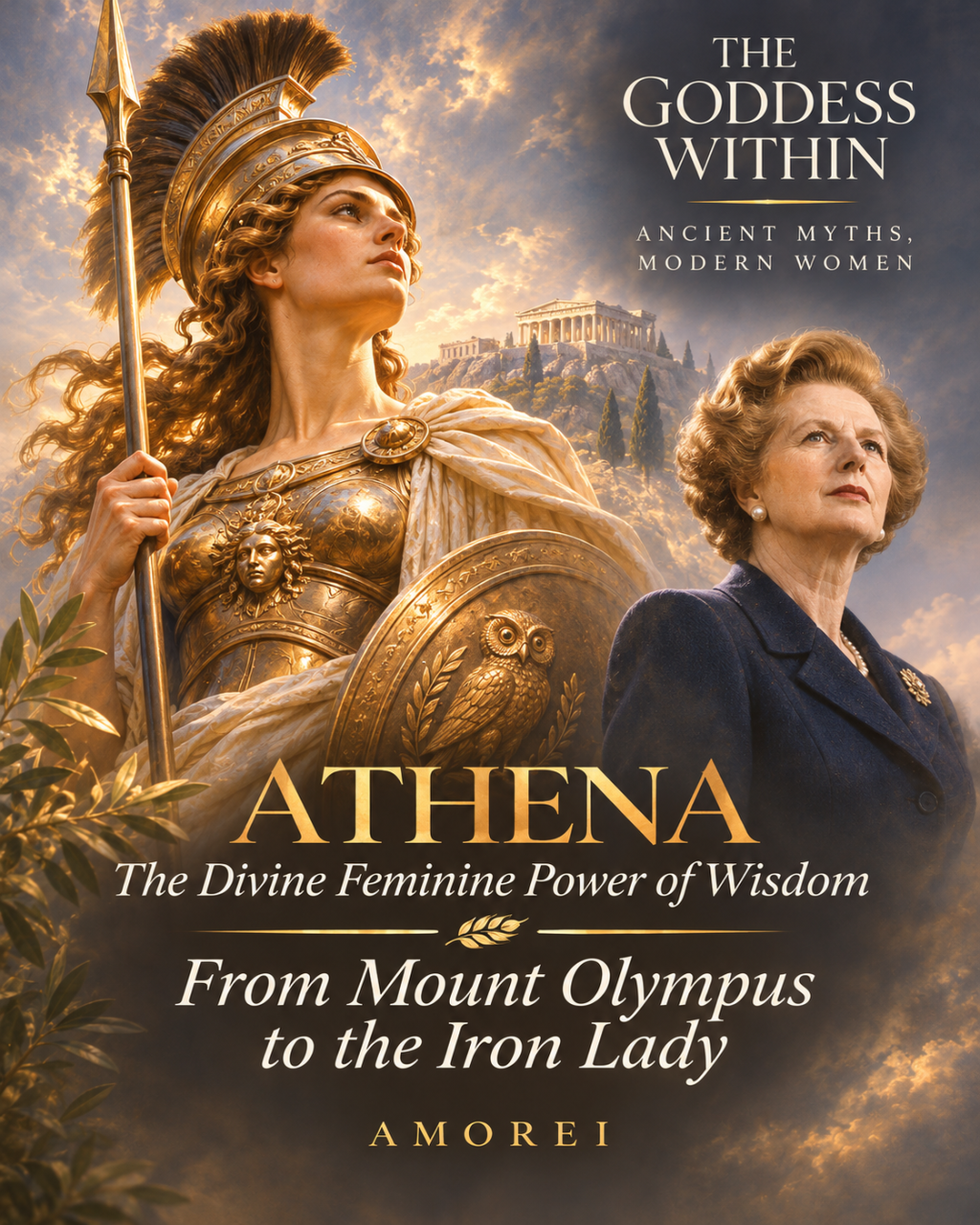
What could possibly connect the heroine of one of the most famous novels of the twentieth century, Britain’s first female prime minister, and a Hollywood beauty whose inventions were decades ahead of their time?
Three remarkably different women, three extraordinary lives, each transforming the world around her in her own way.
For one, Athena awakened through devastating life circumstances. Another grew up preparing to enter a world where decisions could determine the fate of an entire nation. The third possessed an extraordinary combination of beauty, sensuality and inventive genius that remained largely unrecognized for much of her life.
Each of their stories offers a fascinating glimpse into how the ancient goddess continues to express herself in the modern world.
Scarlett O’Hara: The Goddess Awakened by War
When we first encounter Scarlett O’Hara in Margaret Mitchell’s novel Gone with the Wind, she is only sixteen. She lives on the beautiful Tara plantation, surrounded by admirers and entirely confident in her ability to charm any man she desires.
Aphrodite dominates her life, although her determination to marry Ashley Wilkes already reveals the awakening of Hera. Scarlett wants to become the wife of the man she has chosen, and the announcement of his engagement to Melanie feels like a personal defeat.
Then the American Civil War begins, and the familiar world in which Scarlett has grown up gradually falls apart.
 After surviving the horrors of war in Atlanta, Scarlett returns to Tara. Her mother is dead, her father is no longer capable of managing the estate, and hunger and devastation surround her. The people who once depended on her parents now look to Scarlett for survival.
Here, we witness one of the most remarkable awakenings of Athena in literature.
The pampered young woman who once occupied herself with dresses and admirers begins working in the fields, finding food, organizing labor and accepting responsibility for the survival of her family.
Standing on the devastated land of her beloved Tara, Scarlett makes a promise to herself: she will never go hungry again.
That promise will shape many of her future decisions.
The Woman Who Learned to Win
When Scarlett discovers that she may lose Tara because she cannot pay its taxes, she travels to Atlanta in search of money.
Realizing that her sister’s fiancé, Frank Kennedy, has the financial resources she needs, Scarlett deceives him into marrying her, betraying her own sister in the process.
Once involved in Frank’s business affairs, she quickly recognizes his limitations as a businessman. Eventually, she acquires a sawmill and becomes an entrepreneur herself.
She negotiates contracts, deals with suppliers and manages finances in a society where such behavior is considered entirely inappropriate for a respectable Southern lady.
Her ability to recognize opportunities where others see only devastation and loss is remarkable.
Yet we gradually begin to witness the shadow side of her awakened Athena.
Scarlett’s fear of returning to poverty becomes so powerful that financial success begins to justify actions that cause suffering to others. In the novel, she even employs convict labor in her business despite the brutal conditions under which the prisoners are forced to work.
Scarlett’s story unfolds against the collapse of a Southern society whose prosperity had been built upon slavery. Her determination to rebuild her fortune does not absolve her of responsibility for the methods she chooses.
The Man She Failed to See
Scarlett’s relationship with Rhett Butler is particularly fascinating.
Rhett appreciates her intelligence, courage, beauty, independence and business abilities. He recognizes the very qualities that provoke criticism from the society around her. In many respects, their personalities and attitudes toward life are remarkably similar.
Imagine how much love and creative potential could have been realized within such a partnership.
Yet Scarlett remains emotionally attached to her dream of Ashley, barely recognizing what is happening within her own marriage.
Athena enables her to evaluate business opportunities with extraordinary precision, but in her emotional life, Scarlett remains captive to an ideal she created in her youth.
Only after Melanie’s death does she begin to understand how much this woman truly meant to her. She finally recognizes that her love for Ashley was largely a love for her own fantasy and that the man she genuinely loves is Rhett.
By then, however, he has exhausted himself trying to reach her heart.
Scarlett has learned how to fight for almost everything she wants in life. She has yet to learn how to love the man she wishes to have beside her.
What Could Scarlett Have Learned from Melanie?
In Melanie, we can recognize a beautiful expression of Demeter. Her generosity of spirit allows her to love people even when society considers them undeserving of affection.
For much of their relationship, Scarlett mistakes Melanie’s gentleness for weakness, failing to recognize the extraordinary inner strength of this woman.
Melanie protects her, trusts her and remains loyal to their friendship even when Scarlett becomes the subject of widespread condemnation.
Only after losing Melanie does Scarlett begin to appreciate the true value of her presence.
And here an interesting question arises: what might Scarlett’s life have become if Aphrodite, Demeter and Hera had continued to develop alongside her newly awakened Athena?
Perhaps she would have created not only financial prosperity but also a happy family, meaningful relationships with her children and an extraordinary partnership with a man capable of sharing her ambitions.
Margaret Mitchell’s novel ends, but Scarlett’s journey of inner evolution remains unfinished. Her second birth is still ahead of her.
Fortunately for millions of readers, in Alexandra Ripley’s novel Scarlett, published in 1991, more than half a century later, the heroine finally finds her happiness and reunites with the man she loves.
Margaret Thatcher: Athena in the World of Power
In the small English town of Grantham, the daughter of a grocer grew up to become one of the most influential women of the twentieth century.
Her father, Alfred Roberts, was actively involved in public affairs and eventually became the town’s mayor. An avid reader with a keen interest in politics and economics, he frequently discussed world events with his daughter.
It was within this environment that the worldview of the future Iron Lady began to take shape.
Margaret admired her father and inherited many of his beliefs about personal responsibility, hard work, entrepreneurship and the organization of society.
Here, we recognize an almost classical expression of Athena as her father’s daughter.
After studying chemistry at Oxford University, Margaret worked in scientific research and later pursued a qualification in law. Politics, however, gradually became her primary passion.
Her husband, Denis Thatcher, a successful businessman, played an important role in her journey. His financial support and encouragement enabled Margaret to pursue her legal studies and develop her political career while raising two children.
In 1979, she became Britain’s first female prime minister.
The Iron Lady
 Interestingly, Margaret Thatcher acquired her famous nickname before becoming prime minister.
Following a speech criticizing the Soviet Union in 1976, the Soviet press referred to her as the Iron Lady. Originally intended as criticism, the name eventually became an integral part of her political identity.
It is difficult to imagine a more striking modern association with Athena in her armor.
Thatcher possessed an extraordinary ability to withstand pressure, defend her convictions and make decisions under the scrutiny of millions of people.
This became particularly evident in October 1984, when the Irish Republican Army bombed the Grand Hotel in Brighton, where the Conservative Party was holding its annual conference.
Five people were killed. Thatcher narrowly escaped the attack and, only hours later, continued with the conference.
Her remarkable composure in the face of mortal danger reminds us of the goddess who entered the world fully armed.
When Athena Defends Her System
Margaret Thatcher was deeply committed to her economic and political principles.
She sought to reduce government intervention in the economy, encouraged private enterprise, privatized state-owned industries and reduced the influence of trade unions.
Her reforms profoundly transformed Britain.
Supporters credit her with revitalizing the British economy, encouraging entrepreneurship and restoring the country’s confidence in its economic potential.
Critics associate her policies with growing social inequality, the decline of industrial communities and deteriorating living conditions for many working-class families.
The confrontation between her government and the coal miners during the strike of 1984–1985 was particularly dramatic.
The closure of financially unviable mines was regarded by the government as an economic necessity. Yet for thousands of families, the mines represented their livelihood, their community and a way of life that had continued for generations.
Following the closure of many mines, numerous communities experienced unemployment, poverty and prolonged economic decline.
Here, we encounter one of the most complex dimensions of the Athena archetype.
A person may possess exceptional strategic abilities, sincerely believe in the correctness of their decisions, and still underestimate the consequences those decisions will have for people whose lives are fundamentally different from their own.
When Athena becomes deeply identified with a particular system of values, she may find it increasingly difficult to see reality through the eyes of those living outside that system.
Behind economic statistics are human lives. Behind the outcomes of political reforms are families, children and entire communities.
The presence of Demeter can help those who hold power remain attentive to the human consequences of their decisions. Artemis brings the capacity to question the fairness of the social structures themselves, while Hestia can offer the inner freedom necessary to reconsider deeply established convictions.
Of course, it would be mistaken to assume that we understand Margaret Thatcher’s entire inner world through her public life alone.
She shared more than fifty years of marriage with Denis and was both a mother and a grandmother. Behind the public image of the Iron Lady was a woman whose private life contained many dimensions rarely visible to the public.
Her extraordinary journey demonstrates the scale on which Athena can express herself through a woman entrusted with the governance of a nation.
It also invites us to reflect upon the kind of wisdom required of anyone entrusted with such power.
Hedy Lamarr: When Athena Meets Aphrodite
In 1914, a girl named Hedwig Eva Maria Kiesler was born in Vienna to a bank director and a pianist.
Her mother introduced her to music and the arts, while her father encouraged her curiosity about how the world worked.
From an early age, Hedwig was fascinated by mechanical devices. She enjoyed taking things apart to understand their internal workings.
At the same time, she studied ballet and music and dreamed of becoming an actress.
Both Athena and Aphrodite were already finding expression through this extraordinary young girl.
The world, however, was destined to become familiar primarily with one of them.
The Beauty Who Escaped Her Gilded Cage
 Hedwig began her acting career while still in her teens. International recognition came with the release of Ecstasy in 1933, a film that caused considerable controversy because of its unusually explicit portrayal of female sexuality for that period.
That same year, at the age of eighteen, she married Friedrich Mandl, a wealthy Austrian industrialist and one of the country’s major arms manufacturers.
She entered a world of immense wealth, influential personalities and political connections. Her husband, however, sought to control her life and restrict her acting career.
Military officials, industrialists and political figures frequently gathered at Mandl’s home. Hedwig found herself surrounded by people discussing weapons manufacturing and military technology.
Her exposure to this environment may later have contributed to her inventive work.
In 1937, she left her husband and escaped Austria. In Europe, she met Louis B. Mayer, one of the leading executives of Metro-Goldwyn-Mayer, and soon traveled to America.
Her new life as Hedy Lamarr had begun.
The Most Beautiful Woman in the World
Hollywood was captivated by her appearance.
Hedy starred alongside some of the greatest actors of her generation, becoming one of the most recognizable symbols of feminine beauty during Hollywood’s Golden Age.
In Samson and Delilah, she portrayed the legendary woman whose seductive power enabled her to overcome a seemingly invincible hero.
Few of Hedy’s admirers, however, could have imagined how she preferred to spend her time away from the film studios.
In her spare time, she experimented with technical ideas, investigated mechanical devices and developed inventions.
She was fascinated by the possibility of improving existing technologies and creating things that had never existed before.
Athena continued to express herself through this beautiful woman while the world remained almost entirely captivated by her Aphrodite.
An Invention Ahead of Its Time
During World War II, Hedy began thinking about how radio-controlled torpedoes could be made less vulnerable to enemy interference.
The problem was that an enemy could identify the radio frequency being used and jam the signal, disrupting control of the torpedo.
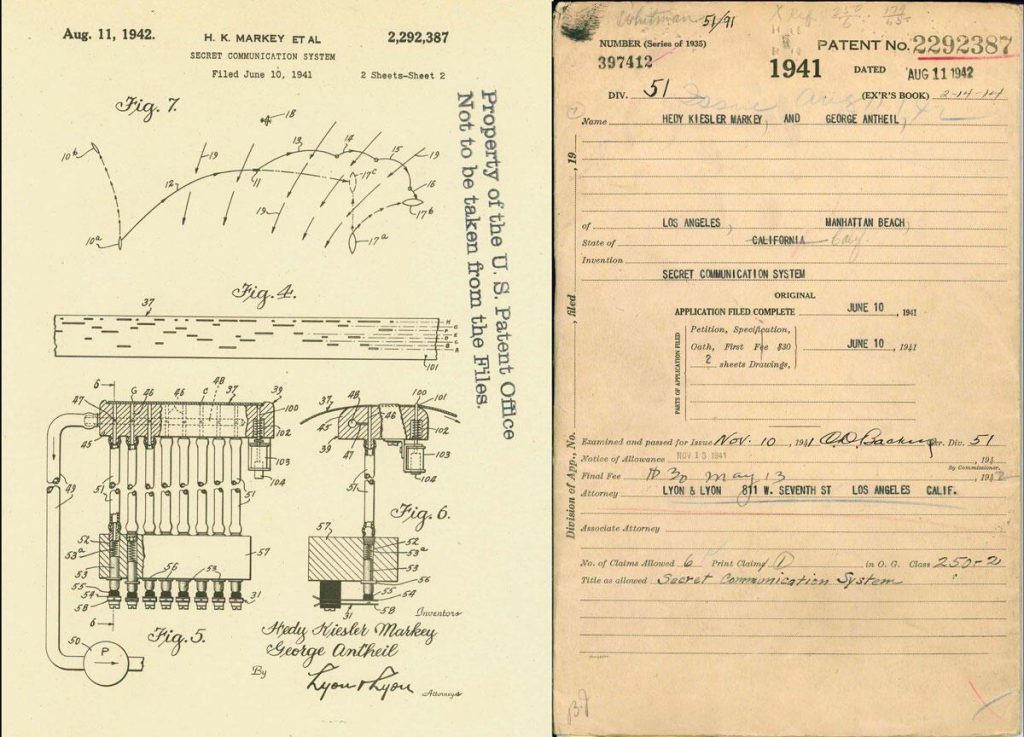 Hedy envisioned an ingenious solution. If the transmitter and receiver could simultaneously switch between different frequencies, interfering with the signal would become considerably more difficult.
In 1940, she met American composer George Antheil, who had experimented with synchronizing mechanical musical instruments.
What followed was a remarkable encounter between two seemingly unrelated fields of human creativity: music and military communications.
Antheil helped develop a practical way to implement Hedy’s concept using principles associated with the operation of a player piano. Their system incorporated switching between 88 frequencies, corresponding to the number of keys on a piano.
On August 11, 1942, Hedy Lamarr and George Antheil were granted United States Patent No. 2,292,387 for their Secret Communication System.
Their invention, however, was never implemented in its proposed form during the war.
Decades later, spread-spectrum and frequency-hopping technologies became important components of wireless communications. Lamarr and Antheil’s work is recognized as one of the historical precursors of technologies used in Bluetooth and certain early forms of Wi-Fi.
Hedy received no significant financial reward for this contribution.
It was not until 1997, when she was eighty-two years old, that she and Antheil, who had already passed away, received recognition from the Electronic Frontier Foundation for their pioneering achievement.
Hedy died in January 2000.
When Society Sees Only One Dimension of a Woman
Hedy Lamarr’s story invites us to consider how limited society’s understanding of feminine potential can be.
Hollywood recognized Aphrodite in her. Her beauty became a commercial asset around which an entire film career was constructed. Meanwhile, another remarkable dimension of her nature remained largely unrecognized.
Yet both goddesses existed within Hedy herself.
How many more possibilities might have opened before her if the people around her had recognized the full range of her abilities?
With appropriate encouragement and resources, she might have established her own research laboratory, devoted more time to developing inventions and introduced the world to many other discoveries.
At the same time, the presence of two powerful archetypes does not necessarily imply complete inner harmony. Hedy experienced six marriages, numerous personal difficulties and periods of loneliness.
Her story reminds us that recognizing the diversity of our talents is only the beginning of our journey. We must also learn to integrate them into a meaningful and fulfilling life, allowing every dimension of our nature to find its expression.
Hedy Lamarr offers a particularly beautiful example of how divine femininity can express itself simultaneously through beauty, sexuality, artistic creativity, technological innovation and scientific thinking.
Athena and Aphrodite can coexist within the same woman, enriching one another and expanding the possibilities of her existence.
Three Women, Three Expressions of Athena
Scarlett O’Hara discovered Athena within herself when her familiar world collapsed. Margaret Thatcher developed Athena’s qualities from childhood and eventually gained the opportunity to influence the destiny of an entire nation. Hedy Lamarr possessed an inventive genius that remained hidden from much of the world behind her extraordinary beauty.
Each of these women demonstrated a remarkable ability to transform material reality.
Yet each of their stories presents us with a different question.
Scarlett invites us to reflect upon the price we may pay for the pursuit of security when it overshadows our capacity to love.
Margaret Thatcher invites us to consider the moral responsibility of those who possess the power to determine the living conditions of millions of people.
Hedy Lamarr invites us to contemplate how much human potential remains unrealized when society recognizes only one dimension of a multidimensional human being.
Perhaps, in reading these stories, every woman will discover something of Athena within her own life.
When has this goddess come to her assistance? What dreams has she helped bring into reality? What abilities has she helped uncover? And which other goddesses are now waiting to awaken within her so that her continued evolution may lead toward greater wholeness?
Human evolution continues throughout our lives.
And the most beautiful creation that Athena within us can ever undertake is the creation of ourselves.
References and Biographical Sources
- Margaret Mitchell. Gone with the Wind, 1936.
- Alexandra Ripley. Scarlett, 1991.
- Gone with the Wind, directed by Victor Fleming, 1939.
- Margaret Thatcher Foundation. Biographical materials.
- Churchill Archives Centre. The Papers of Margaret Thatcher.
- Smithsonian Institution. Hedy Lamarr and George Antheil Invention Papers.
- Richard Rhodes. Hedy’s Folly: The Life and Breakthrough Inventions of Hedy Lamarr, 2011.
- Original interpretation of divine archetypes and the evolution of consciousness developed within the AMOREI Consciousness Project.