
Aphrodite Archetype: Love, Desire, Sensuality, Creativity and Life Force
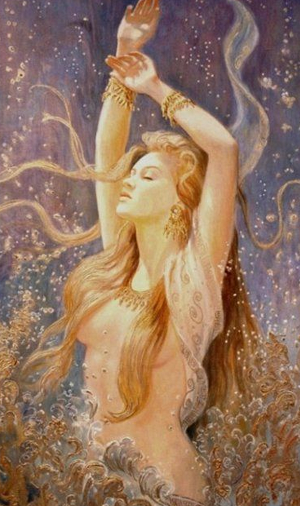
Aphrodite is one of those archetypes that cannot be understood through the word “love” alone.
She is associated with love, desire, beauty, sensuality and sexuality, but her influence reaches much further. Aphrodite represents the capacity to be deeply touched by lifeto feel its beauty, respond to attraction, become fully present in what is happening, and allow an encounter with a person, an idea, a work of art, or one’s own desire to become the beginning of something new.
This is why the Aphrodite archetype is not simply about what a woman feels, but about how deeply she is capable of being present within her own experience.
It may appear in love and creativity, in relationships and embodiment, in the ability to notice beauty, and in that particular moment when a woman suddenly recognizes:
“This truly interests me.”
“This is what I want.”
Aphrodite does not ask life only whether something is useful, rational, productive or strategically advantageous. Her questions are different:
Is there room in my life for desire, sensuality, for love, for pleasure, for creativity, for beauty?
Is there room in my life for spontaneous, living self-expression?
Is there something here that draws me closer, something that awakens my senses, makes my body respond and allows my imagination to come alive?
It is within this inner territory that Aphrodite begins to appear.
When Attention Becomes Presence
One of the most evocative images associated with Aphrodite is a kind of golden light.
People who are falling in love seem to see one another differently. The world becomes brighter, sensations more vivid, attention more refined. Ordinary sounds, smells, gestures and details suddenly become meaningful because perception has become concentrated around something that matters.
But this image can be understood as something much deeper than romantic infatuation.
When the Aphrodite archetype is active, a woman can become genuinely present with whatever has captured her attention.
If she is speaking with someone, she is actually there. She hears not only the words but the tone of voice, notices an expression, a movement, a change in mood. She responds not merely to the information being exchanged but to the living energy between two people.
The same thing can happen in creativity.
When an idea captures her imagination, she may remain with it for hours, turning it over, discovering unexpected connections, sensing what it could become. When she dances, paints, writes, makes music, cooks, works with her hands or walks through nature, she may stop being a detached observer of her own life and enter into direct contact with what is happening.
This is one of the distinctive qualities of Aphrodite’s attention:
where genuine attraction appears, attention stops being scattered and becomes presence.
Aphrodite’s intensity, therefore, is not simply the intensity of emotion. It is the capacity to enter an experience so completely that the experience begins to reveal its depth.
This is why Aphrodite belongs not only to love, but also to sensuality, creativity, beauty and the art of being fully alive.
The Desire That Belongs to You
One of Aphrodite’s most important questions is also one of the simplest:
What do I really want?
Not what people expect me to want.
Not what is considered appropriate for a woman of my age.
Not what my parents wanted for me.
Not what my partner wants.
Not what my social environment tells me a successful woman should want.
And not even what I have learned to call my own desire simply because I have spent years being told that this is what a woman is supposed to want.
We live surrounded by ready-made images of desirable lives. Social media tells us what happiness should look like, what successful relationships should look like, what a beautiful woman should look like, what she should buy, where she should travel, how she should dress and what she should achieve.
Over time, other people’s desires can become so deeply embedded in us that we stop noticing the difference between what genuinely attracts us and what we have learned to desire.
Aphrodite asks us to pause long enough to feel that difference.
What genuinely draws me?
What creates a living response in me?
What do I want not because someone will approve of it, but because something inside me says yes?
In this sense, Aphrodite is connected with a particular kind of inner honesty toward one’s own desire.
She does not promise that desire will always be convenient or rational, or that it will always fit comfortably within other people’s expectations.
But she reminds us that when a woman completely loses contact with her desires, she also loses contact with an important part of herself.
At the same time, a mature Aphrodite does not mean acting on every desire that appears.
Maturity begins when a woman can hear a desire, acknowledge it, and then consciously decide what to do with it.
Hearing your desire is not the same as having to obey it.
Attraction as the Beginning of Creation
Aphrodite is not concerned only with romantic love.
Her energy appears whenever something genuinely attracts us: a person, an idea, a piece of music, an image, a place, a material, a movement, a possibility.
When we allow ourselves to enter into contact with what attracts us, something begins to happen between us and the object of our attention.
And sometimes something new is born from that encounter.
Two people meet, and something exists between them that did not exist before: intimacy, a shared language, a story, a relationship.
A person encounters an idea or a material and begins a dialogue with it. They experiment, change direction, make mistakes, discover something unexpected. Eventually, something comes into existence that was not there before.
This is why Aphrodite’s relationship with creativity is not accidental.
Her power is not simply the ability to notice something beautiful or to feel inspired.
It is the capacity to enter into relationship with what attracts us, remain within that relationship long enough for something to develop, and allow the encounter to become generative.
Sometimes the result is a work of art.
Sometimes it is an idea, a project or a conversation.
Sometimes it is a relationship.
And sometimes it is a new understanding of oneself.
Aphrodite and the Pleasure of the Process
Aphrodite reminds us that life cannot be reduced to outcomes.
It is possible to become so focused on goals, efficiency, achievement and responsibility that the actual experience of living gradually disappears from view.
We become accustomed to doing, accomplishing, completing, obtaining and moving on to the next thing without noticing how we are actually experiencing what is happening now.
Aphrodite brings attention back to the process itself.
She allows us to feel the movement of the body while dancing, to watch a color gradually appear on a canvas, to notice what happens between two people during a conversation, to experience the road rather than thinking only about the destination.
Even sexuality, within the symbolic world of Aphrodite, is not simply about reaching an outcome. It is about sensation, touch, breath, closeness, responsiveness, trust and the capacity to remain present.
This is why Aphrodite’s sensuality is, at its heart, a capacity for perception.
To notice.
To listen.
To feel.
To look.
To touch.
To allow yourself to experience pleasure without immediately turning it into a goal.
The Body as a Place of Presence
For Aphrodite, the body is not primarily an object to be evaluated, compared or displayed according to someone else’s standards.
It is a place of experience.
Through the body, a woman can discover what feels good, what creates resistance, where attraction appears, where tension arises, where she wants to come closer and where she wants to move away.
This is why developing Aphrodite is not simply about becoming more physically beautiful.
It can involve returning to the capacity to feel the body from within.
This may happen through dance, music, movement, touch, massage, intimacy, nature or art. But sometimes it begins much more simply with a few quiet moments in which a woman stops looking at herself from the outside and notices what is actually happening inside.
The body then ceases to be an image that must be presented to someone else.
It becomes once again the place where life is directly experienced.
And with this, our understanding of beauty begins to change.
Beauty Beyond Appearance
Aphrodite is often imagined as the embodiment of perfect physical beauty, conforming to a particular ideal.
But the Aphrodite archetype is not defined by clothing size, facial features, age or conformity to a fashionable standard.
Attraction can live in a voice, a gaze, a smile, a movement, the way someone speaks, the ability to listen, the liveliness of a response, warmth, individuality or that mysterious quality of presence that cannot be reduced to a single physical characteristic.
Sometimes a woman does not fit conventional ideas of beauty at all, yet something about her is unmistakably compelling.
There is something alive in her.
Something expressive.
Something real.
And that becomes the source of attraction.
The beauty of Aphrodite, therefore, is not only about how a woman looks.
It is also about how she inhabits her own life.
Falling in Love and the Power of Attraction
When we fall in love, the world can genuinely change.
A person who seemed ordinary yesterday suddenly becomes extraordinary. A familiar conversation acquires new meaning. Music sounds different. Touch becomes more vivid.
A woman may suddenly feel more beautiful, more alive, more desirable and more connected to herself.
This is one of Aphrodite’s most powerful expressions because falling in love can release an enormous amount of life energy.
But this is also where the shadow of the archetype begins to reveal itself.
The power of attraction can open a woman to life.
It can also gradually take over her life.
When Desire Takes Over
Sometimes attraction becomes so powerful that the person who awakened it becomes the center of thought, fantasy and emotional attention.
A woman thinks about him constantly.
She repeatedly returns to the same person in her imagination.
She begins to justify things she would once have considered unacceptable.
She stops noticing her own boundaries.
Little by little, other parts of liferelationships, work, children, friendships, creative interests, even her own sense of direction began to move into the background.
This can become especially painful when the desire is not reciprocated.
Instead of the joy of mutual attraction, there is a continuous state of longing.
The intensity that feels beautiful when love is mutual can become excruciating when there is no response.
At this point Aphrodite is no longer simply opening a woman to love, sensuality and passion.
Desire begins demanding that everything else make room for it.
This is one of the most important distinctions within the archetype:
the difference between feeling desire and giving desire authority over your life.
A mature Aphrodite does not become less capable of falling in love, feeling passion or being moved by another person.
She develops the capacity to feel deeply while still seeing her whole life.
She can ask:
What am I feeling?
What does this attraction awaken in me?
And what do I consciously choose to do with it?
Two Doors Through Which Aphrodite Arrives
Ancient mythology preserves two well-known versions of Aphrodite’s origin.
In one, she emerges from the sea foam already fully formed and magnificent.
In another, she has a more conventional divine genealogy as the daughter of Zeus and Dione.
Taken symbolically, these two stories offer two different ways in which Aphrodite can emerge in human experience.
Sometimes desire arrives suddenly.
A woman may not have expected anything at all and suddenly discover an intensity of attraction she did not know existed within her.
Such an experience can be beautiful and overwhelming at the same time, particularly when she has not yet learned to distinguish desire, impulse, intimacy and choice.
But Aphrodite can also emerge gradually.
Trust develops.
Closeness grows.
Defenses soften.
The body becomes more relaxed and receptive.
Something that was initially subtle becomes increasingly alive.
One path is associated with the sudden force of desire.
The other is associated with desire slowly emerging through closeness and trust.
Both belong to the human experience of Aphrodite.
Aphrodite Is Not Only About Relationships
It is easy to associate Aphrodite primarily with romantic love, attraction, sexuality, and the experience of falling in love, because these are among the most visible expressions of her energy.
Yet to understand Aphrodite only through relationships is to reduce something much larger to one particular area of life.
A woman can experience Aphrodite profoundly while she is single, without looking for a partner and without having romance at the center of her attention. Aphrodite is present whenever something awakens her capacity to become genuinely involved, when the world stops feeling like something she merely observes from a distance and begins to feel like something she is in living contact with.
This may happen through art, music, dance, writing, photography, nature, travel, an intellectual discovery, a new project, a profession that allows self-expression, or simply through the experience of becoming deeply interested in something that matters to her.
She may sit for hours working on an idea without noticing how much time has passed, become absorbed in a piece of music, lose herself in the movement of her body, become fascinated by a landscape or a color, or suddenly see a possibility in her work that she had not noticed before. In these moments, something very characteristic of Aphrodite is happening: her attention is no longer divided. It becomes intimate.
This kind of involvement is different from simply being productive or accomplishing a task.
A woman may work very hard because she has a responsibility, because she has set herself a goal, or because she knows that something needs to be completed.
Aphrodite brings another quality into the experience. She creates a relationship between the woman and what she is doing. She looks, listens, senses, responds. She becomes interested in what is emerging rather than trying only to impose a predetermined result. An idea can change while she is working with it; a painting can suggest something she did not intend to paint; a sentence can lead her somewhere unexpected; a movement can reveal another movement. The process becomes a conversation.
This is one of the deeper meanings of Aphrodite: not simply the ability to love another person, but the ability to enter into a living relationship with what matters.
There is a subtle but important distinction here.
Aphrodite does not necessarily ask,
What should I do?
She is often asking something closer to, What is calling me? What draws my attention? What makes me want to move closer? What becomes possible if I allow myself to become genuinely involved? Her intelligence is not primarily the intelligence of calculation or strategy.
It is an intelligence of attraction, perception, participation, and connection.
This is why Aphrodite can become a powerful source of creativity. The same movement that draws two people toward one another can draw a person toward an idea, an image, a piece of music, a question, a material, a landscape, or a possibility that she feels compelled to explore. Something catches her attention, and instead of remaining outside it, she enters into a relationship with it.
Through that relationship, something new can emerge.
In this sense, Aphrodite is not asking a woman to spend her life chasing excitement. She is inviting her to notice where she is genuinely alive. There is a difference between stimulation and aliveness, between constantly looking for something new and being capable of allowing something meaningful to deepen. The first can leave a person scattered; the second can become a source of creation, intimacy, beauty, and meaning.
A woman may therefore discover Aphrodite in places where she never expected to find her. She may find her while creating something with her hands, while writing a sentence that suddenly feels true, while dancing without performing for anyone, while sitting beside the ocean, while having a conversation that changes the way she sees her own life, or while becoming completely absorbed in a project that matters to her. Romance is one possible expression of this capacity for connection, but it is not its only destination.
At her deepest level, Aphrodite is concerned with the experience of coming into contact — with another person, with beauty, with the body, with desire, with an idea, with the imagination, with the creative process, and ultimately with life itself. What matters is not simply what she loves, but what happens to her when she allows herself to love something enough to become genuinely present to it.
Aphrodite and a Woman’s Inner Value
There is another dimension of Aphrodite that becomes especially important as a woman matures: the relationship between desirability and self-worth.
Aphrodite is vulnerable wherever a woman does not yet feel that she has value simply because she exists.
Then being desired can become a way of proving that she matters.
She may begin to need confirmation through another person’s eyes:
If he wants me, I must be valuable.
If he admires me, I must be beautiful.
If he chooses me, there must be something right about me.
The ability to be attractive, which could have been a free expression of sensuality and vitality, gradually becomes dependent upon external validation.
A woman may choose not the person she truly loves, but the person beside whom she feels most desirable.
She may care for her appearance not because she enjoys beauty, but because she needs to satisfy someone else’s definition of attractiveness.
She may remain in a painful relationship because the attention of that person has become evidence of her own worth.
This is one of the deeper shadows of Aphrodite:
looking outward for proof of a value that has not yet been fully felt inwardly.
This is why mature Aphrodite begins with a different question.
Not:
“Do they like me?”
But:
“Can I feel my own value even when nobody is looking at me with admiration?”
This does not mean that a woman no longer needs love, intimacy, recognition or the desire of another person.
Human beings do not stop needing connection simply because they become more internally grounded.
What changes is the quality of the connection.
Another person no longer has to function as the mirror without which she does not know who she is.
Instead, she meets another person from a life that already has its own center.
This is the inner foundation of mature Aphrodite.
A woman who knows her value can allow herself to be beautiful without turning beauty into proof.
She can be desired without making another person’s desire the measure of her worth.
She can love without trying to earn love.
She can leave someone who does not choose her without interpreting that rejection as proof of her inadequacy.
And she can say no to what diminishes her dignity even when she continues to feel a powerful attraction.
Self-worth, in this sense, is not the belief that a woman is better than other women.
It is a quieter knowledge:
“I have value not because someone chose me. I have value before that choice and independent of it.”
This distinction changes everything.
Because when a woman feels her own worth, Aphrodite no longer needs to operate through seduction, validation or the endless search for another person’s gaze.
Beauty becomes expression rather than proof.
Desire becomes experience rather than currency.
Sexuality becomes a connection rather than a strategy for keeping someone.
Love becomes meeting rather than self-abandonment.
And pleasure becomes something she can receive without believing she must first earn the right to have it.
She can say:
“I can desire you without losing myself.”
“I can love you without abandoning myself.”
“I can enjoy my beauty without needing you to constantly confirm it.”
“I can experience pleasure without having to justify my right to be alive.”
This is where Aphrodite begins to move from something that possesses a woman to something she can consciously embody.
When Aphrodite Has Been Suppressed
In some families and cultures, love, sexuality, beauty, pleasure and feminine attractiveness have been treated as qualities that should be controlled, hidden or viewed with suspicion.
A woman may have been taught to be useful, responsible, serious, productive and accommodating while gradually losing contact with her own desires.
In such cases, Aphrodite may not disappear.
The woman may simply learn not to hear her.
And then Aphrodite can return unexpectedly.
Through falling in love.
Through a creative crisis.
Through an intense desire to change one’s life.
Through a sudden need to reconnect with the body.
Through an unexpected attraction.
Through the desire to feel beautiful again not for someone else, but for oneself.
This is why the awakening of Aphrodite does not necessarily begin with romance.
Sometimes it begins with a much simpler question:
“What actually brings me joy?”
And when a woman finally allows herself to answer without immediately replacing her own response with should, must, appropriate or practical, a different quality of life can begin to emerge.
Aphrodite Through Different Stages of Life
Aphrodite does not belong only to youth.
Her expression changes as a woman changes.
In childhood, her qualities may appear as delight in beauty, play, imagination, performance, charm and the pleasure of being seen.
In adolescence and early adulthood, attraction and sexuality may become more conscious, while the woman is also learning how to navigate desire, boundaries, social expectations and choice.
Later, Aphrodite may express herself through intimate relationships, creative work, artistic expression, beauty, embodiment, sensuality or the courage to rediscover desires that have been neglected beneath years of responsibility.
And at another stage of life, Aphrodite may become less concerned with being perceived as desirable and more concerned with the experience of being genuinely alive.
Her presence can become quieter and deeper.
The question is no longer:
“Am I attractive?”
but:
“Am I still capable of being touched by life?”
Can I still become fascinated?
Can I still create?
Can I still experience beauty?
Can I still desire it?
Can I still allow myself to be surprised?
The form changes.
The life force does not have to disappear.
Aphrodite and Other Inner Forces
An archetype never exists completely alone.
Different inner forces can be active within the same woman, and their interaction often determines how love, desire, creativity and relationships are actually lived.
Alongside Athena, Aphrodite can combine desire with strategy and clear choice.
Alongside Hera, her capacity for attraction and love can enter the territory of commitment and enduring partnership.
Alongside Demeter, sensuality and love may meet nurturing, motherhood and care.
Alongside Artemis, Aphrodite can meet independence and a woman’s own direction.
Alongside Persephone, she may encounter sensitivity, receptivity and the deeper layers of inner experience.
This is why archetypal exploration should never become a search for one definitive answer to the question:
“Which kind of woman am I?”
The more useful question is:
“What is active in me now?”
One archetypal quality may be strong while another is underdeveloped.
A quality that was central during one stage of life may become quieter during another.
Circumstances, relationships, responsibilities, transitions, desires and choices can all change the way different archetypal dimensions appear.
The archetypes are therefore mirrors, not labels.
Mature Aphrodite
Mature Aphrodite does not arrive when a woman becomes less passionate, less sensual, or less capable of falling deeply in love. On the contrary, maturity does not require her to diminish the intensity that makes her feel so vividly connected to life.
What changes is her relationship with that intensity. She gradually learns that passion can be experienced without being obeyed, that desire can be honored without automatically becoming a command, and that the fact that something powerfully attracts her does not, by itself, mean that she must follow it wherever it leads.
This is an important distinction, because the strength of Aphrodite lies precisely in her capacity to become completely present to an experience. When she is captivated, she does not stand at a safe distance and analyze what is happening; she enters the experience with her senses, her emotions, her imagination and her body fully awake. This quality can make love extraordinary, creativity exhilarating and ordinary moments unexpectedly beautiful.
But the same openness that allows a woman to experience life so intensely can also make it difficult to recognize when fascination has become compulsion, when inspiration has become idealization, or when the desire to remain inside a beautiful experience begins to cost her something essential.
Mature Aphrodite therefore develops something that the archetype does not possess automatically: vision and perspicacity.
She begins to understand that not every powerful attraction is a sign of destiny, just as not every loss of excitement is a sign that something has lost its value.
She can remain open to desire while becoming more capable of asking what that desire is actually telling her. Is she drawn toward a person because there is a genuine meeting between them, or because she has fallen in love with an image she has created?
Is she attracted to a new possibility because it truly belongs to her, or because novelty temporarily makes her feel more alive?
Is she following a creative impulse that wants to mature into something real, or is she moving from one intoxicating beginning to another because she has difficulty remaining with the quieter, less glamorous stages of creation?
These questions do not diminish Aphrodite. They deepen her.
A mature woman can enjoy beauty without believing that she must remain beautiful according to someone else’s definition in order to be worthy of love.
She can care for her body without turning her body into a project that must constantly be perfected.
She can appreciate being desired without making other people’s desire the measure of her value.
She can experience sexuality as a source of intimacy, pleasure and vitality without allowing sexuality to become the currency through which she secures attention, approval or belonging.
And perhaps most importantly, she can fall in love without dissolving herself inside the experience of being in love.
She can allow another person to matter profoundly to her while continuing to hear her own thoughts, recognize her own boundaries, remember her own commitments and remain in contact with the life that existed before the relationship. She does not have to choose between intimacy and individuality. She begins to understand that genuine intimacy becomes richer, rather than poorer, when two people remain capable of meeting one another as whole human beings.
The same maturation takes place in creativity. The young or less integrated Aphrodite may be carried from one fascination to another, captivated by beginnings, by the electricity of possibility, by the feeling that something new is about to be born. Mature Aphrodite still loves that moment of inspiration, but she learns to stay with what follows it. She discovers that creation is not only the moment of attraction between an idea and the imagination; it is also the period in which the idea must be given attention, form, patience and time. The initial spark may be unmistakably Aphroditic, but bringing something into the world requires the capacity to remain in relationship with it after the first enchantment has passed.
This may be one of the deepest transformations available through the archetype: learning that aliveness is not the same thing as constant excitement.
Sometimes what is truly alive within us is not the newest possibility, the most intoxicating relationship or the strongest emotional experience. Sometimes it is the quiet desire to continue, to deepen, to create, to remain, to discover what becomes possible when we stop searching for the next wave of intensity and allow the present experience to reveal its deeper dimensions.
Mature Aphrodite therefore begins to distinguish between what excites her and what genuinely brings her alive; between what she has been taught to desire and what she actually desires when she becomes quiet enough to hear herself; between attraction that opens her world and attraction that gradually causes her world to become smaller.
She does not need to reject the first movement of desire in order to develop the second capacity of choice.
Instead, she learns to let desire speak before she decides what to do with what she has heard.
This is why maturity does not transform Aphrodite into a restrained or overly rational woman. She remains capable of wonder, eroticism, beauty, creative obsession, tenderness and delight. What changes is that these experiences no longer have to take control of her life in order to be fully felt. She becomes increasingly capable of holding passion consciously and allowing herself to be moved by life without surrendering her ability to choose.
And perhaps that is the mature form of Aphrodite: not a woman who has learned to want less, but a woman who has become capable of wanting deeply without abandoning herself in the act of wanting.
Aphrodite as a Return to Becoming Really Alive
Aphrodite reminds a woman of the part of herself that does not want to live entirely through duties, goals and correct decisions.
She brings attention back to what can be felt, loved and created; to beauty, the body, intimacy, pleasure and creativity; to that unmistakable inner response that arises when we encounter something that genuinely matters to us.
But the depth of Aphrodite lies in the fact that these qualities are not separate.
Love, desire, sensuality and creativity are connected by one fundamental human capacity:
the ability to enter into living contact with what attracts us, become fully present within that contact, and allow the encounter to create something new.
Then Aphrodite becomes much more than an image of the woman who is desirable to others.
She becomes an image of the woman who hears her own life.
She knows that her desires may be many and sometimes contradictory.
She knows that not every desire requires action.
But she no longer refuses to hear herself simply because her inner truth does not fit someone else’s script.
She learns to distinguish her own voice among the many expectations surrounding her and to choose what genuinely belongs to her.
This is where a deeper encounter with Aphrodite begins.
Because the question is no longer whether the archetype exists within a woman.
In different forms, it may appear in many women and at different moments of life.
The more interesting question is:
What happens to our lives when we allow ourselves to feel what genuinely attracts us while remaining conscious enough to decide where that attraction will lead us?
Aphrodite invites us to explore love, desire, the body, beauty, sensuality, pleasure, creativity and attraction as parts of one larger human experience.
And perhaps that is why an encounter with Aphrodite rarely remains only a conversation about love.
It gradually becomes a conversation about what in us wants to live, feel, connect and create.
Because beneath the archetype of love, beauty and desire lies something much older and more powerful: the movement toward life itself, toward contact, experience, union and creation.
Aphrodite does not ask a woman to become someone else.
She asks her to become more intimately acquainted with what is already alive within her.
And perhaps the most important question she leaves us with is not:
“How can I become more desirable?”
but:
“What makes me feel alive and am I willing to meet that part of myself?”
That is where Aphrodite begins.
And that is also where archetypal work becomes more than an intellectual exercise. The purpose of the archetypes is not to tell a woman who she is, but to give her a symbolic language through which she can recognize different qualities, desires, patterns and possibilities within herself.
Explore Aphrodite Beyond the Idea
Aphrodite can be understood intellectually through mythology and psychology.
But there is another way to encounter her through the body, through sensation, through creativity, through desire, through relationship, through beauty and through direct experience.
This is the deeper invitation of The Goddess Within Retreat in Costa Rica: not simply to learn about feminine archetypes, but to explore them through lived experience, embodiment, emotion, reflection, creativity and conscious presence.
Because Aphrodite is not merely an idea to understand.
She is an invitation to feel what is alive in you and to discover what becomes possible when you allow yourself to meet it consciously.
The archetypes are mirrors, not labels.