Aphrodite in Real Life: Isadora Duncan and Gala Dalí

When we speak about the Aphrodite archetype, it is easy to keep her in the world of mythology – a beautiful goddess surrounded by desire, beauty, love, pleasure and stories of passion.
But archetypes become much more interesting when we begin to recognize their movements in real human lives.
Not because we want to call a particular woman “an Aphrodite woman,” as if she belongs to one fixed category. No real person can be reduced to a single archetype.
A woman may have many different qualities within her, and different parts of her personality may become stronger at different moments of life.
The value of an archetype is not in giving us a label.
It is in giving us a language to explain humanity from a different perspective.
A language through which we can notice something that may otherwise be difficult to describe: the way a person is drawn toward life, what awakens her, what she loves, what she creates, what she allows herself to feel, and what happens to the people around her when she is fully alive.
Aphrodite is especially interesting because her influence does not stop with romantic love.
She is connected with attraction, sensuality, beauty, pleasure, creativity and the experience of being deeply touched by life. Something catches her attention. Something moves her. She feels drawn toward it. She enters into contact with it. And from that contact, something new can be born.
Sometimes that “something” is a relationship.
Sometimes it is a child.
Sometimes it is a painting, a dance, a poem, a business, a new idea, a way of living, or simply a different relationship with one’s own body.
And sometimes a woman herself becomes a source of inspiration for another person’s creativity.
This is one of the most beautiful and misunderstood aspects of Aphrodite.
She does not only create.
She can make other people want to create.
Two women from modern history show these different sides of Aphrodite particularly well: Isadora Duncan and Gala Dalí.
Their lives were very different. Their personalities were very different. Their relationships with art were very different.
And yet, in both of them, we can see something of the same archetypal movement: a powerful relationship with desire, beauty, creativity, attraction and the experience of being fully involved in life.
Isadora Duncan: When the Body Becomes a Language of Freedom
When Isadora Duncan walked onto the stage barefoot, there was much more happening than simply a dancer choosing not to wear ballet shoes.
She was changing the meaning of the body.
At the beginning of the twentieth century, classical ballet was built around discipline, control, precision and a very specific idea of what a beautiful movement should look like. The body had to learn the correct form and then reproduce it with extraordinary discipline.
 Duncan was searching for something different.
She wanted movement to come from somewhere inside the person.
Her bare feet, loose clothing, flowing hair and movements inspired by nature and ancient Greek images became part of her artistic language, but behind the visual image was something much deeper: she wanted the body to stop being something that simply obeyed an external form and become a living expression of inner experience.
She was not interested only in making the body look beautiful.
She wanted the body to feel alive.
This is one of the reasons her story has such a strong connection with Aphrodite.
Aphrodite is not simply about being beautiful.
She is about being in contact with life.
She is the part of us that does not want to experience life only through ideas. She wants to feel it. To come closer to it. To be touched by it. To allow an experience to enter the body and change something inside.
For Aphrodite, it is not enough to know that something is beautiful.
She wants to experience it.
And this is exactly how Duncan approached dance.
She did not simply move her body while music played in the background. Music seemed to enter the body and continue through movement. Sound became breath. Breath became a gesture. Gesture became a living expression of feeling.
Dance was no longer simply a performance of technical skill.
It became a way of experiencing existence.
In that sense, Duncan did not merely create a new form of dance.
She helped return something to the body that had been lost: the feeling that the body itself could be a source of knowledge, expression and freedom.
And eventually, her life became an extension of the same artistic principle.
When Love and Creativity Speak the Same Language
There were many loves and passionate relationships in Isadora Duncan’s life, but it would be too simple to understand her only through the men she loved.
For Duncan, love and creativity belonged to the same inner world.
When we fall deeply in love, something happens to our perception. The world can suddenly seem brighter. Music can sound different. A touch can become much more meaningful. Colors, smells, movement and even ordinary moments may seem strangely alive.
Something similar can happen in creativity.
An artist becomes so deeply involved with what she is creating that, for a while, the separation between the creator and the creation becomes very thin.
This is one of the central movements of Aphrodite.
Something attracts us.
Our attention moves toward it.
We become emotionally involved.
We come into contact with it.
And then, through that contact, something new begins to exist.
For one person, the “other” may be a lover.
For another, it may be music, painting, writing, dance, nature, an idea or a new project.
For Isadora Duncan, it was often movement.
But sometimes it was another human being.
Gordon Craig: When Two Creative Forces Meet
One of the important relationships in Duncan’s life was her relationship with the English theatre director and artist Edward Gordon Craig.
Their attraction was not simply a story about a man and a woman.
They met as two creative people who were both searching for a different way of making art.
Craig was looking for a new language for theatre.
Duncan was looking for a new language for the body.
They recognized something in one another because both were trying to move beyond forms they felt had become too rigid and lifeless.
This makes their relationship especially interesting from the perspective of Aphrodite.
Sometimes we are attracted to another person not only because of who that person is, but because of who we become when we are near them.
Another person may awaken a part of us that was waiting for expression.
They may make us feel more creative, more courageous, more alive.
But Aphrodite also has a difficult side.
What inspires us can also take over our attention.
What awakens us can become something we cannot easily step away from.
Duncan experienced love with the same intensity with which she experienced art. Her relationship with Craig was passionate, and they had a daughter, Deirdre. Yet her life also revealed how difficult it can be to hold love, motherhood and an intense creative calling within the same life without feeling pulled in different directions.
This is one of the deeper questions of Aphrodite:
How can I love something deeply without disappearing inside it?
That question is not only about romantic relationships.
It can appear whenever desire becomes powerful.
A woman can lose herself in a lover.
But she can also lose herself in her work, her creativity, her beauty, her need for excitement, or the feeling of being desired.
Aphrodite brings intensity.
Maturity teaches us how to live with that intensity without allowing it to take away our sense of self.
For Duncan, dance remained one of the places where she could return to herself.
She could lose herself in love, but she could also return to the body, to movement, to creation.
Because losing the dance would have meant losing a part of who she was.
The Woman Who Became a Muse
There is another side of Aphrodite that Isadora Duncan reveals particularly beautifully.
Aphrodite does not only create.
 She can awaken creativity in other people.
There are people whose presence changes the way others see the world. They may make someone notice movement, beauty, color, emotion or possibility in a new way.
They do not necessarily inspire others because they are trying to be inspiring.
They inspire because they are deeply engaged with their own way of being alive.
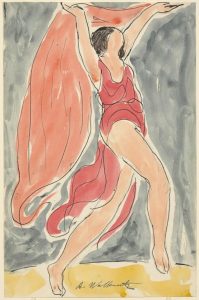
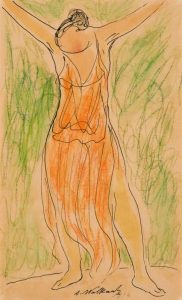
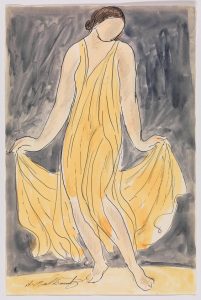
This happened with the artist Abraham Walkowitz, who met Duncan in Paris and returned to her image again and again in his drawings and watercolors.
But what is especially interesting is what he was trying to capture.
It was not simply her face.
It was not only her physical beauty.
It was a movement.
The moment when one position is already disappearing and another is about to begin.
Dance exists in time. A drawing exists in stillness.
And yet the artist was trying to make a still image carry the feeling of movement.
This is a beautiful expression of the Aphrodite principle.
A woman can become so alive inside her own experience that another person begins to create because of the encounter with her.
She is not simply an object of inspiration.
She is not a beautiful woman standing still while someone else creates.
She is living, moving, choosing and expressing herself.
And another person responds.
Isadora danced.
The artist watched.
And something new was born between them.
Not a Woman Who Exists to Be Looked At
This distinction is essential when we speak about Aphrodite.
The archetype is often reduced to female beauty and the ability to attract men.
But if we stop there, we miss almost everything important.
Aphrodite is not the woman who exists so that other people can look at her.
She is the woman who looks at life herself.
She notices what attracts her.
She feels.
She chooses.
She moves toward what calls her.
She allows herself to be touched by experience.
And that is why Aphrodite’s attractiveness cannot be reduced to physical beauty.
Duncan was a beautiful woman, but her power did not come simply from the shape of her body.
Her body was alive.
It expressed music, desire, joy, pain, sensuality and freedom.
It did not simply display beauty.
It participated in life.
This is a very different thing.
A person can spend years trying to make her body more beautiful, younger, thinner, more perfect or more acceptable according to an external ideal.
But the beauty of Aphrodite comes from somewhere deeper.
It comes from presence.
From being inside one’s own body.
From being able to feel.
From allowing life to affect us.
From responding honestly to what genuinely attracts us.
That is why Duncan’s movement could be so powerful.
People were not simply watching a woman who knew how to move beautifully.
They were seeing a person who seemed deeply connected to her own body.
And that kind of presence is difficult to imitate.
A Patron, a Lover and the Power of Bringing a Vision to Life
Another important figure in Duncan’s life was Paris Singer, an heir to the Singer fortune and a supporter of the arts.
His relationship with Duncan is interesting not simply as another romantic story, but because it shows another dimension of Aphrodite.
Duncan had a vision.
She wanted to create a different environment for dance, a place where the body could be understood differently and where young dancers could learn to move in another way.
Her attraction was therefore not limited to herself.
It began to create a world around her.
This is one of the more mature expressions of Aphrodite: the ability to attract not only attention, but participation.
When someone truly loves what she is creating, other people can begin to feel the value of that vision.
They may offer their time, their resources, their knowledge, their support or their own creativity.
Something personal can become something larger.
A private passion can become a cultural contribution.
And this is one of the reasons Aphrodite is connected not only with love, but with creation itself.
The Body That Refused to Be Imprisoned by Form
Perhaps the deepest part of Isadora Duncan’s story begins with something that, on the surface, seems almost simple: she removed the ballet shoes, rejected the corset, moved away from the artificial poses that had shaped the female body according to an external idea of beauty, and chose to dance barefoot, allowing her body to move with a freedom that was still radical in her time.
These were not simply changes in costume or technique. They represented something much more fundamental – a different relationship between a woman and her own body, in which the body no longer had to be constantly corrected, disciplined, restrained, or made to conform to an image created by someone else. For Isadora Duncan, the body could become a source of knowledge, a place from which something true could be felt and understood before it was ever put into words.
She listened to music through her body, rather than simply following it with a trained sequence of movements. She listened to the ground beneath her feet, to rhythm, to breath, to sensation, and to the natural impulse of movement itself. Instead of asking her body to obey an external form, she allowed movement to emerge from within, as though the body already knew something that the conscious mind had not yet learned how to say.
And this is where the story of Isadora Duncan comes into such a deep and beautiful relationship with the Aphrodite archetype.
Aphrodite is not only the archetype of romantic love or sexual attraction; at a deeper level, she represents the capacity to be touched by life – to experience beauty, sensation, desire, creativity, pleasure, and connection not as abstract ideas, but as something that enters us through the senses and awakens something within us.
She reminds us that there are parts of human experience that cannot be fully reached through analysis or control, because they have to be felt, embodied, and lived.
This is what makes Isadora Duncan’s relationship with her body so important.
She was not simply freeing the body so that it could move more beautifully; she was reclaiming the body as a living part of the self, as a place where intuition, emotion, creativity, and desire could meet.
Her dance suggested that a woman does not have to leave her body in order to become intelligent, creative, spiritual, or free. She can enter more deeply into herself through the body.
And perhaps this is one of the most essential gifts of Aphrodite: the reminder that being fully alive is not something that happens only in the mind. It happens when we allow ourselves to be moved – by music, by touch, by beauty, by another human being, by nature, by desire, by creativity, by the simple sensation of being present inside our own lives.
Isadora Duncan’s Aphrodite was not simply the woman who was beautiful, desired, or admired; it was the woman who remained connected to the living experience of being in her body, and who allowed that connection to become art.
That is the deeper Aphrodite – not merely the woman who attracts life toward herself, but the woman who allows life to move through her.
Gala Dalí: The Woman Who Became Part of an Artist’s World
If Isadora Duncan shows us Aphrodite through the body and through the freedom of creative expression, Gala Dalí reveals another side of the archetype: the woman whose presence becomes deeply connected with another person’s imagination and creative world.
There are women who are called muses.
The word itself can sometimes sound passive.
A woman appears beside an artist, inspires him, becomes the subject of his paintings or poems, and the man remains the creator while she becomes the beautiful presence that helped his art come into being.
The story of Gala and Salvador Dalí is much more complicated than that.
Gala certainly became one of the central women in Dalí’s artistic life, but her role cannot easily be reduced to beauty, romantic love or inspiration in the simple sense of the word.
She entered his life at a moment when his artistic identity was developing, and she gradually became part of the world he was creating.
She was his lover.
His muse.
A constant presence.
A partner in the life they built.
And, in many ways, a person who helped transform his enormous imaginative world into something that could exist in everyday reality.
That distinction matters.
Because a muse does not have to be a passive object.
Sometimes a woman becomes part of the creative process precisely because she has a strong presence of her own.
Gala Before Dalí
Gala was born in Russia in 1894 as Elena Ivanovna Diakonova.
Before she met Salvador Dalí, she had already lived a remarkable life and had entered the European artistic and literary world.
She had been married to the poet Paul Éluard and had connections with artists and writers, including Max Ernst.
This matters because Gala did not suddenly become interesting when she met Dalí.
She already had a life.
She already had relationships.
She already had experience with the artistic world.
She already understood something about the strange territory where love, desire, art and imagination meet.
When she met Dalí in 1929, he was twenty-five years old and still at the beginning of his artistic journey.
Their meeting in Cadaqués became one of those encounters in which two people’s lives seem to change direction at the same time.
It would be easy to tell their story as a simple romantic story of sudden attraction.
But the deeper question is:
What happens when we meet someone who seems to open a door into a part of ourselves that we did not know how to reach alone?
That is one of the places where Aphrodite enters.
Aphrodite and the Transformation of Perception
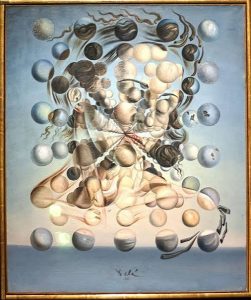 One of the most mysterious things Aphrodite does is not simply make us desire someone, but change the way we perceive the world around us. When we are genuinely touched by another person, something happens to the quality of our attention: the ordinary becomes charged with meaning, details that we might normally overlook suddenly seem significant, and the person who has entered our emotional field can begin to feel as though he or she has opened a door into an entirely different version of life. This is why falling in love can feel so much larger than the simple fact of being attracted to another human being. We are not only seeing the person; we are seeing the world through what has been awakened in us by that person.
Anyone who has truly fallen in love knows this transformation, even if they have never had words for it. A room can feel completely different because someone is standing in it. A song that seemed ordinary yesterday can suddenly become almost unbearably beautiful because it has become associated with a particular moment, a particular voice, a particular pair of eyes. A smell, a street, a piece of clothing, the light at a certain hour of the afternoon can become saturated with emotional meaning because our psyche has connected it with an experience of desire, intimacy, possibility, or longing. The external world has not necessarily changed at all; what has changed is the intensity with which we are meeting it.
This is one of the reasons Aphrodite cannot be reduced to physical beauty or sexuality. Her deeper territory is aliveness of perception. She draws us into a state in which we are more available to experience, more permeable to beauty, more responsive to sensation, and more easily moved by what we encounter. In the language of the archetype, attraction is not merely something that happens between two bodies. It is a movement of consciousness toward something that suddenly feels meaningful enough to deserve our attention.
For an artist, this heightened perception can become particularly powerful because the artist already lives, to some degree, by noticing what other people pass by. What another person experiences simply as a face, a gesture, a color, a landscape, or a moment may become for the artist an image that demands to be explored. Desire intensifies that process. The beloved can become not only someone the artist loves, but someone through whom the artist begins to see differently.
This is part of what makes the relationship between Salvador Dalí and Gala so compelling in the context of Aphrodite. After Gala entered Dalí’s life, she did not remain merely a woman he loved or a model who happened to appear in his paintings. Over time, her presence became deeply intertwined with the imaginative world through which he understood himself and expressed his art. He returned to her image repeatedly, representing her not in one fixed way but through a constantly changing symbolic vocabulary: as lover, woman, sacred figure, mysterious presence, idealized image, and eventually something approaching a personal mythology.
The important point is not simply that Dalí painted Gala many times. It is that she became woven into the way he imagined. She entered the inner landscape from which his creative work emerged. In that sense, Aphrodite operates on a deeper level than inspiration in the ordinary sense of the word. She does not simply give an artist an interesting subject. She can alter the emotional and imaginative atmosphere in which the artist lives, so that the beloved becomes part of the very language through which experience is transformed into art.
And this is why the figure of Gala is so much more interesting than the familiar idea of the beautiful woman standing beside a famous male artist. She allows us to see that the Aphrodite experience is not only about being desired or admired. It can be about becoming deeply consequential to another person’s imagination – and, at the same time, discovering that one’s own presence, desire, intelligence, choices, and influence can shape the reality in which another person creates.
When a Muse Is Also a Force in Real Life
The conventional image of a muse is strangely passive: she inspires, he creates. She is imagined as the beautiful presence who enters the artist’s field, awakens something in him, and then remains somewhere at the edge of the story while the real work is supposedly done by the artist. Gala’s story complicates this picture considerably, because her influence on Dalí’s life was not confined to the symbolic or romantic realm. She became involved in the practical reality surrounding his work, and this makes their relationship a much richer example of how Aphrodite can operate in a human life.
A creative vision, no matter how powerful, still has to find a way into the world. Paintings have to be created, exhibited, sold, negotiated, protected, promoted; a life has to be organized around the demands of creative work; decisions have to be made about money, time, relationships, opportunities, and the public world in which an artist exists. Gala became involved in this reality. She was not simply someone who inspired Dalí while he remained alone with his imagination. She became part of the structure through which that imagination could acquire a life beyond the studio.
That changes our understanding of what a muse can be.
Sometimes the person who awakens our imagination also becomes the person who challenges us, organizes something around us, protects what matters to us, negotiates with the outside world, or simply refuses to allow our vision to remain an entirely private fantasy. Influence can take many forms, and it does not always look romantic or gentle. A woman can become significant in a man’s creative life not because she gives him ideas, but because her presence changes the conditions under which he is able to turn those ideas into reality.
This is especially relevant to Aphrodite because the archetype is fundamentally concerned with connection – with the movement toward something that captures attention and with the transformation that occurs when we enter deeply into that relationship. In creativity, as in love, something outside the ordinary self becomes sufficiently compelling that we are willing to give it our time, our attention, our energy, and eventually a part of our identity. What begins as attraction can become involvement; involvement can become devotion; devotion can become creation.
But this is also where the more complicated side of Aphrodite begins to emerge.
The same force that can bring beauty, vitality, inspiration, and extraordinary creative energy into a life can also become consuming. When another person becomes emotionally central, it can become difficult to distinguish between loving the person and needing the world that exists around the relationship. Desire can create a shared universe, but once that universe becomes too important, stepping outside it may feel almost impossible. Love can enlarge life, but it can also narrow it if everything begins to revolve around one emotional center.
This is why Gala should not be turned into a romantic ideal, just as Aphrodite herself should never be reduced to an ideal of feminine softness, beauty, seduction, or romantic fulfillment. Their relationship was complex, and Gala herself has been interpreted in very different ways. That complexity is important because real relationships are rarely embodiments of a single archetypal quality. They contain attraction and conflict, devotion and independence, inspiration and power, tenderness and manipulation, generosity and self-interest – sometimes all within the same relationship.
Aphrodite is powerful precisely because she is not simple.
She can bring two people into an extraordinary field of mutual fascination, but she does not guarantee that they will know how to live there wisely. She can awaken creativity without telling us what to do with the energy she releases. She can make another person feel like the center of the universe, while quietly raising the deeper question of whether we still know who we are when we step outside that universe.
The Woman Who Becomes Part of Another Person’s Imagination
There is another psychological dimension to Gala’s story that is perhaps even more fascinating. When we love someone deeply, we never encounter only the person who actually stands before us. We encounter that person through the enormous interior world we bring to the relationship – our memories, desires, fantasies, associations, expectations, fears, hopes, and unfinished stories. We see the real human being, but around that human being our imagination begins to build something more.
This happens to everyone, but an artist may transform that process into something visible.
The beloved can gradually become more than a person in the artist’s everyday life. She can become an image, and the image can become a symbol; the symbol can begin to carry meanings that extend far beyond the individual herself, until the real woman and the woman who exists inside the artist’s imagination begin to overlap without ever becoming completely identical.
That distinction matters. To be loved is not necessarily the same thing as being fully seen. Sometimes the person we love becomes part of a story that is larger than who they actually are. We may love the real person, but we may also love what that person awakens in us, what they represent, who we become beside them, or the future we imagine through them. In the experience of Aphrodite, these dimensions can become intensely intertwined.
For Dalí, Gala increasingly became part of this imaginative universe. Her repeated appearance in his work can be understood not simply as the repetition of a beloved face, but as the gradual transformation of a human relationship into an artistic and symbolic language. She became one of the central figures through which he expressed desire, devotion, beauty, identity, and the strange territory where reality and imagination meet.
This is one of the most extraordinary things Aphrodite can do: she can turn an encounter into an inner world.
We meet someone, and something in us responds. Then we begin to notice more. We remember. We imagine. We associate. We create meaning. Eventually the person may become connected to an entire constellation of experiences that did not exist before the encounter. A relationship can therefore become creative long before anyone picks up a paintbrush or writes a poem, because imagination itself has already begun rearranging the world.
This helps explain why love and creativity have been so closely connected throughout human history. The experience of being deeply moved by another person can awaken something that does not want to remain private. We want to give it shape. We want to write, paint, compose, dance, photograph, build, speak, design, or somehow make visible what has happened inside us. The creative act becomes a way of giving form to an intensity that would otherwise remain without language.
And perhaps this is the deeper meaning of Aphrodite as a creative force.
She does not merely make us fall in love with another person. She makes us fall into relationship with life itself. Something becomes vivid enough that we cannot remain indifferent to it. Our attention is captured, our senses become more awake, our imagination begins to move, and we are drawn toward creation because something inside us has been touched and refuses to remain unchanged.
Gala’s significance in Dalí’s story can therefore be understood not simply through the question of whether she was his muse, his partner, his manager, his great love, or the complicated woman behind the myth of the artist. Her deeper significance lies in the way one human presence can become intertwined with another person’s perception, imagination, identity, and creative life.
And this is where Aphrodite becomes psychologically interesting for every woman, whether or not she is an artist and whether or not she is in a romantic relationship. The question is not simply, Who makes me feel desired? It is also: What makes me feel alive enough to see differently? What captures my imagination so completely that I begin to create, to choose, to move, and to become someone slightly different from who I was before?
Because Aphrodite is not only the force that brings us toward another person.
She is also the force that reminds us that when something genuinely touches us, our perception changes – and sometimes, through that change in perception, an entirely new part of ourselves begins to come into being.
Two Very Different Faces of Aphrodite
Isadora Duncan and Gala Dalí could hardly seem more different.
Duncan expressed Aphrodite through her own body.
She made a movement her language.
She searched for freedom through physical expression and allowed her creativity to emerge directly from sensation, music and movement.
Gala expressed another side of Aphrodite.
Her influence unfolded through relationship, attraction, imagination and the creation of a shared world around an artist.
Duncan was herself the movement.
Gala became deeply woven into another artist’s movement.
And yet both stories point toward the same principle.
Aphrodite is about what happens when we are genuinely moved by something.
Something catches our attention.
Something awakens desire.
Something makes us feel more alive.
And instead of remaining untouched, we enter into a relationship with it.
From that relationship, something can be born.
Aphrodite Is Not About Being Desirable
This is perhaps the most important lesson we can take from both women.
Aphrodite is often misunderstood as the archetype of the woman who is desirable.
But being desirable is not the same as living through Aphrodite.
A woman can be beautiful and receive enormous attention while being completely disconnected from herself.
She can be admired by everyone and still feel almost nothing inside.
She can spend years trying to become attractive according to someone else’s definition of beauty while losing touch with the much more important question:
What actually makes me feel alive?
Aphrodite begins somewhere else.
She begins with attraction.
What attracts me?
What moves me?
What makes me curious?
What do I want to experience?
What kind of beauty speaks to me?
What kind of touch, music, movement, conversation, place or creative experience makes something inside me open?
What do I want to create because I have been touched by life?
These are Aphrodite questions.
They are not necessarily questions about men.
They are not even necessarily questions about relationships.
A woman can live deeply through Aphrodite while being single.
She can experience Aphrodite through painting, dance, writing, music, nature, photography, travel, architecture, food, intellectual exploration, creative work or simply through a renewed relationship with her own body.
The essential movement is the same:
something touches her, and she allows herself to be touched.
The Shadow of Aphrodite
There is another reason Isadora Duncan and Gala are so interesting when we look at them through the lens of Aphrodite: their stories allow us to see not only the beauty and creative power of this archetype, but also the danger that appears when intensity becomes so compelling that we begin to lose our ability to remain separate from the experience that has awakened us.
Aphrodite is powerful precisely because she does not always make life more comfortable. The same capacity to surrender deeply to love that can make a relationship feel extraordinarily alive can also become obsession; the same openness to another person that allows intimacy to flourish can gradually make it difficult to recognize where our own needs, desires, and identity end and where the other person’s world begins. The same hunger for beauty, inspiration, sensuality, or emotional intensity that can awaken creativity can also become a dependency on feeling something extraordinary all the time, as though ordinary life has somehow become insufficient.
This is one of the places where the psychological meaning of Aphrodite becomes much more important than the romantic image of her.
A woman may be deeply sensual, passionate, creative, loving, and responsive to beauty without having to surrender her center of gravity to whatever has awakened those feelings in her. She can fall in love without making the relationship the only place where she feels alive. She can be profoundly moved by another person without turning that person into the source of her identity. She can experience desire without assuming that every desire must be followed, and she can allow herself to be transformed by love without confusing transformation with self-abandonment.
This is why the mature expression of Aphrodite is not the absence of desire, and it is certainly not the suppression of sensuality in the name of being sensible, independent, or emotionally protected. Maturity does not require a woman to become less passionate. It asks something much more difficult: that she remains conscious while she is passionate.
Can I enter deeply into what I love without disappearing inside it?
Can I allow another person to touch something profound in me while still hearing my own inner voice?
Can I experience desire without making another person’s desire for me the measure of my worth?
Can I enjoy beauty without becoming imprisoned by an image of how a woman is supposed to look, behave, age, or be desired?
Can I follow inspiration without becoming dependent on constant emotional excitement?
Can I love someone intensely while remembering that the person I love is not responsible for making my life meaningful?
And perhaps the deepest question is this: Can I allow passion to change me without allowing passion to take possession of my life?
These questions matter because Aphrodite can be extraordinarily seductive even when the object of seduction is not another person. We can become seduced by the feeling of being desired, by the excitement of a new romance, by the image of ourselves as a certain kind of woman, by the admiration of others, by beauty, by artistic recognition, by intensity itself. What begins as an authentic movement toward life can slowly become something we need in order to feel that we are alive.
The mature woman does not have to reject that intensity. She learns to hold it.
She can say, Yes, this moves me. Yes, I want this. Yes, I am deeply affected by this person, this experience, this beauty, this creative impulse. And at the same time she can remain capable of stepping back far enough to ask, What is actually happening to me? What am I choosing? What am I giving away? What remains mine?
That capacity to remain present to oneself while being deeply touched by life is one of the clearest signs of mature Aphrodite.
And this is also why the lives of women such as Isadora Duncan and Gala should be approached with care. Their lives can illuminate an archetypal force, but they should never become a standard against which another woman measures the intensity, beauty, creativity, or significance of her own life. Their stories were unusually expressive, dramatic, and historically visible. They lived in circumstances that allowed certain dimensions of Aphrodite to become extraordinarily concentrated and public, but that does not mean that a woman who does not live with the same intensity is somehow less alive, less feminine, less creative, or less connected to her own Aphrodite.
The archetype is not an instruction to become extraordinary.
It is an invitation to become more conscious of what is already alive within you.
What Isadora and Gala Can Teach Us
Isadora Duncan and Gala offer two very different windows into Aphrodite, and what makes them valuable is not that either woman represents a perfect expression of the archetype, but that their lives allow us to see certain qualities of it in motion.
In Isadora, Aphrodite can be felt through the body and through the radical experience of allowing the body to become a language of its own. Her relationship with movement challenged the idea that a woman’s body existed primarily to be controlled, decorated, displayed, or made acceptable according to an external standard. What makes her relevant to Aphrodite is not simply that she was beautiful or that she danced, but that movement became a way of experiencing life from within the body rather than merely performing an image of the body for someone else.
There is something psychologically important in that distinction. Aphrodite is not necessarily concerned with looking beautiful. She is concerned with feeling alive enough to inhabit one’s own experience. Sometimes that aliveness can be expressed through dance or art; sometimes it appears in the way a woman walks, touches, laughs, creates, makes love, gardens, sings, dresses, works with her hands, or simply allows herself to feel pleasure without immediately turning the experience into something that must be justified or evaluated.
Gala opens another dimension of the archetype. Through her relationship with Salvador Dalí, we can see Aphrodite operating through attraction, imagination, influence, and the extraordinary psychological space that can develop between two people when one person’s presence becomes deeply woven into the creative and emotional world of the other. Gala was not simply a passive beautiful woman who stood beside an artist and inspired him. Her influence extended into the practical and psychological reality surrounding Dalí’s work, and her presence became deeply entangled with the mythology he created around himself and his art.
Her story therefore reminds us that a muse does not have to be passive, decorative, or merely inspirational. A woman can influence another person’s creative life through her intelligence, presence, choices, challenges, practical involvement, emotional significance, and the way her existence changes the landscape in which another person thinks and creates.
But neither Isadora nor Gala should be turned into an ideal.
This distinction is essential.
We should not look at these women and conclude that a woman must be dramatically creative, sexually expressive, unconventional, intensely desired, artistically visible, or psychologically consumed by passion in order to embody Aphrodite. That would simply replace one restrictive feminine ideal with another. Most women are not Isadora Duncan, and most women are not Gala. Most women will never live lives of such extraordinary public visibility or artistic intensity, and there is absolutely nothing deficient about that.
A woman can live with Aphrodite quietly.
She may experience it through the pleasure of creating a beautiful home, through music that moves something inside her, through the way she experiences nature, through cooking, painting, writing, gardening, photography, intimacy, motherhood, friendship, intellectual curiosity, clothing, movement, sexuality, or simply through the ability to notice that a particular morning feels beautiful. She may never call herself an artist and never stand on a stage, yet still possess a rich inner relationship with beauty, desire, imagination, pleasure, and creation.
And she may also have almost no interest in some of the things we traditionally associate with Aphrodite. She does not need to be seductive. She does not need to be glamorous. She does not need to be sexually expressive. She does not need to attract attention. She does not need to be young, conventionally beautiful, romantic, artistic, or constantly inspired.
This is particularly important because archetypal material can very easily become another form of comparison. A woman reads about Aphrodite and begins to wonder whether she is passionate enough, beautiful enough, sensual enough, creative enough, desirable enough, adventurous enough, or alive enough. She begins to compare the reality of her ordinary life with the mythology surrounding extraordinary women, and instead of becoming more connected to herself, she begins performing another version of femininity.
That is precisely what the archetypal approach should help us avoid.
We are not studying Isadora Duncan and Gala so that we can ask, How can I become more like them? We are looking at them because their lives make certain psychological qualities easier to see. They give us images through which we can recognize something that may exist in a much quieter and more personal form within ourselves.
The useful question is therefore not, “Which goddess am I?”
It is not even, “Am I an Aphrodite woman?”
The deeper questions are more intimate:
Where is this quality alive in me?
What genuinely attracts me, not because I have been told that I should want it, but because something inside me naturally moves toward it?
What makes me feel more present in my body and more awake to my own experience?
What kinds of beauty actually move me?
What do I love so deeply that I want to give something back to life through it?
Where does my imagination become more active?
What awakens my desire to create, to connect, to explore, to experience?
And perhaps most importantly, can I allow myself to be deeply touched by life without losing myself inside whatever touches me?
That final question may be one of the deepest lessons of Aphrodite.
She does not appear only when we fall in love.
She appears whenever something genuinely reaches us and changes the quality of our attention. It may be another person, a piece of music, a landscape, a movement, an idea, a creative impulse, a moment of beauty, a sensual experience, or even a desire we have been afraid to acknowledge. Something enters our awareness, and suddenly the world feels slightly more vivid than it did before. We notice more. We feel more. We become curious. We want to move closer.
And somewhere within that contact, something begins to take form.
Sometimes it becomes a relationship. Sometimes a painting, a business, a dance, a book, a home, a new way of living, a conversation, or simply a different relationship with one’s own body and desires. Sometimes nothing visible is created at all, and yet something inside the woman has shifted because she has allowed herself to experience life rather than standing outside it and watching.
That is Aphrodite.
Not simply the woman who is loved.
Not simply the woman who is desired.
Not simply the beautiful woman who inspires other people.
And certainly not the woman who has to live an extraordinary, dramatic, creatively explosive life in order to prove that she is fully alive.
Aphrodite is the part of us that remains capable of being moved by life – and of allowing that movement, in whatever form is natural and truthful for us, to become connection, experience, imagination, pleasure, or creation.
Her invitation is not to become Isadora.
It is not to become Gala.
It is not even to become some imagined ideal of Aphrodite.
It is to become more honestly, consciously, and fully yourself, while remaining open enough to let life touch you.
If you feel called to explore these qualities not only through reflection, but through direct experience – to meet the different archetypal forces within you, to discover which are already alive, which may have been forgotten, and which may be waiting to awaken –
Goddess Within, our women’s retreat in Costa Rica, offers a space to step away from everyday roles and expectations and enter more deeply into the living experience of your own feminine nature, including the possibility of awakening Aphrodite not as an ideal to imitate, but as a part of yourself that can help you experience more fully, consciously, and authentically the woman you already are.