
Aphrodite in Mythology: Goddess of Love, Beauty and the Power of Desire

Aphrodite is one of those goddesses of the ancient world whose story does not begin with childhood, family, or upbringing. She appears already grown, emerging from the sea as though the forces of beauty, desire, and attraction do not need to develop gradually. They simply arrive – and with them comes a space in which the behavior of everyone around them begins to change.
She cannot be ignored.
And perhaps this is precisely why the myths surrounding Aphrodite are so different from the stories of many other Olympian gods. Again and again, the same thing happens: someone encounters Aphrodite, sees her, desires her, falls in love with her, competes for her, breaks rules because of her, suffers because of her, or finds themselves transformed by her presence.
And, most importantly, an encounter with Aphrodite in mythology never leaves a person exactly as they were before. Her appearance in someone’s life sets events in motion, and the people involved are changed by what follows.
Born from the Sea
There are two major traditions concerning Aphrodite’s origins, and the very existence of these two versions reveals something unusual about her image.
According to Homer, Aphrodite was the daughter of Zeus and Dione. This places her within the familiar genealogy of the Olympian gods.
But Hesiod tells a very different story.
Cronus castrated his father Uranus and threw the severed parts into the sea. White foam gathered around them, and from that foam Aphrodite emerged – already a fully grown and extraordinarily beautiful goddess, having passed through neither childhood nor adolescence.
This image – a woman emerging from the sea – became one of the most recognizable images in Western art. Many centuries later, it received one of its most famous artistic interpretations in Sandro Botticelli’s The Birth of Venus.
In mythology, Aphrodite first sets foot on land either at Cythera or Cyprus, which is why both places became permanently associated with her. She then arrives on Mount Olympus, where she immediately becomes one of the most beautiful goddesses.
And almost immediately, a problem arises.
Everyone admires her.
The gods begin competing for her hand.
And Aphrodite’s beauty becomes more than a personal quality. It becomes a force capable of disturbing the balance of Olympus itself.
The Most Beautiful of the Goddesses
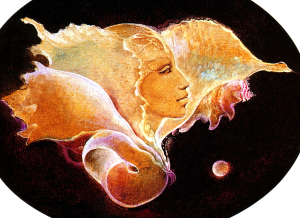 Aphrodite becomes the most beautiful among the goddesses, and her appearance immediately awakens desire.
Many gods want her as their wife. Aphrodite’s beauty itself becomes a source of rivalry because she cannot simply be regarded neutrally.
And here one of the most interesting characteristics of her mythology begins to emerge: Aphrodite does not so much pursue attention as become the center of attention.
Her power differs from that of goddesses who act through authority, strategy, motherhood, or independence. Aphrodite operates differently.
She appears – and the space around her begins to change.
Aphrodite and Hephaestus: A Marriage Arranged by the Gods
When many of the Olympians begin competing for Aphrodite, the possibility of conflict arises. In some versions of the myth, Zeus decides to determine her fate himself and gives Aphrodite in marriage to Hephaestus – the master craftsman of Olympus, creator of the gods’ weapons, palaces, and extraordinary works of art, but also lame and far removed from the traditional ideal of physical beauty.
Another legend is connected with this story.
Hephaestus, after coming into conflict with his mother Hera, once creates a magnificent golden throne. But the throne is a trap: when Hera sits upon it, invisible bonds prevent her from rising. The goddess can only be released after Hephaestus returns to Olympus.
In some traditions, Zeus promises him Aphrodite as a reward. In others, Hephaestus is given the right to choose his own reward for freeing Hera.
In either case, the outcome is his marriage to Aphrodite.
Yet her marriage does not stop the force of desire or become a limitation on her freedom of action.
Aphrodite’s lover becomes Ares, the god of war.
And their relationship leads to one of the most famous scenes in Olympian mythology.
Aphrodite and Ares: Hephaestus’s Invisible Net
Hephaestus discovers the affair and decides to catch the lovers.
He creates an extraordinarily fine, almost invisible net that cannot be broken and places it around the marriage bed. When Aphrodite and Ares come together, the net closes around them.
Hephaestus summons the other gods to witness the trapped lovers.
He wants them to see Aphrodite’s shame.
But something unexpected happens.
Instead of condemning the goddess, the gods become captivated by her beauty. They see Aphrodite naked beside Ares and, according to the myth, rather than mocking them, begin to envy Ares and wish they were in his place.
This detail is important because otherwise the scene can easily be reduced to the simple idea that Aphrodite’s power lies in the perfection of the female body.
But the myth suggests something more.
Nakedness here becomes an extreme form of openness, while Aphrodite’s beauty is not merely a characteristic of her body but an ability to capture attention.
In a contemporary psychological reading, we might see here the force of a deeply attractive feminine presence – an energy that makes another person look, feel, and respond, making indifference almost impossible.
And this does not necessarily depend on conforming to any particular standard of physical appearance.
In mythology, Aphrodite represents a sense of feminine fullness and presence that can be felt throughout the whole person.
It is the energy of desire through which someone becomes noticeable even before they speak or act.
We do not know what Aphrodite herself felt at the moment when Hephaestus attempted to humiliate her before the other gods. The ancient myth does not give us enough grounds to claim that she consciously displayed her power or deliberately responded to what was happening.
But the story tells us something else: even when placed in a situation intended to humiliate her, Aphrodite does not cease to be Aphrodite.
Hephaestus wanted to humiliate her and make her feel guilty. Instead, everyone once again witnessed her power.
The Children of Aphrodite: Love, Fear, Terror and Harmony
Aphrodite’s relationships with other gods give birth to a number of figures who themselves become independent forces within the mythological world.
According to one tradition, Aphrodite and Ares have three children: Harmonia, Phobos, and Deimos.
Phobos is associated with fear, Deimos with terror and dread, while Harmonia represents an entirely different outcome – the union of two powerful forces, love and war.
Aphrodite and Hermes have a child, Hermaphroditus, a deity who combines characteristics of both parents. In later interpretations, the figure becomes associated with androgyny and the union of masculine and feminine qualities.
Eros occupies a special place.
His origins in ancient mythology are ambiguous. In Hesiod, Eros is one of the primordial cosmic forces, existing before the Olympians. In other traditions, he appears alongside Aphrodite, while in later traditions he becomes her son.
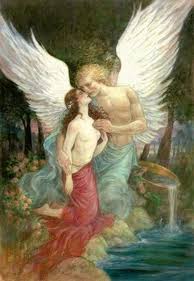 The familiar image of a small winged boy with a bow and arrows therefore represents a later development of the ancient figure of Eros, particularly in the Roman tradition of Cupid.
Anteros is also associated with Aphrodite and Eros and represents reciprocal love or, in some traditions, unrequited love.
These figures become particularly interesting when we later approach the myths psychologically. They seem to reveal some of the forces that can arise around love: attraction, reciprocity and its absence, fear, terror, harmony, and the union of opposites.
But it is important to remember that this is a modern reading of ancient mythology. The ancient myths were not written as psychological treatises.
The Judgment of Paris and the Golden Apple
One of Aphrodite’s most famous stories begins with a golden apple.
At the wedding of Peleus and Thetis, Eris, goddess of discord, appears after not being invited to the celebration. She throws among the guests a golden apple inscribed with the words “to the fairest.”
Three goddesses begin competing for it: Hera, Athena, and Aphrodite.
Zeus does not want to decide who deserves the apple himself, so Paris, a Trojan prince who is living at the time as a shepherd, is chosen as judge.
Each goddess offers him a reward.
Hera promises power.
Athena offers military glory and victory.
Aphrodite promises him the love of the most beautiful woman on earth.
Paris chooses Aphrodite.
That woman is Helen, the wife of the Spartan king Menelaus.
Paris’s choice reveals another dimension of Aphrodite’s power: when a person follows desire and chooses love, that choice inevitably encounters a reality in which other people’s feelings, commitments, rivalries, and consequences exist.
Personal desire becomes the cause of a much larger conflict.
The love that Paris chooses as the greatest gift becomes connected with the struggle for Helen, the destruction of previous alliances, and the Trojan War.
The myth seems to remind us that choosing love means not only receiving what we desire, but also accepting the power of the consequences that follow from our choices.
Where genuine desire arises, there is also the necessity of choosing, acting, struggling for what matters, and encountering what that choice changes in our lives.
Aphrodite and Mortals
Aphrodite’s stories are not limited to the world of the Olympian gods.
Her mythology repeatedly intersects with the lives of mortal men and women.
One of her lovers is Anchises, a handsome shepherd whom the goddess encounters on the slopes of Mount Ida. Aphrodite takes the form of a mortal woman and seduces him.
Later she reveals her true nature and tells him that she will bear him a son, Aeneas, who is destined to become a great hero.
But Anchises does not keep the secret. He begins boasting about his relationship with the goddess and is severely punished for it.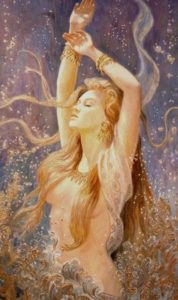
Another of Aphrodite’s lovers is Adonis, a beautiful young hunter.
Aphrodite warns him about the dangers of hunting, but Adonis loves risk too much. During a hunt, a great boar attacks him and mortally wounds him.
Different versions of the myth attribute his death to different gods, including Artemis or Ares.
After his death, Adonis is permitted to return from the underworld to Aphrodite for part of each year. His story therefore becomes associated with the ancient idea of death and return, loss and renewal.
Pygmalion: When Desire Creates an Image
Aphrodite also has a very different story – the story of Pygmalion.
A sculptor creates an ivory statue of a woman who embodies his idea of perfection. The more he looks at his creation, the more deeply he falls in love with it.
He turns to Aphrodite.
And the goddess answers his prayer.
The statue comes alive.
Pygmalion is given the possibility of union with the woman he first created in his imagination.
This is one of the most beautiful stories associated with Aphrodite because here desire is connected not with destruction or suffering, but with love and the creation of new life.
What existed first only in the imagination of a human being takes form and becomes part of reality.
In this myth, the creative power of Aphrodite becomes particularly visible: love does not only unite; it can bring what has been created to life and give it the force of embodiment.
When a person truly loves what they create, when desire arises not from empty whim but from something deeply felt within, what they create can cease to be merely an image and become a living part of their world.
Aphrodite seems to give love the power to transform an inner vision into reality and, through love, to create new life.
Psyche and Eros: A Love That Must Become Adult
But among all the stories associated with Aphrodite, the story of Psyche perhaps reveals her transformational nature most clearly.
Psyche was a mortal girl of extraordinary beauty. People began treating her almost as a goddess and calling her a second Aphrodite. They admired her so intensely that they stopped honoring Aphrodite herself.
Aphrodite became angry.
She decided to punish Psyche and turned to her son Eros, commanding him to make the girl fall in love with the ugliest man alive.
But the opposite happened.
When Eros saw Psyche, he fell in love with her himself.
Thus begins a story that moves through love, secrecy, trust, the breaking of a prohibition, loss, and trials.
Psyche was so beautiful that her father could not find a husband for her. He consulted an oracle and received a terrible prophecy: the girl must be taken to the top of a mountain and left there to meet the husband destined for her.
Psyche is taken to the mountain and waits for her fate.
But instead of death, Zephyrus, the west wind, arrives and carries her away to a beautiful place.
There she finds a magnificent palace.
During the day Psyche is alone, but at night an unknown husband comes to her. He loves her, speaks with her, and lies beside her, but he does not allow her to see his face.
She lives in luxury, surrounded by invisible servants, and gradually becomes accustomed to this strange form of love.
Only one condition remains unchanged:
she must never try to discover who he is.
Psyche is happy, but her sisters become jealous of her. They persuade her that her mysterious husband may not be a beautiful lover at all, but a terrifying monster who will eventually destroy her.
Doubt enters her heart – the kind of doubt that can begin to erode love and harmony.
And one night Psyche breaks the prohibition.
She hides a lamp, waits until her husband is asleep, and illuminates his face.
There is no monster before her.
It is Eros, the god of love.
Psyche is overwhelmed by his beauty. But then misfortune strikes: a drop of hot oil falls onto Eros and wakes him.
He realizes that Psyche has broken her promise.
Eros leaves.
And with him, her former life disappears.
Psyche begins searching for him.
She visits temples, travels, and attempts to recover the love she has lost. Eventually she finds herself before Aphrodite.
And here another part of the story begins.
Aphrodite is no longer simply the goddess angry with a mortal girl.
She becomes the one who leads Psyche through trials and transformation.
Aphrodite gives her four tasks, each of which initially seems impossible.
Psyche must sort a huge mixture of grains. Ants come to her aid.
She must obtain golden wool from fierce rams. She learns when and how to approach danger.
She must fill a vessel with water from an inaccessible source. An eagle helps her.
But the final task is the deepest.
Aphrodite sends Psyche into the underworld – to Persephone – to obtain a portion of her divine beauty.
Psyche must enter the underworld, complete the task, and return.
This part of the myth introduces another important image: Persephone, queen of the underworld and guardian of the boundary between life and death.
In a psychological and symbolic reading, this episode is especially significant. Psyche must descend into a place human beings instinctively resist looking toward, encounter the experience of death, and then return to the light.
Persephone here can be understood as another aspect of the feminine mystery that allows Psyche herself to approach different dimensions of feminine experience.
And Psyche completes the task.
Yet even after returning, she cannot completely escape her human nature.
Given a box containing divine beauty, she opens it out of curiosity and falls into a deathlike sleep.
Eros finds her and restores her to life.
Eventually Zeus makes Psyche immortal, and she is united with Eros not simply as a mortal girl in love, but as a woman who has passed through the trials of love and grown through them.
And here what Aphrodite does to Psyche becomes particularly important.
She does not simply punish her.
She forces her to grow inwardly, transforming infatuation and passion into a more mature form of love.
Each trial requires Psyche to develop a new capacity: to distinguish, to wait, to see beyond immediate emotion, to tolerate danger, to act independently, to descend into depth, and to return.
In a psychological reading, Aphrodite therefore becomes a transformational guide for her.
Psyche’s love must cease to be only an experience of passion and become the capacity to withstand the reality of love.
This is why the story can be read as a story of the development of mature, conscious love.
Aphrodite as a Transformative Force
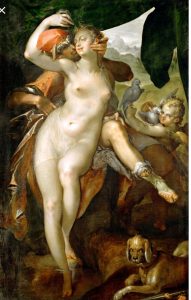 Aphrodite is one of the most powerful transformative forces encountered throughout these myths. Again and again, she enters a story and something changes – not only one person, but the entire field of relationships and events around them.
Paris encounters her and makes a choice that changes the fate of Troy.
Pygmalion receives the embodiment of his desire.
Anchises encounters the goddess and becomes the father of Aeneas, yet betrays her trust and suffers the consequences.
Adonis becomes part of a story of love, death, and return.
Atalanta changes the course of her destiny through the golden apples.
Psyche passes through love, loss, the underworld, and a series of trials and emerges immortal.
Even where Aphrodite brings tragedy, her presence becomes a turning point after which life cannot simply return to what it was before.
This is the distinctive quality of Aphrodite as a transformative goddess.
She does not leave a person as she found them.
And this is not limited to women.
The myths of Aphrodite repeatedly show men who are changed by their encounter with her force: they begin to desire, choose, create, risk, compete, become jealous, suffer, create, cross boundaries, and face consequences when they betray love.
But the pattern becomes particularly interesting in the stories of women, where Aphrodite’s influence can be understood in many ways as teaching them about love for themselves and for life through freedom of choice and through the many forms that love can take.
Psyche passes through trials.
Atalanta encounters a choice between her former independence and relationship.
Myrrha is destroyed by the force of forbidden desire.
Phaedra is overwhelmed by a desire for which she cannot find a safe way of relating.
In this way, Aphrodite becomes a force that moves a person out of a previous state of being.
And this is why an encounter with Aphrodite can be both beautiful and dangerous.
Phaedra and the Rejection of Love
The story of Phaedra is especially important in this regard.
Hippolytus has devoted himself to Artemis and rejects love as a life force. He takes a vow of chastity and openly refuses to honor Aphrodite.
In response, the goddess causes Phaedra to fall in love with him.
The events lead to tragedy: Phaedra cannot bear the intensity of her passion, Hippolytus rejects her, she takes her own life and leaves a false accusation that ultimately leads to Hippolytus’s death as well.
On the literal level of the myth, this may appear to be a terrifying story of revenge.
But there is another layer.
In the world of Aphrodite, as in our own, rejecting love is not necessarily a neutral act.
This does not mean that every person must fall in love or enter relationships. Nor does it justify violence, obsession, coercion, or the violation of another person’s boundaries.
It points toward something else: the attempt to remove entirely from human life the forces of love, desire, sensuality, and connection by declaring them insignificant or unworthy.
The myth presents this denial of one of the fundamental human forces as dangerous.
Phaedra becomes a tragic figure not because love must always be accepted, but because in this story love becomes so suppressed, rejected, and distorted that it returns in destructive form.
Here Aphrodite reminds us of herself not as a gentle goddess of pleasure, but as a force that cannot simply be declared nonexistent.
What Aphrodite Left Us
When all these stories are brought together, what emerges is far from a sentimental goddess of love.
Aphrodite leaves behind not simply an image of a goddess of beauty, but a particular relationship to life itself – to desire, love, the body, beauty, creativity, and the inner force that makes a human being feel alive.
Aphrodite never exists only within the realm of what is proper and convenient. She appears wherever genuine desire arises, and this is why her stories are repeatedly connected with choice – a choice that can ultimately lead either toward profound love or toward suffering and even death.
She knows what she wants and does not try to convince herself that what is merely reasonable, safe, or socially acceptable should be enough.
In this sense, Aphrodite is one of the few goddesses who does not abandon her own desire simply to satisfy the expectations of others.
She chooses love.
Not wealth instead of love.
Not status instead of love.
Not convenience instead of love.
Not a life that looks right from the outside but has long since stopped feeling alive within.
This does not mean that Aphrodite always chooses the easy path or that her choices always lead to happiness. On the contrary, the myths of Aphrodite show how destructive desire can become when it is separated from mature love.
But this is precisely why her image is so far removed from sentimental ideas about love.
Love here is not a promise of happiness.
It is a force capable of changing a person, making them see themselves differently, abandon what they once believed, and move toward what genuinely matters to them.
Aphrodite does not hold on to a form simply because she once chose it. She can change when life requires change. She can leave when a connection is no longer alive. She can move closer when genuine attraction arises.
She does not try to make her feelings convenient for everyone else, nor does she turn her own desire into an endless negotiation with the world around her.
There is one of the deepest qualities of her image: Aphrodite does not separate life itself from the desire to live.
She reminds us that simply existing is not enough – fulfilling obligations, conforming to our age, status, or role is not enough.
At some point, we need to ask ourselves:
What truly draws me?
What makes me feel more alive?
What do I genuinely love?
What in me wants to be expressed?
Where has my life become too correct, too proper, too acceptable – and stopped being alive?
This is why Aphrodite is connected not only with love between people.
Her force appears in creativity, beauty, embodiment, the capacity for pleasure, the courage to express oneself, and the willingness to allow life to affect us.
She restores sensitivity – the ability not simply to know but to feel; not merely to choose with the mind, but to listen to what is happening more deeply within.
And at the same time, Aphrodite leaves us with an important warning.
Desire does not always know boundaries.
Love is not always rational.
Attraction can elevate a person, but it can also deprive them of clarity.
Therefore, a mature relationship with Aphrodite is neither worship of desire nor an attempt to follow every impulse.
It is the ability to acknowledge one’s desire without automatically giving it power over one’s entire life.
This is where Aphrodite becomes especially profound.
She does not teach us to abandon passion in favor of control.
But neither does she invite us to dissolve into passion.
She asks us to encounter the part of ourselves that wants, chooses, feels attraction, experiences pleasure, creates, and is capable of changing the direction of our own lives.
And so Aphrodite leaves us not with a ready-made formula for love, but with a much more difficult question:
How alive is your own life, and how capable are you of choosing what you truly love?
Because love in the myths of Aphrodite is not only a feeling toward another person.
It is a force that returns a person to themselves – to their desire, their capacity to feel, and their ability to choose.
And when a person encounters this force genuinely, it no longer allows them to continue living exactly as they lived before.
After encountering Aphrodite, a person is no longer quite the same.
This is why Aphrodite is not simply a goddess of beauty or love.
Her power lies in attraction – the force that captures attention, awakens desire, and compels a person to choose.
And her deepest power lies in transformation.
Sometimes that transformation happens through love.
Sometimes through loss.
Sometimes through creativity.
Sometimes through suffering.
Sometimes through an encounter with one’s own beauty and desire.
But an encounter with Aphrodite almost always becomes a passage from one state of life into another.
And perhaps this is why this ancient image continues to resonate so strongly with the modern human being.
Because at some point in life, each of us encounters something that cannot simply be ignored: love, beauty, desire, a creative impulse, a powerful attraction, or a person beside whom the familiar picture of our own life suddenly begins to change.
This is the space Aphrodite creates.
And if mythology tells us the story of a goddess who changes the destinies of gods and mortals, archetypal psychology invites us to take the next step and ask:
What happens when Aphrodite awakens within a woman herself – and which parts of her life begin to change as a result?
This is explored in the article “Aphrodite as Archetype: Love, Desire, Sensuality, Creativity and Life Force.”
And for a deeper exploration of how this archetype manifests not in myth but in the lived experience of women – in love, relationships, creativity, embodiment, choice, and different stages of life – see “Living Aphrodite: Love, Relationships, Creativity and the Feminine.”
Meet Aphrodite Beyond the Myth
Sometimes archetypes become truly understandable not when we read about them, but when we begin noticing them in our own lives.
At the AMOREI women’s retreat I Am Goddess in Costa Rica, we explore different dimensions of feminine experience through goddess archetypes, embodiment, creativity, relationships, sensuality, nature, mindfulness practices, and connection with other women.
This is not an attempt to determine “which goddess you are,” nor is it a requirement to fit yourself into any particular archetype.
It is an opportunity to encounter different aspects of yourself and notice which ones are already alive within you, which may need more space, and which may have been waiting for a long time to return.
If you are interested not only in reading about Aphrodite but in exploring your own inner Aphrodite through experience, practice, and the living space of a women’s circle, you can learn more about the Costa Rica retreat I Am Goddess.
And perhaps the most important thing ancient mythology leaves us with is the image of a force that captures attention and changes the direction of human life.
Before Aphrodite, it is impossible simply to remain an observer.
Once we encounter her, we have to respond in some way to our own desire, to beauty, to attraction, to choice, and to the consequences of what we choose.
This is why, thousands of years later, Aphrodite continues to live not only in ancient stories, statues, and paintings, but also in the human imagination as one of the most powerful images of love, beauty, and the force of desire.