Hecate and the Statue of Liberty: Who Stands at the Gates of America?
On the Goddess Who Guards the Boundaries Between Worlds, the Awakening of Divine Feminine Power, and the Mystery of the Human Soul
In New York Harbor, on a small island at the entrance to one of the world’s most famous cities, rises a magnificent statue of a woman. Her gaze is directed toward the horizon, and a torch is raised high above her head. For nearly a century and a half, this figure has welcomed ships, travelers, and people arriving on the shores of America.
For millions of people, the Statue of Liberty has become a symbol of hope, liberation, and the possibility of beginning a new life. Yet when I look at her, I see something more.
I see the ancient Goddess Hecate.
What interests me is not which particular deity the sculptor intended to portray. I am drawn to what reveals itself beyond the monument’s official name when we begin to perceive it through the language of ancient symbols and our own spiritual experience.
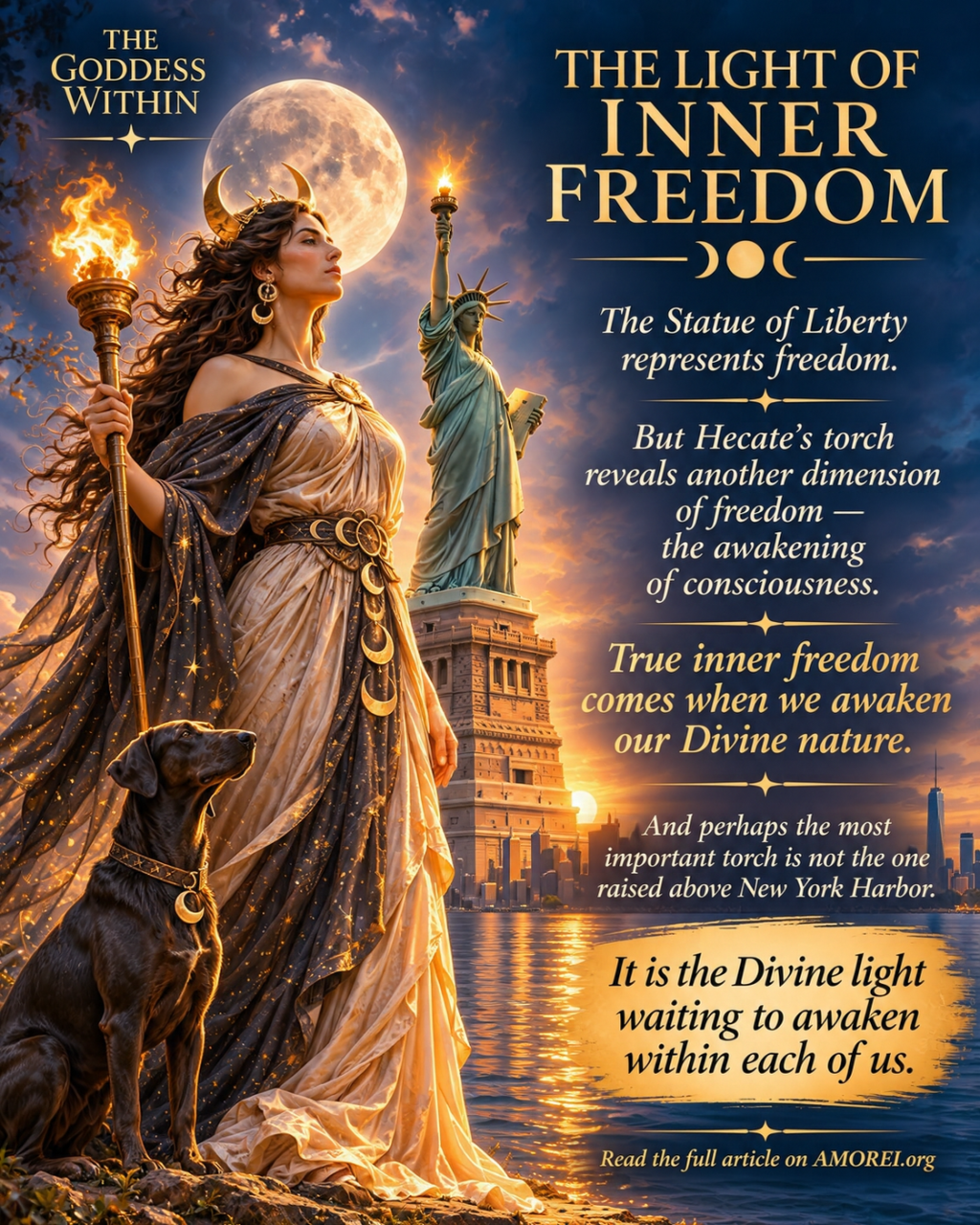
The stone figure of a woman rises at the entrance to the New World. She welcomes people at the boundary between sea and shore, between the journey left behind and an unknown future. In her hand burns a torch, raised so high above her head that its light seems to reach not only human eyes but also the souls searching for direction.
In the ancient Greek tradition, Hecate is the guardian of roads, crossroads, entrances, and passages between worlds. She is depicted carrying torches that illuminate the path through darkness. People turn to her for protection where familiar territory ends and the unknown begins.
This is why the image of a Goddess holding a torch at the gates of America awakens in me such a profound sense of Hecate’s presence.
But there is another remarkable detail in this story.
A Woman with a Torch Above an Ancient Fortress
The Statue of Liberty was a gift from France to the United States, celebrating friendship and the ideals of freedom. It was created by the French sculptor Frédéric Auguste Bartholdi and officially dedicated on October 28, 1886.
The monument’s official name is Liberty Enlightening the World. Its imagery is associated with the ancient tradition of portraying liberty in female form, particularly the Roman goddess Libertas.
Yet the location chosen for the statue has a history of its own.
The monument stands within the walls of Fort Wood, an old military fortification shaped like an eleven-pointed star, built in the early nineteenth century to defend New York Harbor.
Long before the monument appeared, this island was part of the city’s defensive system. A fortress stood here to protect the maritime entrance to New York.
There is something remarkable in this combination: once, the entrance to the harbor was guarded by the walls of a military fort. Now, above those walls rises a female figure holding a torch — an image in which I recognize Hecate, the ancient Divine Guardian of gates and boundaries, as though she continues to protect this place through a different kind of power.
Thirty years after the statue’s dedication, an event occurred near the island that brought the military history of this location back into focus.
On the night of July 30, 1916, while the First World War was already raging in Europe, a massive explosion occurred at the Black Tom ammunition depot in New York Harbor. The explosion was later linked to German sabotage directed against shipments of weapons to Germany’s European enemies.
The blast was so powerful that it damaged buildings and structures throughout the harbor, including the Statue of Liberty itself and the old fortifications of Fort Wood. The shock wave was felt far beyond the island.
Yet the female figure with her raised torch remained standing.
And here a question arises for me — one that historical documents alone cannot answer.
What if the Divine power of Hecate truly is present in this image? What if her protective presence played a part in the statue’s survival during that devastating explosion?
For some, this will remain a beautiful coincidence. For others, a symbol of the indestructibility of freedom. But for someone who perceives the Goddess as a living, conscious Divine being, this story may open the possibility of an entirely different understanding of what happened.
We are not always able to determine where the visible sequence of events ends and the influence of forces we do not yet know how to recognize begins.
This is why I am drawn to a perspective that might be expressed as possible, though not evident.
I do not claim to know how Hecate might have manifested herself that night. But neither do I believe that the absence of a conventional explanation necessarily excludes the possibility of Divine presence.
Especially when we are speaking of a Goddess revered for thousands of years as the guardian of entrances, roads, and boundaries between worlds.
Hecate’s Torch and the Awakening of Kundalini
In my meditations, a particular meaning of the torch raised above the Goddess’s head has been revealed to me.
I perceive it as a symbol of awakened Kundalini — the Divine energy that rises within a human being and opens the possibility of a higher state of consciousness.
In Indian spiritual traditions, Kundalini is described as a latent energy residing at the base of the human body. Its awakening and ascent are associated with profound inner transformation and the expansion of consciousness.
For me, the spiritual meaning of this movement is especially significant: Divine Power rises from its hidden state into fully conscious presence.
This is how I perceive the raised torch of the Statue of Liberty.
The light is above the head. It is no longer concealed within but has unfolded and become visible.
And another thought arises: perhaps the Goddess standing at the entrance to the New World is calling upon the people of this new world, through her raised torch, to awaken their own Divine Kundalini energy. To awaken their consciousness, remember their spiritual nature, and open the way toward a higher understanding of freedom.
In ancient depictions, Hecate often carries torches that illuminate the road. In the myth of Demeter and Persephone, she appears with light in her hands when the search for the missing daughter begins.
A torch makes it possible to see where ordinary light is insufficient. In spiritual experience, it becomes a symbol of inner awakening — the ability of consciousness to perceive what was previously hidden.
Hecate is present at the boundary between the known and the unknown, where a person cannot yet see the entire road but already feels the need to move forward.
Her light does not remove the need to walk one’s own path. It makes that path possible to see.
Hecate — Guardian of Worlds and Guide of Souls
In ancient Greek mythology, Hecate occupies an unusual position between different realms of existence.
She is associated with the earthly world, celestial powers, and the underworld. Her presence is found at roads, gates, crossroads, and boundaries — wherever one realm meets another.
Her participation in the story of Demeter and Persephone is particularly revealing.
When Persephone disappears after being abducted by Hades, Demeter sets out in search of her daughter. Hecate hears her cry and comes to meet her with torches in her hands. Later, after Persephone’s return, Hecate becomes her companion, accompanying the Goddess whose destiny is connected with both the realm of the living and the underworld.
In this myth, Hecate is present beside one of the deepest mysteries of ancient religious consciousness — the passage between life and death, disappearance and return, earthly existence and the invisible world.
Over time, her image becomes increasingly associated with invisible realms, spirits, and the paths traveled by souls. In later ancient religious philosophy, she acquires the significance of a Divine power connecting different levels of the cosmos.
Yet for me, the meaning of a guide of souls extends far beyond accompanying a soul after physical death.
Human life is filled with transitions.
Birth itself is a passage from one state of existence into another. Growing up changes our perception of the world and our place within it. Love can reveal unknown dimensions of the soul. The loss of someone close to us can forever transform our relationship with life. Sometimes a moment arrives when the identity formed through years of experience no longer corresponds to the person we are becoming.
We may continue living in the same house, doing the same work, and interacting with the same people, while inwardly already standing at the threshold of an entirely different world.
In this sense, Hecate becomes, for me, the Goddess who accompanies not only passages between worlds but also transformations of human consciousness.
She is present at the point where the soul is ready to move beyond its former understanding of itself.
This is why her ancient association with crossroads carries such profound significance. A crossroads is a meeting place of different possibilities, where every road offers its own experience and every direction may change the course of a person’s life.
Yet sometimes the most important crossroads lies within us.
Divine Feminine Power and the Infinity of Its Manifestations
Hecate appears before us in many forms. She guards the boundaries between worlds, accompanies souls, carries light into darkness, opens access to hidden knowledge, and is present wherever one road ends and another begins. In ancient representations, she has three faces looking in different directions, as though she can perceive several paths simultaneously and see what remains hidden from human sight.
But this raises a question: if one Goddess can manifest through so many different qualities and forms, what is the nature of Divine Feminine Power itself? And how is Hecate connected with the other Goddesses whom humanity reveres across different spiritual traditions?
For me, the answer lies in the understanding of a single Divine Source that manifests itself through an infinite multitude of independent, conscious Divine beings. Each possesses her own individuality, qualities, and unique way of interacting with the world, while remaining part of one Divine reality.
We find an interesting parallel to this understanding in Indian spiritual traditions, particularly in Shaktism, where there is the concept of Adi Shakti — the primordial Divine Feminine Power underlying all manifested existence.
In this tradition, different Goddesses may be understood as manifestations of one Shakti. Durga, Kali, Lakshmi, Saraswati, and other Divine forms reveal different qualities and possibilities of this primordial Power. At the same time, each has her own image, character, and particular significance for those who enter into spiritual relationship with her.
This is where I see the connection with Hecate.
I am not suggesting that the ancient Greeks called Hecate Adi Shakti, or that these two religious traditions historically described the same Goddess. I am speaking of a deeper spiritual understanding: if the Divine Source is one, then Hecate and the Goddesses of the Indian tradition may be perceived as different conscious manifestations of a single Divine nature.
In my perception, Hecate exists as an independent Divine being, possessing her own individuality and particular qualities. Her connection with the one Source does not make her any less real or independent, just as a person’s belonging to humanity does not erase the uniqueness of that individual’s identity.
And here we return to Hecate’s many faces.
The three faces through which she is depicted help us approach an understanding of her ability to be present at different boundaries and perceive many directions at once. But can Divine consciousness truly be limited to three faces, or to the number of qualities that human beings have managed to recognize and name?
Perhaps every image of the Goddess known to us reveals only a small part of her infinite nature.
We know Hecate as the guardian of crossroads, the guide of souls, the protector, and the bearer of hidden knowledge. Yet beyond these familiar images, there may exist an infinite multitude of other manifestations of her consciousness that have not yet revealed themselves to human perception.
In this understanding, Hecate’s many-faced nature takes on a much deeper meaning. It reminds us of the infinity of the Divine itself — of how the one Source can manifest through many independent Divine beings, while each of them, in turn, may reveal countless dimensions of her own nature.
Thus, for me, Hecate becomes not only the guardian of boundaries between worlds but also one manifestation of the great mystery of Divine consciousness, infinite in both its unity and its diversity.
How Hecate Manifests in a Woman
There is another dimension of this subject that I find especially important.
If Divine powers can manifest through human consciousness, how do the qualities of Hecate unfold within a woman?
In modern depth psychology, goddess archetypes are understood as particular patterns of inner experience, behavior, and personal development. Jean Shinoda Bolen explores goddess imagery in relation to women’s psychology and pays special attention to the changes that take place in maturity.
Yet Hecate’s manifestation within a woman can also be understood through spiritual interaction with a living Divine power.
Across different cultures, there are women whose work is directly connected with transitions between the most significant states of human existence.
Midwives accompany the arrival of new life. Birth doulas support women through pregnancy and childbirth, creating an atmosphere of care, trust, and presence.
There are also end-of-life doulas — women who accompany dying people and their loved ones as death approaches. They help individuals experience the final stages of earthly life with dignity, attention, and compassion.
These two seemingly opposite forms of service share a remarkable quality: the ability to remain present with another human being at the moment of transition between worlds.
Birth and death are two great boundaries of human existence.
And a woman who accompanies another person at these boundaries becomes a kind of guide.
In this, we can recognize one of Hecate’s qualities.
But her manifestations are not limited to birth and death.
In ancient cultures, herbalists, healers, wise women, and those who possessed knowledge of plants, natural cycles, and traditional rituals held a special place. People turned to them for help during illness, childbirth, difficult life circumstances, and spiritual searching.
Women who practice magic and spiritual rituals may also experience Hecate as a Divine power close to them, associated with hidden knowledge, protection, and interaction with invisible realms.
History also tells of women to whom extraordinary intuition, clairvoyance, and the ability to perceive what lies beyond ordinary human awareness have been attributed.
One of the best-known examples is the Bulgarian seer Baba Vanga.
If we approach her biography through the language of archetypes, an interesting sequence emerges: a profound life upheaval, the loss of sight, a deep transformation in her perception of the world, and the subsequent emergence of abilities that others regarded as extraordinary.
In a symbolic reading, her early life experience can be compared with the theme of Persephone — a soul passing through profound transformation. Her later image as a seer to whom people came for guidance and help recalls certain qualities of Hecate — the guardian of hidden knowledge and a guide at life’s crossroads.
This does not mean that we can establish with certainty the spiritual nature of Vanga’s abilities or determine which particular Divine power manifested through her. But such a comparison helps us recognize how mythological images may illuminate different dimensions of human experience.
At the same time, Hecate does not manifest only through unusual abilities or spiritual practices.
Her qualities may unfold within a woman who has learned to understand life deeply, recognize moments of change, and accompany others through difficult periods.
Such a woman is capable of perceiving not only external circumstances but also the inner processes behind them. She knows how to listen, remain present in the face of another person’s pain, and help someone discover their own direction.
This ability often develops through life experience, although age alone does not guarantee wisdom.
Hecate may manifest within a woman at any age, whenever her consciousness becomes ready to interact with the corresponding qualities of Divine power.
And here it is especially important to remember the many-faced nature of the Goddess.
A woman may simultaneously express the love of Aphrodite, the wisdom of Athena, the nurturing presence of Demeter, and the deep knowledge of Hecate. Each Divine power reveals particular qualities, and their interaction enriches human nature.
In this understanding, Hecate becomes part of the living process through which the Divine unfolds within a woman — through wisdom, intuition, the ability to accompany transitions, and the willingness to continue her own journey of spiritual discovery.
Who Stands at the Gates of America?
My thoughts return once again to the Statue of Liberty.
The female figure rises at the entrance to a vast country, holding a torch high above her head. Behind her lies the city; before her stretches the ocean, across which generations of people have arrived, leaving their former lives behind.
For some, this statue has become a symbol of liberation. For others, a promise of hope for the future. For still others, a reminder of human dignity and the right to choose one’s own path.
Yet in my spiritual perception, her image opens another dimension.
I see Hecate — the Goddess standing at the boundary between worlds, illuminating the way for those who are ready to move from the known into the unknown.
Her raised torch reminds me of awakened Kundalini, of the Divine energy that rises within a human being and opens the possibility of a higher state of consciousness.
Before me is the image of an enlightened Goddess-Woman, whose awakened Divine energy becomes a light for others. She seems to address the people of the New World, calling upon them to awaken their own spiritual nature, expand their consciousness, and open themselves to the possibility of change for the better.
And then the very idea of freedom takes on a deeper meaning for me.
External freedom gives a person the opportunity to choose the direction of life. Inner freedom emerges as consciousness begins to free itself from its own limitations, fears, habitual beliefs, and identifications.
This movement cannot be completed through a single decision. It continues throughout life, revealing new levels of understanding ourselves and the world.
And each time a person encounters the unknown, they must once again search for their own light.
Perhaps this is why the image of the Goddess holding a torch resonates so deeply within me.
For me, the Statue of Liberty has become a symbol of the many-faced Hecate — guardian of boundaries, guide of souls, and Divine power accompanying humanity on the path of awakening.
And perhaps the most important torch is not the one held by the statue standing at the entrance to New York Harbor.
It may one day be kindled within the human being.
Sources and Further Reading
- Homeric Hymn to Demeter — the myth of Demeter, Persephone, and Hecate’s participation.
- Hesiod. Theogony, lines 404–452.
- Pausanias. Description of Greece, Book II, 30.2.
- Johnston, Sarah Iles. Hekate Soteira: A Study of Hekate’s Roles in the Chaldean Oracles and Related Literature. 1990.
- Bolen, Jean Shinoda. Goddesses in Older Women: Archetypes in Women over Fifty. 2001.
- National Park Service. Statue of Liberty National Monument — the history of the monument and Fort Wood.
- National Park Service. Historical materials on the Black Tom explosion of July 30, 1916.
- Studies of Shaktism, Shakti, and Kundalini in Indian spiritual traditions.