Can We Accelerate Our Soul’s Evolution?
On Free Will, the Soul’s Plan, and the Divine Laws of TIME
There is a paradox I keep returning to as I explore the nature of consciousness, free will, and the Divine laws of TIME.
If each of us has free will, can we truly choose any future we wish?
And if the soul comes into earthly life with a certain plan for its development, how far does our freedom of choice allow us to move away from that original plan?
Could one soul have many possible paths available from the beginning, while another has certain limits it is not yet able to move beyond?
What determines how much change is possible? Is it the experience the soul has accumulated, its level of consciousness, its inner energy, the strength of its intention, or laws we have not yet learned to understand?
And how does our free will interact with the freedom of choice of other people who are part of our lives? Each of them can make a decision that changes not only their own future but also the direction of ours.
If someone manages to change the course of their existence so deeply that they find themselves on an entirely different life path, does this mean they have moved beyond what was originally destined for them? Or was the possibility of making that choice already part of the Divine law of TIME?
For me, this is where one of the most fascinating paradoxes of human evolution begins: can we consciously change the original plan of our soul, and are there any limits to that possibility?
I do not claim to have final answers. These reflections have grown out of many years of exploring spiritual traditions, meditation, personal observation, and a gradually developing understanding of the nature of consciousness.
 This is my own metaphysical view of reality, one that I continue to explore and reconsider. I am interested in finding connections between things we usually examine separately, and in understanding the place of human freedom of choice within this complex system.
TIME, Shiva, and the Space of Possibility
We are used to experiencing time as a movement from the past, through the present, into the future. In this familiar picture, the past has already happened, the present exists for only a moment, and the future is still waiting to be created.
But what if the structure of TIME is far more complex than our linear perception allows us to see?
In philosophy, there are views in which the past, present, and future can be understood as parts of a single structure of reality, all existing together.
In physics, the theory of relativity changed our familiar understanding of time as something that passes in the same way for every observer. Some interpretations of quantum mechanics also allow for multiple possible versions of the same history.
Of course, these scientific ideas do not prove the existence of soul plans, spiritual portals, or the possibility of consciously moving between parallel life paths. But the questions they raise about the nature of time remind us how limited our everyday understanding may be.
In my spiritual worldview, Shiva holds a special place. Among other things, I see Shiva as the Divine principle of TIME.
In Hindu traditions, Shiva has many meanings and cannot be reduced to a single interpretation. Yet it is Shiva’s connection with time, the dissolution of old forms, and the possibility of new creation that helps me reflect on the laws within which consciousness evolves.
I believe Divine TIME may contain far more possibilities than the single sequence of events we experience as our own life.
From this perspective, the future can be imagined as a complex system of potential directions, each connected with certain events, encounters, decisions, and opportunities for development.
But if many possibilities already exist, what determines which one becomes our reality?
This brings us back to free will.
The Soul’s Plan: The Original Intention and Alternative Paths
In esoteric traditions, there is an idea that the soul enters earthly life with a certain plan.
This plan may include opportunities for growth, meaningful encounters, relationships, events, and important milestones through which the soul is meant to gain experience.
I am drawn to the idea that an original plan does exist. However, I do not imagine it as a rigid script in which every detail must happen at a precisely appointed moment.
I tend to see it as a main plan accompanied by many alternative paths. These paths may differ greatly from one another while still carrying some of the same underlying purposes.
Imagine that one of a soul’s main tasks is to develop the ability to love, to trust, to build deep relationships, and to express love in earthly life.
The original plan may have included circumstances in which this ability could develop naturally: a loving family, close relationships, support, and harmonious experiences.
But if circumstances change, the same task may have to unfold in a very different way.
A person may need to learn how to trust again, work through the effects of painful relationships, explore their fears, and gradually discover qualities that might have emerged much more easily under different conditions.
The soul’s task may remain the same, even though the path toward it becomes completely different. And along that alternative path, the soul may not always be able to fulfill what it originally intended.
I also believe that an alternative path can sometimes lead to a deeper understanding than the original one might have offered. But whether this is always the case remains an open question.
Does that mean a more difficult path is necessarily better? I do not think so.
I do not believe spiritual development must require suffering, especially at the present stage of humanity’s evolution.
Perhaps many of the soul’s tasks could be fulfilled through love, joy, creativity, and harmonious relationships, without the need to go through so many painful experiences.
This is why I find it so important to ask what can change the original plan, and how far the consequences of those changes may reach.
Soul Contracts and the Free Will of Others
In esoteric teachings, there is a concept known as soul contracts: supposed agreements between souls to share certain experiences during their earthly lives.
If we consider this idea as one possible model of spiritual reality, we begin to see how complex the interaction between individual life plans could be.
Each soul arrives with its own tasks, yet its life intersects with the lives of many other people.
Parents, children, partners, friends, teachers, and even people we meet by chance are all part of our story. At the same time, each of them is living a story of their own, connected with other people and circumstances.
And each has free will.
Imagine that two souls intended to share a particular experience. But one of them, following their own decisions, fears, attachments, or life circumstances, chooses a direction in which the original agreement is never fulfilled.
After all, when we enter a human body, we do not remember our soul contracts, where we came from, or why we came here.
What happens to the second soul?
Based on my own experience, I believe it may move toward another potential life path that already exists.
The experience it needs may come through another person. The circumstances, timing, or form of that experience may change. A new person may enter the story and serve the same spiritual purpose, even though the actual events unfold very differently.
This creates an incredibly complex web of connections in which one person’s decisions can change the destinies of many others.
And such changes can begin at the very start of earthly life, when a child is not yet capable of consciously choosing the circumstances of their existence.
There is something especially important to recognize here:
One person’s free will can change another person’s life path, even when that second person never chose those changes.
This is why I find it difficult to agree with the idea that everything that happens to us must be the result of our own spiritual choices.
We live among other people, and the consequences of their decisions become part of our reality.
Life Paths: Every Choice Opens a New Direction
Through my own experience, I have come to believe that movement between potential life paths happens constantly.
It does not necessarily require an extraordinary mystical event.
Every decision, every action, every encounter, and every interaction with another person’s free will influences what happens next.
Sometimes the differences between possible paths are almost invisible. We take one road instead of another, postpone a conversation, accept an offer, or turn it down without giving the moment much thought.
There is a film that explores this idea particularly well: Run Lola Run.
But some decisions have consequences that gradually change the course of an entire life.
One encounter leads to a relationship, another to moving somewhere new, and another to a different profession or a completely new understanding of oneself.
Perhaps in each of these situations, we begin living one of the potential paths that previously existed only as a possibility.
I like to compare this system to a computer game with many possible storylines, where each action affects which events become available next.
Human life, however, is far more complex than any game because an enormous number of people are making their own free choices at the same time.
I also do not believe that all possible life paths are equally valuable from the perspective of the soul’s evolution.
Some may bring us closer to our original purpose, while others may take us further away from it. Some open new opportunities for development, while others lead to circumstances in which it becomes increasingly difficult to fulfill our spiritual potential.
And here I want to make an important distinction.
Not every major milestone of the soul is necessarily fulfilled within a single lifetime.
If a life path changes only slightly, an important event may still happen, perhaps through another person or under different circumstances.
But if the change is too great, certain tasks may remain unfinished.
In my worldview, this may be one of the reasons a soul returns to earthly experience again and again.
Why Difficult Experiences Do Not Always Lead to Growth
There is a common belief that we are only given challenges we are capable of handling.
I cannot fully agree with this idea.
Perhaps a particular challenge was indeed part of the soul’s intended plan. Perhaps, on a spiritual level, the soul expected to go through that experience and gain something important from it.
But then earthly life begins.
We are born into human bodies, with human minds, emotions, nervous systems, limits of perception, and a deep dependence on the circumstances around us.
Something that seemed possible on a spiritual level may turn out to be extremely difficult under the actual conditions of human life.
A person may go through an experience so overwhelming that they lose their inner stability for a very long time. Trauma, betrayal, violence, a devastating loss, or prolonged suffering can change more than their circumstances. These experiences can affect their very ability to make decisions.
Sometimes a person gradually recovers, develops a new understanding, and continues to grow.
But sometimes what they have experienced leads to a prolonged period of emotional breakdown, addiction, despair, or a loss of direction in life.
I do not believe that such a state is necessarily what the soul intended.
Even if a difficult experience was part of its original plan, I would understand the purpose of that experience as an opportunity to go through it, gain understanding, and continue moving forward.
Destruction itself, endless suffering, or losing the ability to develop does not seem to me like a spiritual achievement.
At the same time, someone who finds themselves in such a condition does not become less valuable or spiritually unworthy. Trauma and addiction have real psychological, physiological, and social causes. Recovery may require help from others, treatment, time, and supportive circumstances.
This is why I am reluctant to explain another person’s suffering by saying that they somehow chose their own fate.
For me, a much more important question is this: why does an intended plan for spiritual development sometimes prove so difficult for human consciousness that the soul is unable to fulfill its purpose in that lifetime?
The Spiral of Evolution: Growth, Stagnation, and Decline
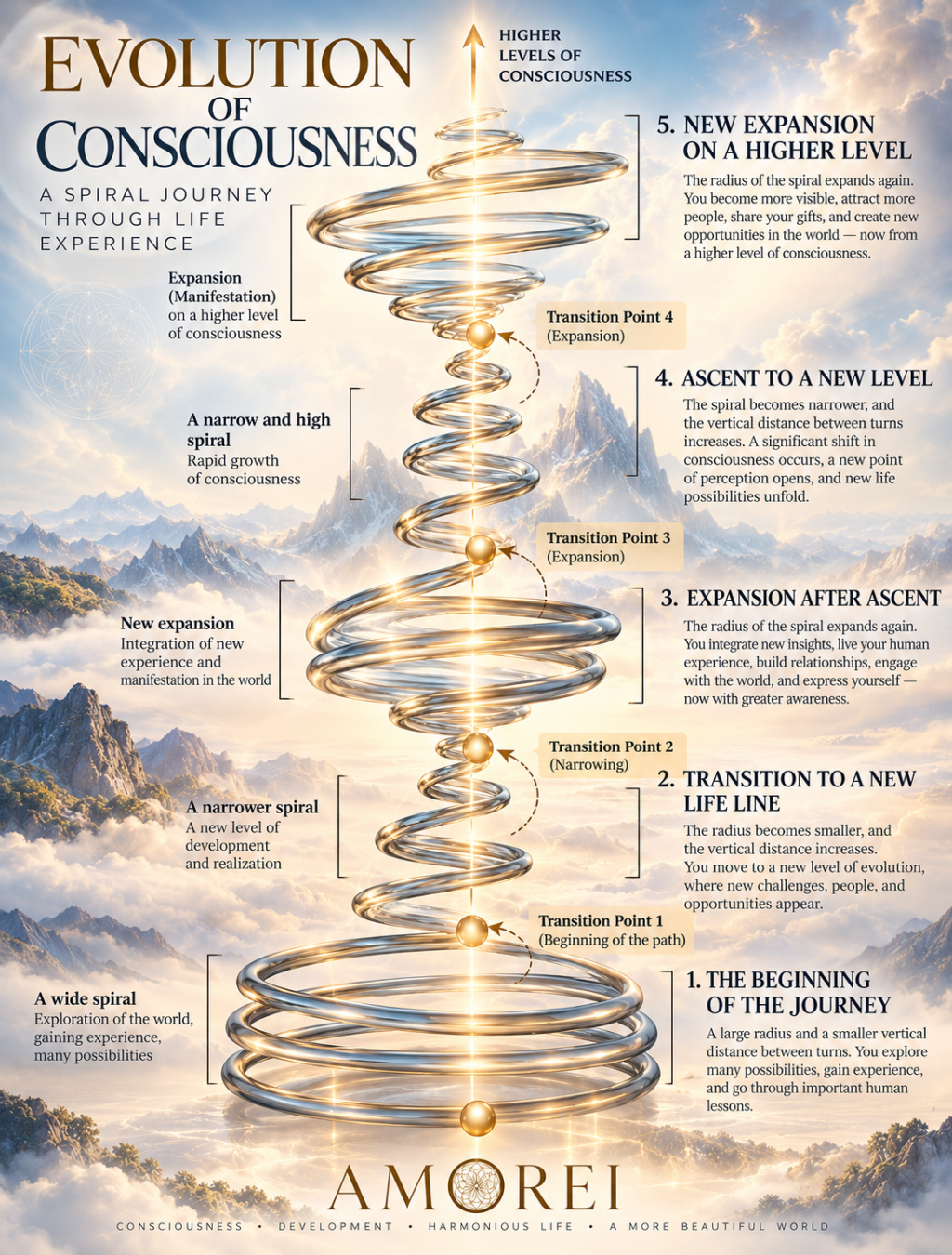
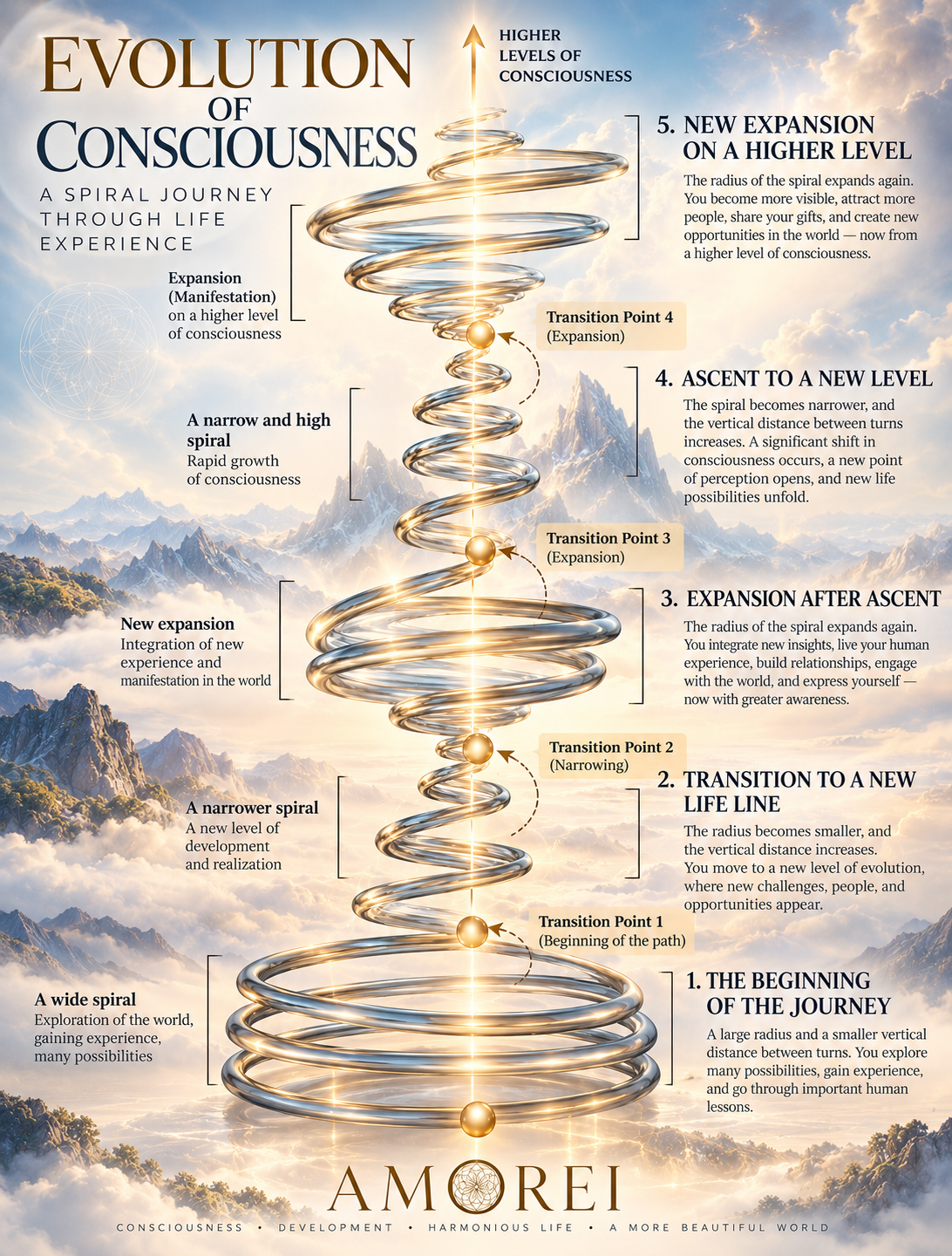
To explain how I understand the evolution of consciousness, I often use the image of a spiral.
Imagine that life unfolds along a spiral path, with the direction and speed of movement influenced by many different circumstances.
Sometimes the spiral rises gradually, almost imperceptibly. A person gains experience, learns, develops inner stability, and expands their understanding of life.
At other times, movement accelerates, and changes that might once have taken many years happen within a relatively short period.
But movement in the opposite direction is also possible.
Under the pressure of difficult events, a person may lose the balance they have achieved and begin moving along a destructive path.
Sometimes this happens so quickly that their entire previous life seems to collapse.
In my metaphysical model, I imagine this as a sudden downward movement along the spiral.
And here we come to a question I consider especially important for understanding samsara.
If the soul comes into earthly life to develop, but circumstances prevent it from fulfilling its purpose, what happens next?
In teachings about samsara, repeated births are connected with the continuing cycle of conditioned existence. In my personal interpretation, one possible reason for returning to earthly life may be that certain tasks of the soul remain unfinished.
I consider it possible that between incarnations, the soul reflects on its previous experience and once again forms the intention to accomplish what it could not achieve before.
But a new incarnation brings human limitations, circumstances, attachments, and the need to interact with the free will of others all over again.
So even a sincere spiritual intention does not guarantee that the task will be fulfilled.
Perhaps this is how some souls return to similar lessons over many lifetimes.
However, this remains a spiritual hypothesis. We cannot reliably determine the reasons behind a particular incarnation, a difficult life, or someone’s death. I do not believe it is right to make such judgments about other people.
For me, what matters most here is the possibility that the evolution of consciousness is not an automatically upward process.
Free will gives us the ability to choose, but it does not guarantee that every choice will contribute to our development.
Can We Consciously Change the Soul’s Original Plan?
So far, we have mainly explored situations in which a person’s life path changes because of circumstances and decisions they may not fully understand or consciously recognize.
But there is another possibility.
What if, at some point, a person consciously decides to move beyond the original plan of their incarnation?
For example, the soul may have intended to reach a certain level of spiritual development, fulfill certain tasks, and continue its evolution in future lifetimes.
But while living this earthly life, the person begins exploring the nature of consciousness and develops the intention to accomplish much more than may originally have been planned.
They begin consciously cultivating awareness, changing familiar patterns of perception, exploring spiritual practices, and gradually freeing themselves from inner limitations.
Sometimes such a decision follows a profound inner experience that completely changes the way a person understands their own life.
Spiritual practices can bring experiences that feel as though they reach far beyond ordinary personal memory. Whatever explanation we give to these experiences, they can lead someone to seriously reconsider their intentions and the direction of their life.
But having an extraordinary experience does not mean that a transition has already taken place.
For me, what matters most is the conscious choice a person makes afterward, and their ability to remain committed to that direction over time.
Can we then say that the soul is trying to move ahead of its own evolutionary time?
I believe this is one of the most fascinating possibilities that free will may offer.
But another paradox appears here.
If such a transition is possible, does it mean that a person can accomplish a task that was originally intended for another incarnation?
Or did a life path already exist within the multidimensional structure of Divine TIME in which this transition was possible?
I tend toward the second possibility. Such a path may have existed as a potential, but that does not mean it was always accessible to human consciousness.
In my view, this kind of transition requires a certain degree of development. I also believe that access to some possibilities may depend on the broader stage of humanity’s evolution.
I consider it possible that human consciousness is now approaching a stage at which transitions once available to only a few may become possible for a much larger number of people.
For now, this remains a spiritual hypothesis that I continue to explore.
An Evolutionary, or Quantum, Leap: Passing Through the Portals
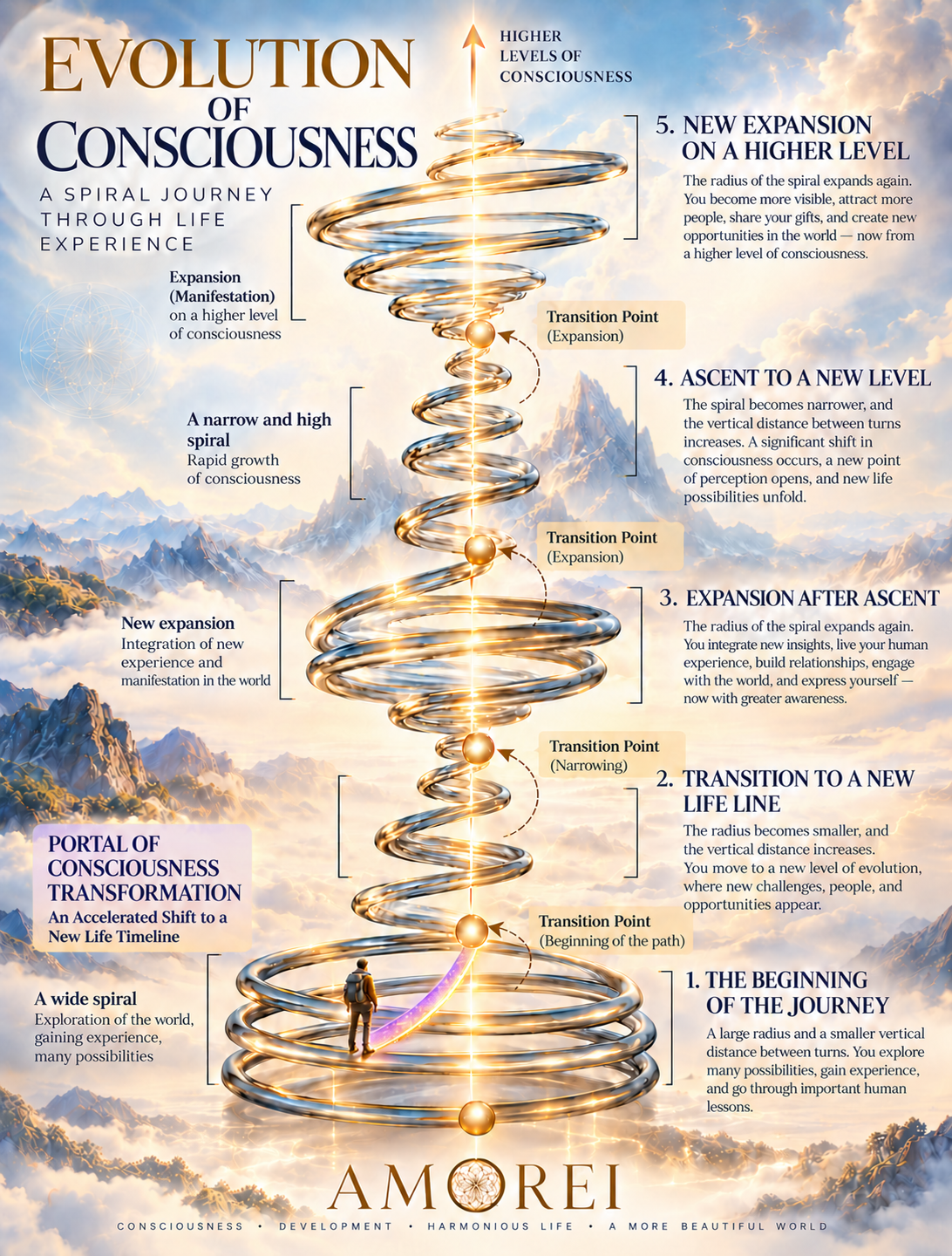
Here I want to make an important distinction between an ordinary change in one’s life path and what I call an evolutionary, or quantum, leap in my spiritual practice.
If we imagine the soul’s evolution as movement along a spiral, each turn represents a certain stage in the development of consciousness, together with the possibilities for earthly existence associated with that stage.
In the ordinary course of development, a person moves through these stages one after another, gaining the necessary experience. This may take years, decades, or, according to some spiritual beliefs, even several incarnations.
But I believe another possibility may exist: a conscious transition from one turn of the spiral to another, higher one, without having to go through the entire sequence of intermediate experiences in the usual way.
This is what I call an evolutionary, or quantum, leap.
In my metaphysical worldview, such a transition involves more than a change in awareness.
I believe that different states of consciousness may be connected with different paths of life, and therefore with different possibilities, relationships, and conditions of physical existence.
This is why I see a quantum leap as a transition to another timeline within the space-time continuum — a timeline in which certain events and opportunities become available earlier than they would through the ordinary course of development.
I see this as a conscious process involving inner preparation, sustained intention, the cultivation of energy, and a change in the way a person perceives reality.
I use the terms quantum leap and quantum portal here in a metaphysical rather than a physical sense. They help me describe a possible transition between levels of consciousness and life paths. I am not suggesting that quantum mechanics has scientifically confirmed such processes.
Perhaps the desired life path already exists among many potential futures. But its existence does not mean that a person can automatically make it their reality.
In my understanding, this requires a certain readiness of consciousness.
Imagine that along one life path, a person continues living within familiar circumstances, repeating the same patterns of relationships, decisions, and inner perceptions.
At the same time, they begin to recognize the possibility of a completely different life.
Perhaps it is a life in which they are able to build a deep relationship, bring a meaningful project into reality, fulfill their calling, or express qualities that previously existed only as potential.
If consciousness is indeed connected with the realities available to us, then changing our state of consciousness may be part of moving toward such a life.
I am not claiming that intention alone can guarantee specific events. But I believe conscious inner work may change the range of possibilities a person is able to recognize, choose, and bring into reality.
In this model, a quantum leap means moving onto a life path where a certain level of development, along with the conditions associated with it, becomes available much earlier.
Metaphorically speaking, it is as though a person passes through a portal, moving beyond several turns of their usual evolutionary journey.
Willpower, Energy, and Conscious Effort
But this brings us to a question without which the idea of a quantum leap would remain incomplete.
If moving onto another timeline is truly possible, what allows a person to make that transition?
I believe we need to distinguish between free will and willpower.
Free will gives us the possibility of making a choice. But is having that possibility enough to truly change our lives?
We may know what decision we want to make and still feel unable to carry it out.
We may recognize that certain habits are destructive, yet continue repeating them.
We may clearly see the direction in which we want to grow, but keep returning to a familiar way of living because it requires less effort.
This is where willpower becomes important: the ability to maintain an intention, direct our attention, overcome the inertia of habits, and continue moving forward even when circumstances make it difficult.
But willpower does not exist separately from a person’s inner energy.
If our entire life revolves around automatically meeting everyday needs, familiar entertainment, work, and repeating the same activities, we may never stop to consider what possibilities for growth exist beyond the life we already know.
There is nothing inherently wrong with ordinary life. The question is whether we still have the attention, strength, and inner space needed to make conscious choices.
When we develop a serious intention to change the direction of our lives, what matters is not only what we want, but also whether we are capable of sustaining our decision.
I understand inner energy as something broader than physical vitality. In my spiritual experience, it is connected with the quality of attention, the state of consciousness, the stability of intention, and the ability to remain connected with the direction we have chosen.
At the same time, it is important to remember that human resources are not unlimited.
Trauma, illness, exhaustion, and difficult circumstances can significantly restrict a person’s ability to act. A lack of strength does not always mean a lack of willpower. It may also be connected with unresolved fears, deeply rooted emotional patterns, and what I understand in spiritual terms as lower-vibrational emotions and thoughts.
This makes the question of freedom of choice even more complex.
We may have free will but lack the inner strength, energy, clarity, or necessary conditions to carry out what we have chosen.
This is why I do not imagine a quantum leap as a random event that happens simply because someone decides they want a different life. I see it as a conscious transition that may require significant and sustained effort.
A person may spend years exploring their consciousness, working through emotional trauma, reconsidering familiar beliefs, developing inner discipline, strengthening their intention, and learning to remain steady in circumstances that once completely controlled their reactions.
Sometimes the external changes remain invisible for a long time. But that does not necessarily mean nothing is happening.
Often, preparation for a transition begins long before its effects become visible in physical life.
This is where practices that expand consciousness and awareness become especially meaningful.
Meditation, prolonged contemplation, attention training, exploration of inner states, and various spiritual disciplines may create conditions in which a person begins noticing things that were previously beyond their usual perception.
Some traditions also use special rituals and altered states of consciousness. But an unusual experience alone does not guarantee spiritual development or a transition to another level of awareness.
The depth of the experience, the ability to understand and integrate it, and the way it is expressed in everyday life are essential to the expansion of consciousness and meaningful change.
It is important to understand that a quantum leap cannot be reduced to one ceremony, one meditation, or one extraordinary experience.
It is sustained conscious preparation and practice that, in my understanding, create the conditions in which such a transition may become possible.
And if someone truly intends to change not only the circumstances of their life but also the evolutionary direction of their soul, they may need much more than a desire for change.
They need the ability to choose their direction again and again, and to keep moving toward it.
For some people, exploring consciousness also involves stepping outside their familiar environment and creating space for deeper personal inquiry.
This is one of the ideas behind my Private Journey in Peru – an individually designed journey that brings together personal dialogue, spiritual practices, nature, and time for reflection. The experience is shaped around the person, their questions, and their readiness to explore them.
Can We Move Ahead of Divine TIME?
Now we return to the question with which we began.
If the soul has an original plan, and Divine TIME contains many potential paths of existence, can we consciously accelerate our own evolution?
Based on my personal spiritual experience, I believe we can.
But perhaps the expression moving ahead of time does not fully describe what is happening.
If we understand TIME as a multidimensional structure of possibilities, accelerating our evolution may mean moving onto a path where a certain level of development becomes available earlier than it would have along the originally intended journey.
Such a transition would not necessarily violate the laws of TIME.
Perhaps it would happen precisely because of them.
As we have already explored, free will can take a person so far from their original plan that their most important tasks remain unfulfilled in the current incarnation.
Using the image of the spiral, we might describe this as downward movement, a halt in development, or a prolonged period at a level from which it becomes difficult to continue rising.
But that same free will, when combined with awareness, inner strength, energy, and sustained intention, may open a path toward development that was originally expected only at a later stage.
This suggests that moving beyond the original plan may lead either to a delay in evolution or to its acceleration.
The difference lies not only in the direction of the life path we choose, but also in the state of consciousness from which we make that choice, and in our ability to consistently act on our intention.
Still, an important question remains: are human intention and effort alone enough?
Or must certain conditions come together for such a significant transition to occur, including the readiness of the soul, our interactions with other people, and a particular moment in Divine TIME?
Perhaps there are periods when certain possibilities become accessible, even though a person could not come close to them before.
In my spiritual understanding, these are the dates we recognize as portal openings. There are many such dates throughout the year, and what matters is learning how to make conscious use of them.
This gives inner preparation an even deeper meaning: a person gradually becomes ready to recognize and use an opportunity when it appears.
And here we encounter another remarkable paradox.
If Divine TIME already contains all potential paths of development, then even a conscious movement beyond the original plan becomes part of a greater Divine design.
In one screen adaptation of the Mahabharata, after the great war has ended, Queen Gandhari, grieving the loss of her sons, curses Krishna. When she realizes what she has said, she is horrified by her own words.
But Krishna calmly responds with something along these lines:
“You said what you were meant to say, so that what was meant to happen could happen.”
I find this thought remarkably close to what I have been exploring throughout this article.
Perhaps even the decisions we make entirely of our own free will are already part of a much greater Divine design. And sometimes, knowingly or unknowingly, people become participants in the unfolding of that design through their words and actions.
From a human perspective, this may look like an unexpected change of destiny. But from the perspective of the multidimensional structure of TIME, it may simply be the realization of one possibility that has always existed.
Perhaps what we call the acceleration of evolution is the ability of consciousness to move toward a path of development that once seemed inaccessible.
Freedom of Choice Within the Divine Design
The more deeply I reflect on free will and destiny, the less I see them as opposites.
This is how I currently understand their relationship.
The soul has an original plan, but that plan does not include every possibility for its development.
Divine TIME contains many potential paths, and human consciousness is constantly choosing the direction in which its existence continues.
Our own decisions, together with the free will of other people, can change the original course of our lives far more than we may realize.
At a certain level of inner maturity, the soul may gain the ability to consciously move toward an entirely different level of development, while also changing the circumstances of its earthly life.
I do not know whether there are absolute limits to such changes.
But I believe it is important to remember that free will comes with responsibility for the direction we choose, to the extent that this direction is genuinely within our influence.
We cannot always change our circumstances, other people, or the consequences of their decisions.
But as our awareness develops, we can learn to recognize our possibilities more clearly, find the inner and outer resources we need, and gradually expand the range of choices available to us.
As we move in this direction, we may also find ourselves meeting more people who are following a similar path in the evolution of consciousness.
And if Divine TIME truly contains many possible paths, perhaps one of the deepest meanings of human existence lies in our ability to participate consciously in choosing the direction of our own evolution.
There is, however, one more side to this question that I would like to explore before bringing these reflections to a close.
What Kind of Reality Are We Creating for One Another?
If our lives are so deeply connected with the lives of others, and if one person’s decisions can change another person’s destiny for many years, how much more carefully should we treat one another?
We do not know the original plans of other souls, and we cannot reliably judge what tasks another person has come here to fulfill.
But we can influence the conditions in which they live their lives.
We can support someone during a difficult time, help them preserve their trust in the world, and allow them to experience love and safety. Or, through our fears, cruelty, indifference, or desire to control others, we can create circumstances whose consequences may remain with them for many years.
I believe it is time for humanity to develop a deeper awareness of this connection.
Perhaps we could move through many of life’s lessons much more easily if we learned to treat one another with greater love, kindness, respect, and understanding.
If we stopped creating additional suffering for one another through fear, struggles for power, oppression, and violence, how different might the reality of human existence become?
Even if we accept the possibility of spiritual plans and soul contracts, that does not free us from responsibility for our actions.
On the contrary, such a worldview makes that responsibility even more significant.
If my choices can change another person’s life path, then every act of kindness, support, respect, and love carries a special meaning.
And here, the individual question of free will unexpectedly becomes a question about the evolution of humanity as a whole.
In contemporary spiritual discussions, we increasingly encounter the idea of a transition into another reality, often called the fifth dimension, or 5D.
I see this idea as a possible image of a profound change in collective consciousness: a movement toward a way of human existence in which love, cooperation, respect for another person’s freedom, and responsibility for the consequences of our decisions become a natural foundation of life.
Perhaps changes in collective consciousness and changes in the reality of our existence are much more closely connected than we usually imagine.
And perhaps the transition toward a more harmonious reality begins not only with deep spiritual practices and individual quantum leaps, but also with how we treat one another in the most ordinary moments of everyday life.
But that is a subject for another exploration.
For now, I would like to leave you with one question.
If every choice we make influences not only our own lives but also the paths of other people, what kind of reality are we creating for one another today?