The Hera Archetype in Women’s Lives: Elizabeth Taylor, Princess Diana, and Jane Eyre
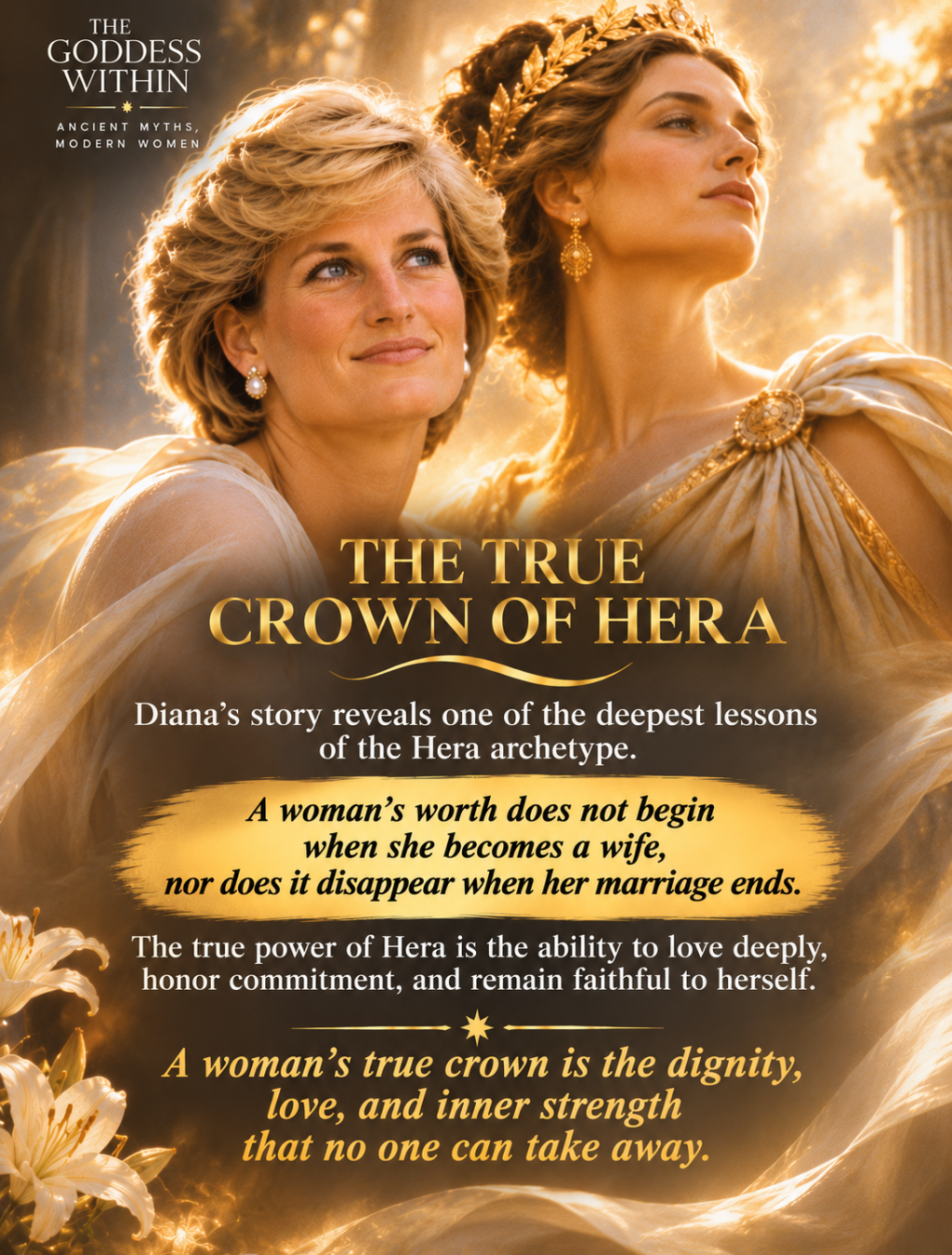
Three stories of love, marriage, feminine dignity, and the journey toward inner wholeness
Ancient myths continue to live because human nature does not change as quickly as the world around us.
Centuries pass. Societies develop new ideas about marriage, relationships, and women’s independence. Women gain freedoms that earlier generations could scarcely imagine. Yet the desire to love and be loved, the longing for a lasting partnership, the pain of betrayal, and the fear of losing someone we love remain deeply familiar.
Hera, the great Queen of Olympus, is still present in women’s lives.
Her energy awakens when a woman longs to share her life with a partner, build a family, and create a lasting union. She wants to be chosen, recognized, and loved as the woman with whom a man wishes to build his future.
At her best, Hera brings devotion, loyalty, dignity, and the ability to create a relationship that grows stronger through shared experience.
Yet the same energy can become a source of suffering when a woman’s sense of worth depends on her husband’s attention, fidelity, or recognition.
She may remain in an unhappy marriage because she cannot imagine herself outside it. She may compete with other women for a man’s love. Or she may become so afraid of losing her relationship that she gradually loses herself.
The ancient stories of Hera and Zeus reveal these contradictions with remarkable clarity.
But we do not need to remain in Greek mythology to understand them.
Literature and biography preserve human experiences just as mythology preserves the stories of the gods. A novelist may invent a character, yet the emotions, choices, and conflicts of that character reflect experiences that countless people have lived.
A real woman’s biography can reveal similar patterns, although we must remember that no public account can tell us everything about her inner life.
The goddess archetypes offer us a way to explore these stories.
They are not fixed personality types. They represent different energies and possibilities within human consciousness. Several archetypes may become active in one woman, sometimes supporting each other and sometimes pulling her in different directions.
Through the lives of Elizabeth Taylor and Princess Diana, and the fictional story of Jane Eyre, we can explore three very different expressions of Hera.
One woman repeatedly seeks to unite passion with marriage.
Another enters a royal marriage hoping for lasting love, then gradually discovers a life beyond her role as a wife.
And a third chooses to protect her dignity even when doing so means walking away from the man she loves.
Together, their stories reveal the possibilities and challenges of the Hera archetype.
Elizabeth Taylor: When Hera and Aphrodite Desire the Same Man
The woman who married eight times
Passion, marriage, and the search for a lasting union
Few Hollywood actresses embodied romantic glamour as powerfully as Elizabeth Taylor.
Her extraordinary beauty, violet-looking eyes, celebrated film career, and passionate relationships made her one of the most recognizable women of the twentieth century.
But beyond the glamour lies a fascinating story.
Elizabeth Taylor married eight times, to seven different men.
She married Richard Burton twice.
At first glance, such a history might seem to suggest that marriage held little meaning for her.
Yet from the perspective of the goddess archetypes, we might ask a different question.
Why did a woman who experienced such powerful romantic attractions repeatedly seek marriage?
Why did love so often lead her toward the formal commitment of becoming someone’s wife?
Here we can see a possible interaction between two powerful feminine energies.
Aphrodite awakens romantic attraction, passion, sensuality, and the desire to experience love.
Hera seeks to transform a romantic relationship into a recognized and lasting union.
When these energies work together, a woman may feel that passionate love naturally leads toward marriage.
She wants to experience the excitement of being in love and the security of belonging to a shared life.
But passion and lasting partnership do not always develop at the same pace.
Aphrodite lives in the intensity of the present moment.
Hera thinks about the future.
Aphrodite is drawn toward beauty, emotional connection, and desire.
Hera wants commitment, loyalty, and continuity.
Both energies can contribute to a beautiful relationship. Difficulties arise when the excitement of falling in love is mistaken for the foundation of a lasting marriage.
Elizabeth Taylor’s life gives us a particularly interesting opportunity to explore this tension.
Elizabeth Taylor and Richard Burton: A love that became a marriage twice
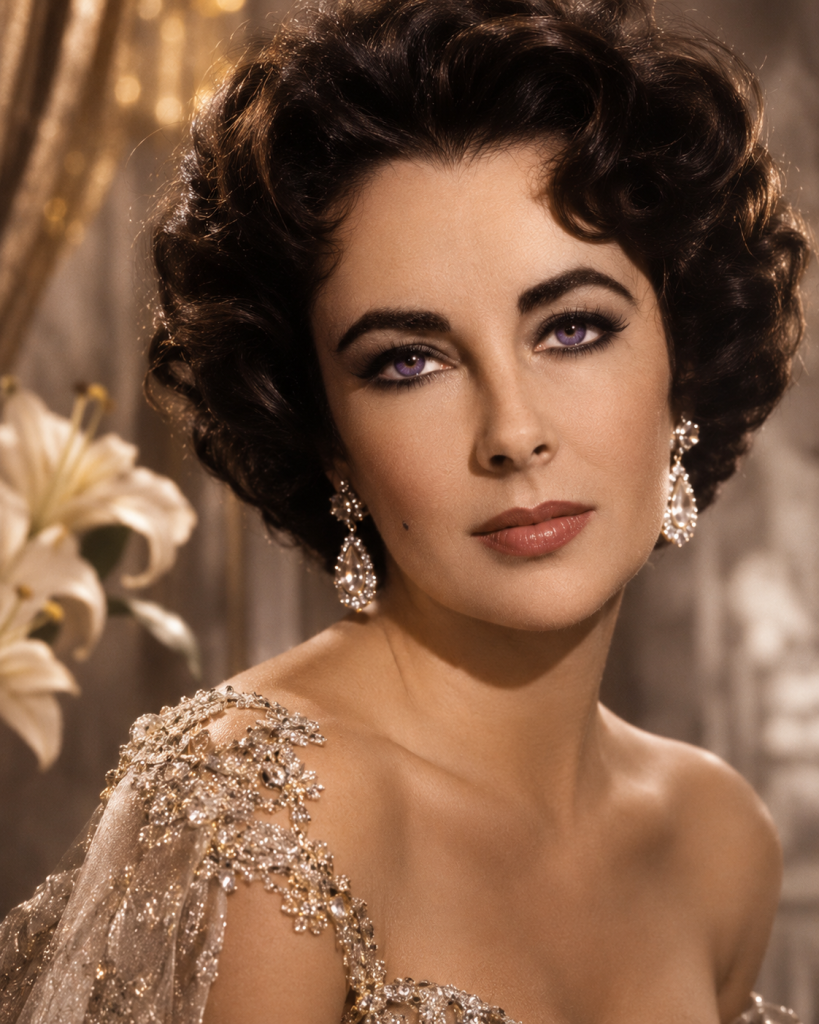 Elizabeth Taylor met Richard Burton during the filming of Cleopatra in the early 1960s.
Their attraction became one of the most widely discussed romances of the era.
Both were married to other people when their relationship began.
Their affair attracted enormous publicity and criticism, particularly because Taylor had already become the subject of public controversy surrounding her earlier marriage to Eddie Fisher.
Yet the relationship continued.
Taylor and Burton married in 1964.
They were both internationally famous, exceptionally successful, and known for their intense personalities.
Their marriage was filled with public fascination, artistic collaboration, extravagant gifts, emotional intensity, and serious conflicts.
They divorced in 1974.
Then, in 1975, they married each other again.
The second marriage lasted less than a year.
What makes this story so interesting from an archetypal perspective?
The first marriage suggests an attempt to give a powerful romantic attraction a permanent place in their lives.
The second marriage raises an even more compelling possibility.
After experiencing the difficulties of their first union, they still chose to marry again.
Perhaps they hoped that love could overcome the conflicts that had separated them.
Perhaps the desire to restore the relationship remained stronger than their ability to create a peaceful life together.
We cannot know every private motive behind their decisions.
But their story illustrates something familiar in human relationships.
Two people may experience an extraordinary attraction and still struggle to build a stable partnership.
A powerful emotional bond does not automatically provide the understanding, patience, responsibility, and mutual respect that marriage requires.
This is where Hera and Aphrodite must learn to cooperate.
Aphrodite can bring two people together.
Hera must help them discover how to remain together.
When the desire to be married becomes stronger than the relationship itself
There is an important distinction between wanting to marry a particular person and wanting to experience the state of being married.
Sometimes these desires are closely connected.
A woman falls in love, recognizes a compatible partner, and wants to build a shared future.
But sometimes the longing for marriage becomes so powerful that the woman begins to overlook the actual quality of the relationship.
She may believe that marriage will make the love more secure.
That an official commitment will end uncertainty.
That becoming a wife will finally confirm that she is the most important woman in a man’s life.
Yet marriage cannot create emotional maturity where it does not already exist.
It cannot guarantee fidelity, resolve incompatible values, or replace the willingness of both partners to care for their relationship.
The Hera archetype becomes vulnerable when the institution of marriage begins to matter more than the experience of mutual love within it.
Elizabeth Taylor’s repeated marriages offer an opportunity to reflect on this possibility, although they do not prove that it was her personal motivation.
Her life also reveals something else.
She was never simply someone’s wife.
She was a highly accomplished actress, a successful professional, and later a prominent humanitarian.
Her achievements and public influence existed independently of her marriages.
The other goddesses within Elizabeth Taylor
Aphrodite is perhaps the most immediately recognizable energy in Elizabeth Taylor’s public image.
Beauty, sensuality, charisma, emotional intensity, and romantic attraction were central to the way audiences perceived her.
But Aphrodite alone cannot explain her life.
Her long and successful acting career required discipline, intelligence, professional judgment, and the ability to navigate a demanding industry.
Here we can recognize qualities associated with Athena.
Later in life, Taylor became a major advocate for people affected by HIV and AIDS.
At a time when the disease was surrounded by fear, prejudice, and widespread public misunderstanding, she used her fame to raise awareness and support research and care.
She helped establish organizations that became important parts of her humanitarian legacy.
In this work, we can recognize Demeter’s compassion and Athena’s ability to turn concern into organized action.
The same woman who was celebrated for her beauty and passionate relationships also became a powerful public advocate.
This reminds us that no woman is limited to the archetype most visible in her romantic life.
Elizabeth Taylor’s story can be read as a journey through several feminine energies.
Aphrodite brought extraordinary romantic intensity.
Hera may have expressed the recurring desire to give love the form of marriage.
Athena supported professional achievement and purposeful action.
Demeter appeared through compassion and concern for people who needed help.
Her life was far more complex than her marriages.
And that is precisely why it is valuable to look beyond the familiar headlines.
What Elizabeth Taylor’s story teaches us about Hera
A woman may experience passionate love many times.
She may marry once, several times, or never.
The number of marriages does not determine the strength of her Hera archetype.
What matters is the inner meaning she gives to partnership.
Does marriage represent a conscious commitment between two people who understand and respect each other?
Or does it become a way to secure love that feels uncertain?
Does she choose the person she truly knows?
Or does she hope that marriage will transform a passionate relationship into something it has not yet become?
These questions are relevant far beyond Hollywood.
They arise whenever a woman believes that the promise of marriage will resolve difficulties that the relationship itself has not resolved.
The mature Hera learns to recognize that love requires more than intensity.
She can welcome Aphrodite’s passion while allowing Athena’s wisdom to help her understand the person with whom she wishes to share her life.
She discovers that the deepest commitment begins long before the wedding ceremony.
It begins when two people consciously choose to care for the relationship they are creating.
To explore the creative and shadow expressions of romantic attraction, read The Aphrodite Archetype (link).
Princess Diana: A Modern Hera in a Royal Marriage
When becoming a princess does not guarantee being loved
In 1981, nineteen-year-old Lady Diana Spencer was preparing to marry Charles, Prince of Wales, the heir to the British throne.
For millions of people around the world, their wedding appeared to be a fairy tale brought to life.
A young woman in an extraordinary wedding gown.
A magnificent ceremony at St Paul’s Cathedral.
The royal family.
Crowds celebrating the marriage of a future king and queen.
The world watched a young woman become a princess.
But behind the public celebration was a young bride who hoped to create a loving marriage and family.
Diana later spoke about how much she had wanted her marriage to succeed.
She also reflected on the divorce of her own parents and her desire to avoid repeating that experience.
From an archetypal perspective, we can recognize the energy of Hera in these hopes.
Marriage represented a lasting partnership.
A shared future.
The creation of a family.
And the desire to be loved and chosen by the man with whom she would share her life.
Diana entered a marriage that gave her one of the most prestigious positions available to a woman in British society.
Yet the title of princess could not guarantee emotional intimacy.
This is where her story begins to resemble the ancient myth of Hera and Zeus.
The Queen who cannot secure her husband’s love
In Greek mythology, Hera is the legitimate wife of Zeus.
She is the Queen of Olympus, recognized among the gods and honored as the goddess of marriage.
Her position is extraordinary.
Yet Zeus repeatedly becomes involved with other women.
Hera possesses the highest status, but she cannot make her husband faithful.
This contradiction becomes one of the central sources of her suffering.
Diana experienced a different version of this conflict.
Her marriage to Charles was deeply affected by his relationship with Camilla Parker Bowles.
Diana later spoke publicly about the emotional pain she experienced and her sense that another woman was present within the marriage.
In her famous 1995 interview with the BBC, she described the situation by saying that there were three people in the marriage, making it rather crowded.
The words became internationally known because they expressed something many women understood.
A woman may be legally married, publicly recognized, and admired by millions of people.
Yet she may still feel that she has not received the exclusive love and devotion she expected from her husband.
And then a painful question arises.
What does it mean to be a wife if the man does not fully choose the marriage?
For the wounded Hera, this question can become inseparable from her sense of personal worth.
She may begin to compare herself with another woman.
She may wonder what the other woman possesses that she lacks.
She may believe that winning back her husband’s attention will restore her dignity.
But a woman’s value cannot be measured by a man’s fidelity.
His choices are his responsibility.
The painful task of the wounded Hera is to discover that her dignity exists independently of those choices.
When a princess begins to discover her own power
Diana’s life offers an especially interesting example of what can happen when other archetypal energies begin to develop alongside Hera.
 Even during her marriage, she became deeply involved in charitable work.
She visited hospitals, supported children and vulnerable families, and helped challenge public prejudice toward people living with HIV and AIDS.
One of her most memorable public acts was her willingness to shake hands with people affected by HIV at a time when many still feared ordinary physical contact.
Through such gestures, Diana helped communicate a powerful message of human dignity and compassion.
She also supported the arts.
Dance and ballet were among her personal interests, and she became a patron of English National Ballet.
Her involvement brought public attention to artistic institutions and helped connect her public role with her personal interests.
Gradually, Diana developed an identity that extended beyond being the wife of the future king.
And here we can recognize several archetypal energies working together.
Demeter appears through compassion, nurturing, and concern for people who are vulnerable or suffering.
Athena emerges through Diana’s growing ability to make independent decisions, select causes that mattered to her, and use her public position to influence society.
Aphrodite expresses herself through beauty, charm, emotional openness, and the ability to inspire affection.
Diana’s extraordinary public appeal was not based solely on royal status.
People responded to her warmth, her willingness to connect with others, and the sense that she could see the person behind the social label.
Her personal style also became a form of expression.
Clothing, beauty, movement, and public presence helped her communicate an increasingly recognizable identity.
These qualities allowed Aphrodite’s charisma to support Athena’s purposeful action and Demeter’s compassion.
Her public influence became more personal and independent.
The woman who had entered royal life primarily through marriage was gradually becoming known for her own choices.
When Aphrodite awakens in her personal life
Diana’s story also reveals a more complicated interaction between Hera and Aphrodite.
Although she had wanted her marriage to succeed, she later entered an extramarital relationship herself.
In her 1995 interview, Diana acknowledged her relationship with James Hewitt and spoke about her feelings for him.
How can we understand this through the goddess archetypes?
Hera seeks commitment, loyalty, and the security of marriage.
Aphrodite awakens romantic attraction, sensuality, and the desire to experience love.
When a woman feels emotionally rejected or lonely within her marriage, another relationship may awaken her longing to feel desired and loved.
This is one possible archetypal interpretation of Diana’s experience.
But we cannot know all her private motivations, and it would be misleading to present her relationship as an inevitable response to Charles’s infidelity.
Her choices, like his, carried their own responsibilities.
What matters for our exploration is the possibility of an inner conflict.
One part of a woman may still wish to preserve her marriage.
Another may long for emotional and romantic fulfillment elsewhere.
Can we call this the shadow side of Aphrodite?
Only if we understand the shadow as the expression of desire without sufficient awareness of its consequences.
The longing for love is not itself a shadow.
Neither is sensuality.
But when desire leads a person to violate commitments, ignore the needs of others, or seek emotional fulfillment without understanding the deeper problem, Aphrodite’s energy can become destructive.
The mature expression of Aphrodite includes awareness, responsibility, and the ability to recognize the difference between genuine connection and the temporary relief of feeling desired.
Diana’s story reminds us that a woman can experience conflicting inner forces.
Her desire for marriage may coexist with her desire for romantic love.
Her longing for security may coexist with a growing need for independence.
The task is to bring these energies into conscious relationship rather than allowing them to compete for control of her life.
Beyond the role of wife
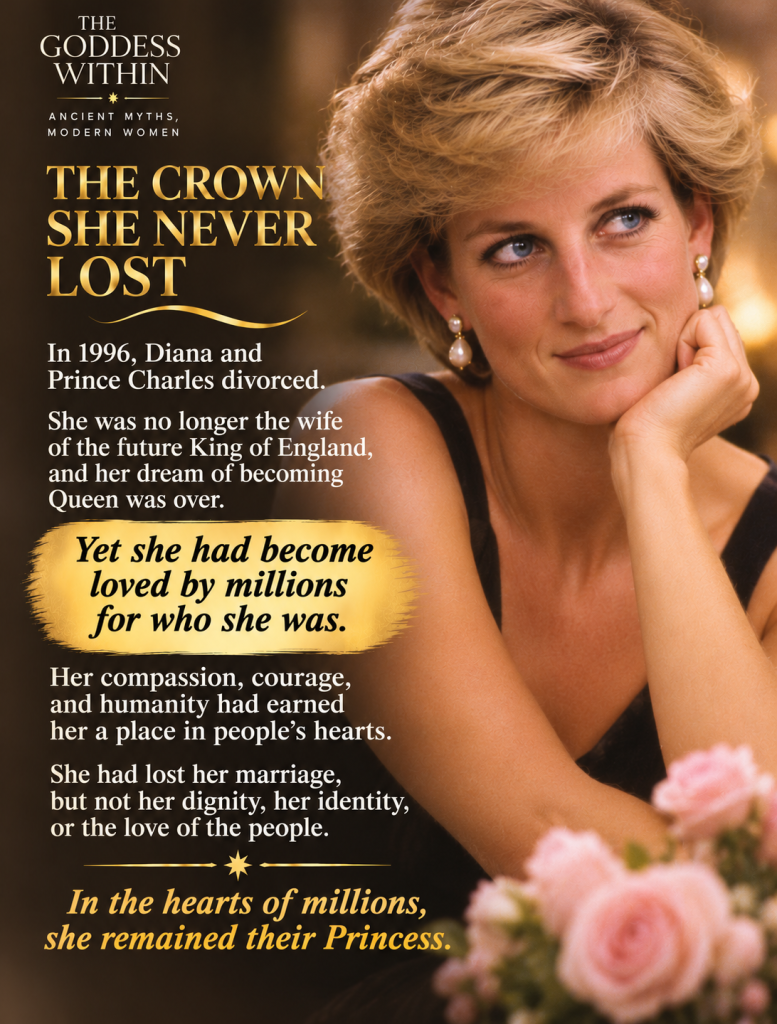
Diana and Charles separated in 1992 and divorced in 1996.
Following their separation, Diana continued to develop her public and humanitarian work.
She supported causes related to HIV and AIDS, homelessness, children’s welfare, and the suffering caused by landmines.
Her involvement in the campaign against landmines became particularly visible during the final year of her life.
By this time, Diana had become an internationally influential public figure in her own right.
Her identity was no longer defined exclusively by her marriage.
She remained a princess in the eyes of the public, but her significance had grown far beyond her former position as the wife of the heir to the throne.
Through the language of archetypes, we might say that Athena was becoming increasingly visible.
Diana was developing the ability to act according to her own priorities and use her influence for purposes she considered meaningful.
Aphrodite continued to express herself through charisma, beauty, and the emotional connection she inspired.
Demeter appeared through compassion and humanitarian concern.
Together, these energies gave her opportunities to express parts of herself that marriage alone could never contain.
We should not turn this into a simple story of complete liberation.
Diana’s life remained emotionally complicated, and public attention created enormous pressures.
We cannot know whether she ever reached the inner peace she was seeking.
But we can recognize an important development.
She was gradually discovering ways to express her individuality beyond her relationship with Charles.
And this is one of the most important possibilities available to the Hera archetype.
What Diana’s story means for women today
Even in contemporary society, many women continue to connect their sense of worth with the success of their marriages.
A woman may be educated, professionally accomplished, financially independent, and respected by others.
Yet if her husband becomes emotionally distant or unfaithful, she may feel that everything else has lost its meaning.
Diana’s life reminds us that even royal status cannot protect a woman from this experience.
External recognition does not automatically create inner confidence.
But a woman can gradually discover that her value is not limited to being someone’s wife.
She may be a mother, an artist, a professional, a leader, a creator, or a woman whose presence inspires others.
These expressions of her nature do not diminish the importance of marriage.
They allow her to enter a relationship as a more complete human being.
Hera remains the Queen of Olympus regardless of Zeus’s behavior.
Her divine nature does not disappear because her husband fails to honor their union.
Likewise, a woman remains worthy of love, dignity, and respect regardless of the choices her partner makes.
When she begins to understand this, her relationship with love can change.
She can seek a lasting union without making it the sole foundation of her identity.
For a deeper exploration of Hera’s longing for recognition and her journey toward mature partnership, read The Hera Archetype: Sacred Union, Feminine Dignity, and the Shadow Side of Expectations (link).
Jane Eyre: The Hera Who Chooses Her Own Dignity
A woman who refuses to lose herself in love
After the passionate marriages of Elizabeth Taylor and the public struggles of Princess Diana, we turn to a woman who never existed as a historical person.
Yet her story has spoken to generations of readers.
Jane Eyre, the heroine of Charlotte Brontë’s novel, offers one of literature’s most compelling examples of a woman who experiences deep love while remaining faithful to her own principles.
Jane begins life with very little power.
She is an orphan, dependent on relatives who do not welcome her, and later a student at a harsh charitable school.
As she grows older, she becomes a governess.
She has no great fortune, no influential family, and no impressive social position.
But she possesses something that becomes increasingly important throughout her story.
A strong sense of personal dignity.
Jane wants to love and be loved.
She also wants to be respected as a person.
And when she meets Edward Rochester, the master of Thornfield Hall, these desires become deeply intertwined.
Love between two unequal people

Rochester is wealthy, socially powerful, and considerably older than Jane.
She is employed as the governess of his ward.
Their positions in society are unequal.
Yet their conversations gradually reveal a deeper connection.
Jane is not impressed by Rochester’s wealth alone.
She challenges him, questions him, and speaks with an independence that surprises him.
Their attraction develops through emotional and intellectual recognition.
Jane feels that Rochester sees something in her that others have overlooked.
And Rochester becomes increasingly drawn to her intelligence, honesty, and strength.
Here we can recognize the energy of Aphrodite.
Love awakens.
Two people discover an attraction that goes beyond social expectations.
But we can also recognize Athena.
Jane thinks independently.
She does not abandon her judgment simply because she is in love with a powerful man.
And as Rochester proposes marriage, Hera becomes increasingly important.
Jane wants a genuine union.
She wishes to become his wife, share his life, and enter a relationship in which both partners recognize each other’s humanity.
But the wedding does not take place as planned.
The secret that changes everything
On the day of their wedding, Jane discovers that Rochester is already married.
His wife, Bertha Mason, is still alive.
Rochester has concealed this fact from Jane.
He explains the circumstances of his earlier marriage and asks Jane to remain with him.
He wants her to continue loving him even though they cannot legally marry.
Jane faces an extraordinary inner conflict.
She loves Rochester deeply.
She does not suddenly stop loving him when she discovers the truth.
Her feelings remain powerful.
But she recognizes that remaining with him under these circumstances would violate her understanding of herself and the life she wishes to lead.
And so she makes a painful decision.
She leaves.
When Hera and Athena stand together
This moment is one of the most revealing expressions of the mature Hera archetype.
Jane desires marriage.
She loves the man who has asked her to become his wife.
But she refuses to build her future on a relationship that requires her to abandon her principles.
Hera seeks a legitimate and lasting union.
Athena provides clarity, judgment, and the ability to make a difficult decision.
Together, these energies allow Jane to act according to her deepest convictions.
She does not stop loving Rochester.
She chooses to leave despite loving him.
That distinction is essential.
Love does not disappear simply because a relationship becomes impossible or unacceptable.
A woman may continue to feel deeply attached to someone while recognizing that remaining with him would cause her to betray herself.
Jane’s decision reveals a form of inner strength that is particularly relevant to modern relationships.
She understands that love cannot justify every choice.
She also understands that her own dignity deserves protection.
Her circumstances are especially difficult because she has little money and no secure place to go.
Leaving Rochester means stepping into an uncertain future.
Yet she accepts that uncertainty.
She would rather face hardship than remain in a situation that conflicts with her conscience.
A woman’s worth does not depend on a man’s wealth or status
Jane’s story contains another important dimension.
Throughout the novel, she repeatedly insists on her equality as a human being.
Rochester possesses wealth, property, and social authority.
Jane has none of these advantages.
But she does not believe that his position makes his soul more valuable than hers.
This conviction is central to her character.
It also reveals a quality that the wounded Hera often struggles to develop.
The wounded Hera may believe that marriage to a powerful or admired man increases her own value.
She may become attached to the status of being his wife.
Jane refuses to accept such a hierarchy.
She wants love, but she also wants recognition of her equal humanity.
Her dignity does not come from Rochester’s wealth.
It does not come from the possibility of becoming mistress of Thornfield Hall.
It comes from her understanding of herself.
This is why her decision to leave is so significant.
She is willing to lose the relationship rather than lose her integrity.
The journey toward independence
After leaving Rochester, Jane experiences hardship and uncertainty.
Eventually, she finds shelter, develops new relationships, and gains greater independence.
She later receives an inheritance that changes her financial circumstances.
For the first time, she has the means to make decisions without depending entirely on an employer or husband.
This development matters enormously.
Jane’s inner independence existed before she had money.
But financial independence gives her greater freedom to express it.
Here Athena’s energy becomes especially visible.
Jane can now make practical choices about her life.
She no longer needs marriage as a means of economic survival.
She can choose a relationship because she wants it, rather than because she has no other way to live.
And then another possibility appears.
St John Rivers proposes marriage to Jane.
He offers her a life devoted to missionary work.
But his proposal is based primarily on duty and shared religious purpose rather than romantic love.
Jane recognizes that such a marriage would require her to suppress an essential part of herself.
She refuses.
This decision reveals another important aspect of her development.
Jane is not seeking marriage at any cost.
She wants a union that includes love, respect, and genuine emotional connection.
Her Hera is becoming more discerning.
She can recognize the difference between a socially respectable marriage and a relationship that honors her whole nature.
Returning to Rochester: Love becomes a free choice
Eventually, Jane returns to Rochester.
But their circumstances have changed dramatically.
Thornfield Hall has been destroyed by fire.
Bertha Mason has died.
Rochester has been injured and has lost his sight.
He is no longer the powerful master of a great estate in the way Jane first knew him.
Jane, meanwhile, has gained financial independence and a stronger position in the world.
Their relationship can now begin on different terms.
Rochester is free to marry.
Jane is free to choose.
She returns because she loves him.
And they marry.
This ending is especially meaningful through the lens of the Hera archetype.
Jane’s dream of marriage is fulfilled, but only after she has protected her dignity and established greater independence.
She does not need Rochester to give her social importance.
She does not need his wealth to provide her with a future.
She chooses him because she wishes to share her life with him.
The relationship is no longer defined by the same imbalance of power that existed when she was his employee.
Their circumstances have changed, and Jane can enter marriage with greater freedom.
This is a powerful image of mature Hera.
A woman who desires a lasting union, yet remains capable of living without it.
A woman who loves deeply, yet does not surrender her principles.
A woman who can make a commitment because she chooses it.
What Jane Eyre teaches us about love and dignity
Jane’s story raises a question that remains important in every generation.
What should a woman preserve when love and personal values come into conflict?
Social expectations change.
Marriage laws change.
Women’s opportunities change.
The freedom available to Jane in nineteenth-century England was very different from the freedom available to many women today.
Yet certain values can remain meaningful across historical periods.
Honesty.
Respect for another person’s dignity.
Responsibility for one’s choices.
Faithfulness to one’s word.
The ability to distinguish deep love from emotional dependency.
These principles do not need to be imposed by society.
They can become part of a person’s conscious understanding of how she wishes to live.
Jane’s decisions are rooted in her moral convictions and the circumstances of her time. Modern readers may interpret those convictions differently.
But her essential question remains relevant.
Can I remain true to myself while loving another person?
Jane’s story suggests that the answer can be yes.
Love can become a part of a woman’s life without requiring her to abandon the person she is.
And when Hera and Athena work together, devotion gains the support of wisdom and self-respect.
Three Women, Three Expressions of Hera
Elizabeth Taylor, Princess Diana, and Jane Eyre lived in very different worlds.
One was a Hollywood star whose romantic life became international news.
Another was a real princess whose marriage was watched by millions.
The third was a fictional governess in nineteenth-century England.
Yet each story reveals a different possibility within the Hera archetype.
Elizabeth Taylor invites us to explore the relationship between passion and marriage.
Through her repeated marriages, especially her two unions with Richard Burton, we can consider how Aphrodite’s desire for romantic intensity may interact with Hera’s longing for lasting commitment.
Her life also reminds us that a woman possesses many dimensions beyond her relationships.
Princess Diana reveals the pain of discovering that marriage, even a royal marriage, cannot guarantee love or fidelity.
Her story shows how the wounded Hera may struggle with rejection and the desire to preserve a union.
It also illustrates how other archetypal energies can help a woman discover her identity beyond the role of wife.
Athena brings independent direction.
Demeter brings compassion.
Aphrodite brings charisma, emotional connection, and the ability to inspire.
Jane Eyre represents a woman whose desire for marriage develops alongside a powerful sense of dignity.
She loves deeply, but refuses to sacrifice her principles.
Her story shows how Hera can mature through the clarity of Athena and the development of personal independence.
These three women do not represent fixed categories.
They reveal different relationships between the same inner energies.
And that is why their stories can help us understand our own lives.
When Love Becomes Attachment
One of the most important distinctions in the development of Hera is the difference between love and emotional dependency.
Love allows two people to recognize each other’s individuality.
It creates a desire to share life, support one another, and grow together.
Emotional dependency develops when a person’s sense of security and self-worth becomes increasingly dependent on the relationship.
A woman may begin to believe that she cannot be happy unless her partner chooses her.
That his attention determines her value.
That losing the relationship would mean losing herself.
At this point, the fear of losing love can become stronger than the experience of love itself.
Jealousy may increase.
The need for reassurance may become constant.
A woman may begin to control, compete, or sacrifice her own needs in the hope of preserving the relationship.
The wounded Hera can become trapped in this pattern because marriage holds such deep meaning for her.
She may experience the loss of a relationship as the loss of her identity.
But the mature Hera gradually discovers that she remains whole even when a relationship changes or ends.
Her ability to love is part of her nature.
Her dignity belongs to her.
And her life contains possibilities that extend beyond marriage.
This understanding does not make partnership less important.
It makes partnership a freer choice.
Why Hera Needs the Other Goddesses
The stories of these women reveal a central principle of working with goddess archetypes.
No single archetype contains everything a woman needs.
Hera brings the desire for sacred union, commitment, and lasting partnership.
But she needs the support of other energies.
Aphrodite brings sensuality, beauty, pleasure, romantic attraction, and creative vitality.
She reminds Hera that a marriage must remain alive as a relationship between two people, rather than becoming only a social institution.
Athena brings independent thought, practical wisdom, professional ability, and the capacity to make decisions.
She helps Hera recognize whether a relationship truly supports the life she wishes to create.
Artemis brings autonomy, personal boundaries, and the freedom to follow one’s own path.
She reminds Hera that a woman can remain an individual within a partnership.
Demeter brings nurturing, compassion, motherhood, and the ability to care for others.
She enriches family life, but must also learn to balance care for others with care for herself.
Persephone brings the capacity for inner transformation.
She helps a woman move through disappointment, loss, and uncertainty, discovering new possibilities within herself.
These energies are not competing personalities.
They are different expressions of the divine feminine.
Each can contribute to a woman’s development.
And when they begin to work together consciously, the woman becomes less dependent on any single role.
She can be a wife without losing her individuality.
A mother without abandoning her own needs.
A lover without surrendering her judgment.
A professional without suppressing her emotional life.
A woman capable of commitment and freedom at the same time.
Every Woman Creates Her Own Story
When we read Greek mythology, the gods may seem distant from ordinary human experience.
They are immortal.
They possess extraordinary powers.
They rule over nature and influence human destiny.
Yet their relationships reveal emotions that remain deeply recognizable.
Hera fears losing love.
Zeus desires freedom while continuing to value his marriage.
Aphrodite awakens passion.
Demeter suffers when separated from her daughter.
Persephone undergoes a profound transformation.
These stories continue to unfold in human lives.
Literature preserves them through fictional characters.
History preserves them through the lives of real women.
And everyday life reveals them through our own relationships, families, choices, and experiences.
We may recognize ourselves in Elizabeth Taylor when passion makes us believe that marriage will secure a love we do not want to lose.
In Princess Diana when we begin to discover our own significance beyond the role of wife.
In Jane Eyre when we choose to remain faithful to our principles, even when doing so requires a painful decision.
But none of these stories is a destiny that every woman must follow.
An archetype reveals a particular energy.
Consciousness gives us the possibility of understanding that energy and choosing how to express it.
This is why the stories of goddesses and women remain so valuable.
They allow us to recognize our own inner experiences from a different perspective.
To see where love begins to turn into dependency.
Where devotion becomes self-sacrifice.
Where the desire to preserve a marriage prevents us from recognizing our own needs.
And where the Queen finally awakens within us.
The woman who knows her dignity.
Who no longer needs to compete endlessly for recognition.
Who understands that her capacity for love is a precious gift.
And who wishes to share that gift with someone capable of responding with equal depth.
The mature Hera creates a sacred union from a place of inner wholeness. She knows that her love is valuable, and she chooses to share it with someone who can meet her with the same sincerity, commitment, and respect.
Then the ancient story of Hera can continue in a new way.
In the life of a woman who knows how to love while remaining herself.
References and Further Reading
- Charlotte Brontë. Jane Eyre (1847).
- Jean Shinoda Bolen. Goddesses in Everywoman: Powerful Archetypes in Women’s Lives.
- Carl Gustav Jung. Writings on archetypes and the collective unconscious.
- Elizabeth Taylor’s published biographies and historical accounts of her marriages, film career, and humanitarian work.
- Elizabeth Taylor AIDS Foundation — biographical and historical materials concerning Taylor’s HIV/AIDS advocacy.
- Diana, Princess of Wales. BBC Panorama interview, November 20, 1995.
- Historical and biographical materials concerning Diana’s royal marriage, humanitarian activities, and patronage of the arts.
- Greek mythological sources concerning Hera, Zeus, and the sacred institution of marriage.