
Athena in Mythology: Goddess of Wisdom, Warfare and Craftsmanship
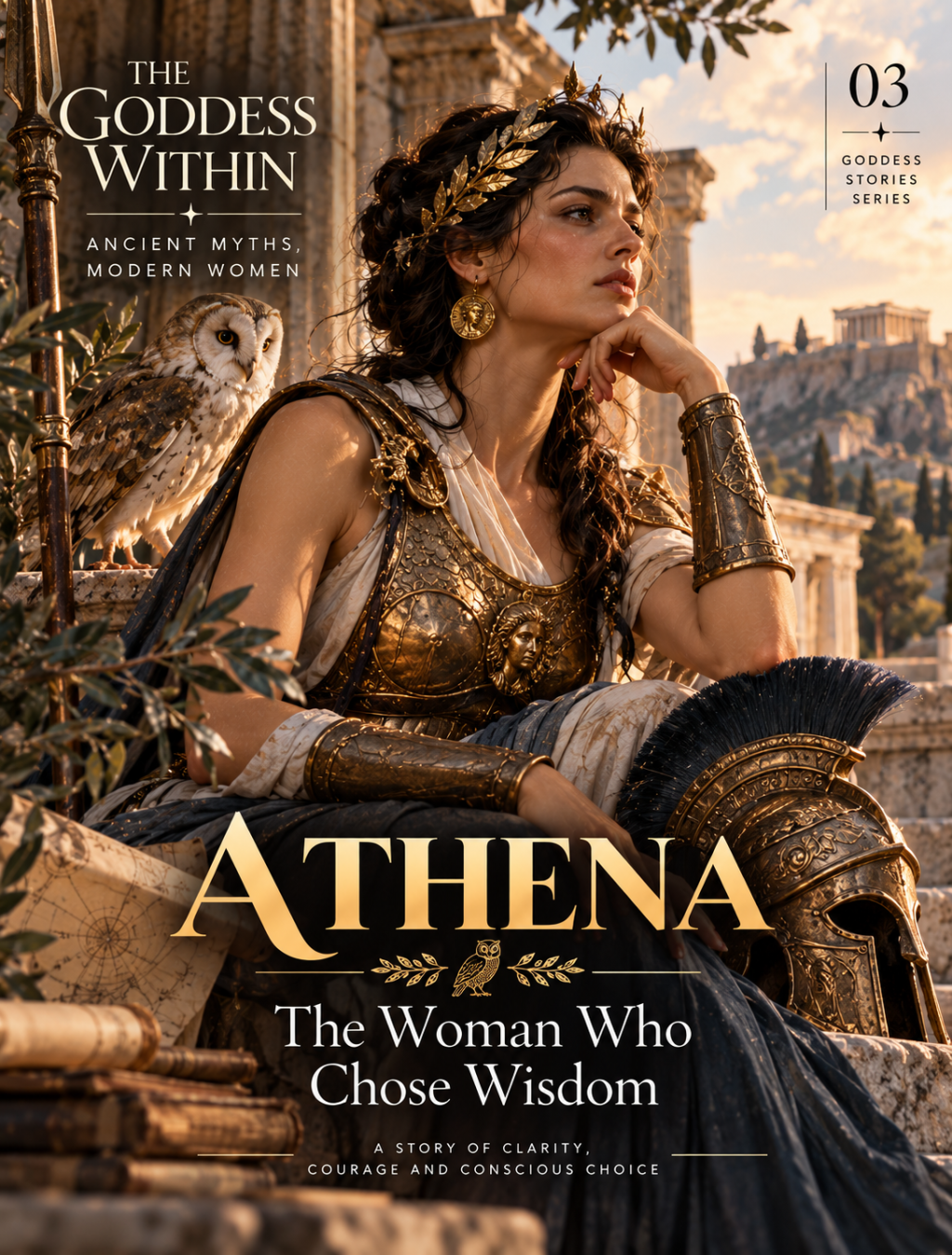
Among the twelve Olympian gods, Athena occupies a remarkable place. Her presence can be found in almost every area of human activity that requires knowledge, ingenuity, skill and the ability to anticipate the consequences of one’s actions.
She is the patroness of warriors and artisans, rulers and inventors. She helps heroes accomplish extraordinary feats, teaches people to cultivate the land and create beautiful things. Cities and temples are dedicated to her, and people turn to her for guidance and protection.
Yet as we explore the ancient myths, we discover how multifaceted and sometimes contradictory the nature of this goddess can be.
And her story begins with the extraordinary mystery of her birth.
The Birth of Athena: The Mystery of Metis
Long before the beautiful Hera became Queen of Olympus, Zeus had another wife. Her name was Metis, and among gods and mortals there was no one who could rival her wisdom. She possessed an extraordinary ability to foresee the consequences of events and find solutions to the most difficult situations.
It was Metis who once helped the young Zeus free his brothers and sisters, whom his father Cronus had swallowed for fear of an ancient prophecy. She prepared a magical potion that forced Cronus to release his children back into the world.
But destiny had prepared a similar challenge for Zeus himself.
When Metis was expecting a child, Gaia and Uranus revealed a great secret to the ruler of Olympus. His wife was destined to bear two children. The first would be a daughter equal to her father in wisdom and strength. The second would be a son destined to become the ruler of gods and mortals.
Zeus knew all too well what such prophecies meant. After all, he had once overthrown his own father.
Metis possessed the gift of transformation and could assume many different forms. Zeus deceived her and swallowed her together with their unborn child.
The danger seemed to have passed. But wisdom cannot be destroyed, even when swallowed by the ruler of Olympus himself.
Metis continued to live within Zeus, offering him advice and helping him make decisions. And within her, their daughter continued to grow.
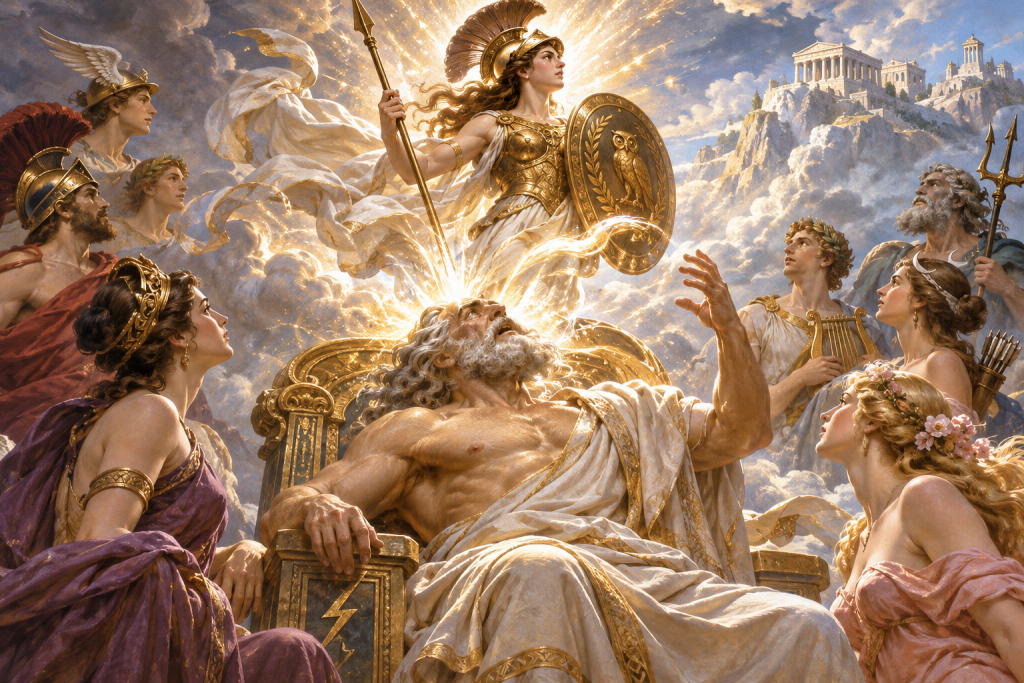 Time passed, until one day Zeus was struck by such a terrible headache that his cries shook the whole of Olympus. None of the gods knew how to help him. Finally, Zeus summoned Hephaestus, the divine blacksmith, and ordered him to split open his head.
Hephaestus raised his heavy axe and struck.
And then something extraordinary happened.
From the head of Zeus emerged a magnificent goddess in shining armor, wearing a golden helmet and carrying a shield and spear. She uttered a mighty battle cry that made the earth and sea tremble. Even Helios, driving his solar chariot across the heavens, halted his fiery horses for a moment.
Thus Athena was born.
She entered the world already endowed with strength and knowledge.
In her, Zeus found a loyal ally, a beloved daughter and a trusted advisor to whom he would even entrust his mighty thunderbolt.
And the wisdom of Metis, which he had once attempted to conceal within himself, acquired a face, a voice and a will of its own.
How symbolic Athena’s birth is! Within her, the wisdom of the great goddess Metis united with the power of the supreme ruler of Olympus. For this new force to acquire an independent existence, the boundaries of the space in which it had developed had to be broken.
Perhaps this ancient myth conceals one of the great mysteries of the birth of a new consciousness: there comes a moment when the knowledge accumulated within seeks an expression of its own in the world.
Yet the armor in which Athena appeared at birth may create a misleading impression of her nature. One of the earliest legends about the goddess reveals an entirely different side of her.
Athena and Pallas: The Story of a Lost Friend
An ancient legend tells how the sea god Triton became Athena’s guardian. He had a daughter named Pallas, with whom Athena spent much of her time.
The two young women practiced the art of warfare together, learning to master the spear and shield. They were worthy opponents and close friends, each taking pleasure in the other’s accomplishments.
One day, the friends engaged in a friendly contest.
Zeus himself was watching. At one point, as Pallas prepared to strike, Zeus feared for his daughter and suddenly displayed his terrifying aegis — his magical protective armor.
Startled, Pallas froze.
Athena was unable to stop the movement of her spear. The blow proved fatal.
In a single moment, the goddess lost her beloved friend.
Athena mourned Pallas deeply. Wishing to preserve her memory, she created a wooden statue in her likeness and adorned it with the aegis.
The statue became known as the Palladium and eventually found its way to the city of Troy. People believed that as long as the sacred Palladium remained within its walls, no enemy would be able to conquer the city.
This legend is also associated with another name of the goddess — Pallas Athena, which we encounter so frequently in Greek mythology.
In this story, we discover an Athena capable of love, grief and devotion to the memory of someone dear to her. Even divine power does not spare her the experience of loss.
Equally remarkable is the way in which the memory of a beloved friend becomes embodied in a sacred object whose power protects an entire city for generations.
When Mythology Becomes Part of Modern Life
The names of the ancient Greek gods continue to live thousands of years later, finding entirely new forms of expression in our world.
In 1802, the German astronomer Heinrich Olbers discovered one of the largest asteroids in our solar system. It was named Pallas in honor of Pallas Athena.
A year later, the English chemist William Wollaston discovered a new precious metal, which he named palladium after the recently discovered asteroid.
Today, palladium is widely used in electronics, medicine, the chemical industry and modern technology.
How fitting that the name of a goddess who presided over craftsmanship, invention and the pursuit of knowledge should find its continuation in science and technological progress.
Ancient mythology has become part of our everyday reality, often without our even realizing it.
Yet perhaps the greatest monument to Athena remains the city that has carried her name for thousands of years.
And the story of how she became its patroness deserves particular attention.
Athena and Poseidon: How Athens Received Its Name
Near the shores of the Aegean Sea, among the rocky hills of Attica, stood a beautiful city ruled by the wise King Cecrops. The city grew and prospered, and in time two powerful gods wished to become its protectors — Athena and Poseidon.
To resolve their dispute, it was decided that each deity would present a gift to the inhabitants. Whoever offered the most valuable gift would become the city’s patron.
Poseidon stepped forward first. The ruler of the seas raised his enormous trident and struck the rock with such force that the earth trembled. A spring burst forth from the opening. The people approached in admiration, but when they tasted the water, they discovered that it was as salty as the sea itself.
Then came Athena’s turn.
The goddess touched the earth, and a tiny green shoot emerged. Before the astonished inhabitants, it grew into a beautiful tree with silvery-green leaves and fruit they had never seen before.
It was an olive tree.
Athena had given the people a tree whose fruit could provide both food and precious oil. Its oil could illuminate their homes, be used to care for their bodies, support trade and bring prosperity to generations yet unborn.
Cecrops recognized Athena’s gift as the more valuable, and the goddess won the contest.
From that time onward, the city became known as Athens, and the olive tree became one of the most revered trees in Greece, a symbol of peace, prosperity and wisdom.
Magnificent temples were built in honor of the goddess on the summit of the Acropolis. Athena’s sacred olive tree continued to live even when wars and fires devastated the city. According to an ancient account, after the Persians burned the Acropolis, a new green shoot emerged from the charred tree the very next day.
Athens was reborn together with its sacred tree.
In this myth, the creative nature of the goddess becomes particularly apparent. Among the countless gifts she could have offered humanity, Athena chose a living organism capable of growing, developing, reproducing and sustaining human life for centuries.
Within a single tiny shoot lay the prosperity of future generations.
Perhaps the ability to envision the future of what we create today is one of the most beautiful expressions of Athena’s wisdom.
But the goddess also cared for the well-being of her city in another, rather unusual way. She was destined to raise one of its future rulers.
Athena and Hephaestus: The Child Born of the Earth
Among the Olympian gods, there was one who shared Athena’s love of craftsmanship and invention. He was Hephaestus, the great blacksmith capable of creating extraordinary things from fire and metal.
One day, Athena visited his forge to commission some weapons. But Hephaestus, captivated by the beautiful goddess, was overcome by desire and attempted to force himself upon her.
Athena fiercely resisted and managed to escape. The seed of Hephaestus fell upon her leg. With disgust, she wiped it away with a piece of wool and threw it onto the ground.
And then a miracle occurred.
The Earth, the great primordial mother Gaia, received the seed of the god, and from her a child was born. He was named Erichthonius.
Athena did not abandon this extraordinary infant. She decided to care for him, raise him and grant him immortality.
To protect the secret of his birth, the goddess placed the child inside a closed chest and entrusted it to the three daughters of King Cecrops — Aglaurus, Herse and Pandrosus.
“Guard this chest,” Athena told them. “But whatever happens, never open it.”
For some time, the young women obeyed the goddess. Eventually, however, curiosity overcame Aglaurus and Herse. What was Athena hiding? Why were they forbidden even to glance inside?
Finally, they lifted the lid.
Inside lay an infant surrounded by serpents. The sight filled the young women with such terror that they lost their minds and threw themselves from the heights of the Acropolis.
Pandrosus, who had remained faithful to the goddess’s instructions, survived.
After this tragedy, Athena took responsibility for raising Erichthonius herself. Under her protection, he grew up to become King of Athens, taught people the art of driving chariots and established festivals in honor of his divine guardian.
Thus Athena, who had never married or given birth to children of her own, became the guardian and foster mother of a future king.
And the serpent, associated with the mystery of Erichthonius’s birth, remained one of the sacred symbols of the goddess.
It is fascinating to observe how the energies of three deities intertwine in this story. Hephaestus provides the seed of life, the great Earth brings the child into existence, and Athena assumes responsibility for his development and upbringing.
The virgin goddess reveals another expression of feminine nature — the capacity to become a mother to a being she did not physically bring into the world.
Although the circumstances surrounding the birth of Erichthonius arose from an offense against Athena, she does not direct her feelings about the actions of Hephaestus toward the innocent child.
Her response in another legend, also involving an Olympian god’s violation of a woman, is therefore all the more surprising.
This time, we encounter an entirely different side of Athena.
Athena and Medusa: The Deadly Gaze
Once, Medusa was a beautiful young woman. She was particularly renowned for her magnificent hair, which inspired admiration in everyone who saw her.
Medusa’s beauty attracted the attention of Poseidon himself. The ruler of the seas violated her in Athena’s temple, desecrating the sacred space of the goddess.
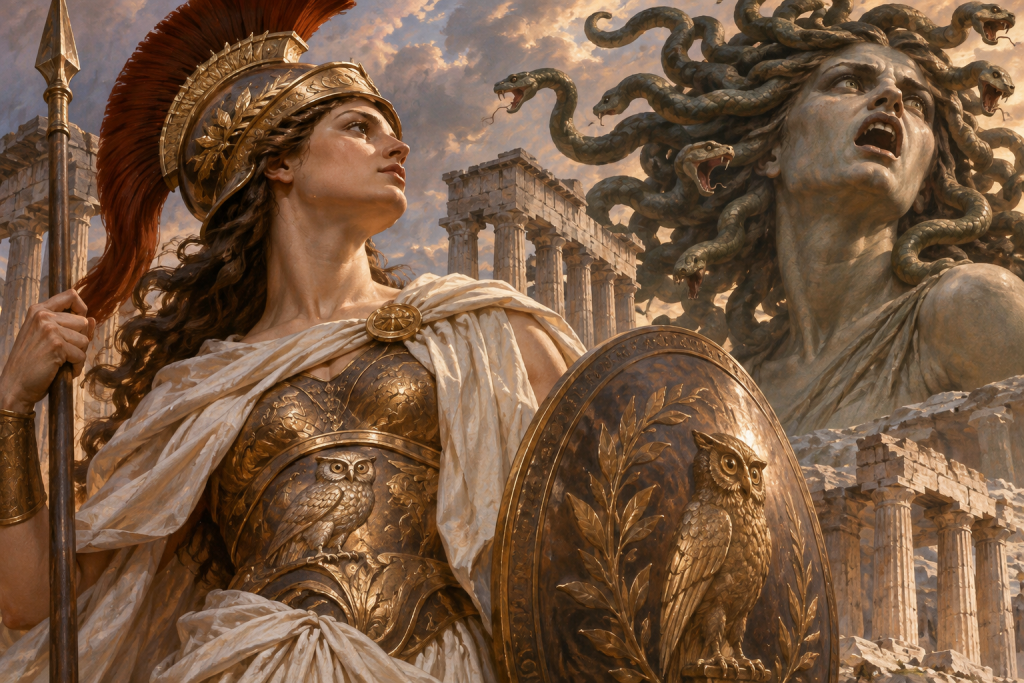 Enraged, Athena directed her punishment toward Medusa. Her beautiful hair was transformed into a mass of living, venomous serpents, and her gaze became deadly. Anyone who looked into her eyes was instantly turned to stone.
Medusa withdrew from the world of humanity and settled at the far edge of the earth with her Gorgon sisters. Around her dwelling stood the stone figures of those who had dared to approach her.
Years passed.
On the island of Seriphos lived a young hero named Perseus, the son of Zeus and the beautiful Danaë. King Polydectes, wishing to rid himself of the young man, ordered him to bring back the head of Medusa.
The task seemed impossible. How could anyone defeat a creature upon whom they could not even look?
Athena and Hermes came to Perseus’s assistance. The gods helped him acquire magical weapons and discover the way to the dwelling of the Gorgons.
Athena gave Perseus a shining bronze shield, its surface polished like a mirror.
“Look only at her reflection,” the goddess instructed him. “Then her gaze will have no power over you.”
When Perseus reached the dwelling of the Gorgons, Medusa was asleep. The serpents upon her head moved slowly, and an ominous silence surrounded her.
Keeping his eyes fixed upon her reflection in the shield, Perseus approached Medusa. Athena guided his hand, and with a single blow he severed the Gorgon’s head.
At that very moment, two extraordinary beings emerged from Medusa’s body — the winged horse Pegasus and the warrior Chrysaor, the children of Poseidon.
Perseus placed the Gorgon’s head inside a magical bag and hurried away. Even after Medusa’s death, her eyes retained their terrifying power.
The hero later used that power on several occasions to protect himself and those he loved. When his adventures came to an end, he presented the head of Medusa to Athena.
The goddess placed it upon her aegis.
From that time onward, the face of the Gorgon adorned Athena’s chest, capable of striking terror into even the most courageous warriors. The power that had once terrified humanity became part of the goddess’s own divine protection.
This is perhaps one of the most tragic and contradictory stories about Athena. It brings to mind the myths of Hera, in which mortal women suffered punishment for the actions of Zeus.
Why does the goddess of wisdom punish someone who has already experienced violence? How are we to understand the transformation of a beautiful woman into a terrifying creature? And why does Athena subsequently make this destructive power part of her own protection?
These questions invite us to reflect upon the complexity of the divine forces represented through human mythology.
We will return to a deeper exploration of this story in our article about the Athena archetype.
For now, let us meet another mortal woman whose destiny became intertwined with the anger of the great goddess.
Athena and Arachne: A Contest with a Goddess
In distant Lydia lived a young weaver named Arachne. She came from a humble family, yet possessed such extraordinary talent that her reputation spread far beyond her native town.
People traveled from neighboring villages to watch her beautiful fabrics take shape. Even the nymphs left their forests and springs to admire her work.
Beneath Arachne’s hands, wool became delicate threads, and the threads became extraordinary images. The birds she wove seemed ready to take flight, the flowers appeared to release their fragrance, and the waves seemed about to move.
Many believed that only Athena herself, the patroness of weaving and craftsmanship, could have taught her such an art.
But Arachne was indignant.
“No one taught me!” she declared. “Everything I know, I have created with my own hands. Let Athena herself come and try to surpass me!”
Her words reached Olympus.
One day, a gray-haired old woman appeared before Arachne, leaning upon a staff.
“You are indeed a great weaver,” she said. “Take pride in your art, but do not challenge a goddess. Ask Athena to forgive you, and she will.”
Arachne merely laughed.
“If Athena is so skillful, why does she not come herself?”
In that instant, the old woman was transformed. Standing before Arachne was the majestic goddess.
Everyone present bowed before Athena. Only Arachne remained standing.
The contest began.
Two looms stood beside one another, and the two weavers created their tapestries with astonishing speed.
Athena depicted the majesty of the Olympian gods, her contest with Poseidon and the victory that had made her the patroness of Athens. In the four corners of her tapestry, she illustrated the punishment of mortals who had dared to challenge the immortals.
Arachne chose entirely different subjects.
Upon her tapestry appeared stories of gods deceiving mortal women, assuming the forms of animals, abducting beautiful maidens and taking advantage of their power.
There was Zeus as a white bull carrying away the beautiful Europa. There was the golden shower entering the chamber of Danaë. There was Leda encountering the divine swan.
One after another, stories emerged that the immortals might have preferred to forget.
When the work was complete, Athena carefully examined Arachne’s tapestry. It was flawless. Even the goddess could find no fault in its craftsmanship.
But the scenes it depicted filled her with rage.
Athena tore the beautiful fabric apart and struck Arachne with her weaving shuttle.
Unable to bear the humiliation, the young woman attempted to hang herself. Athena, however, prevented her from dying.
“You shall live,” the goddess declared, “and you shall weave forever.”
She sprinkled Arachne with the magical essence of one of Hecate’s herbs. The young woman’s body began to shrink, her arms and legs became slender limbs, and a silvery thread emerged from her body.
Thus Arachne became a spider.
To this day, her descendants create their extraordinary webs, inspiring admiration for the perfection of their patterns and the delicacy of their craftsmanship.
In modern science, Arachne’s name survives in the classification Arachnida and in arachnology, the scientific study of spiders and other arachnids.
The legend itself opens a fascinating subject: the relationship between human talent and its divine origin.
Arachne possessed craftsmanship worthy of Athena herself. How extraordinary her artistic ability must have been for a mortal woman to create a tapestry whose perfection even the goddess had to acknowledge!
But at what point does admiration for one’s own gift become pride? And why, having retained her ability to weave, did Arachne lose her creative freedom and become condemned to the endless repetition of the same activity?
We encounter a similar theme in the story of another mortal to whom Athena granted extraordinary possibilities.
Athena and Bellerophon: The Golden Bridle of Pegasus
After the death of Medusa, the magnificent winged horse Pegasus gained his freedom. He flew over mountains and seas, descended to mountain springs and disappeared into the clouds before anyone could approach him.
Many dreamed of taming the divine horse, but none succeeded.
Among them was a young hero named Bellerophon, who was destined to accomplish an almost impossible feat.
The King of Lycia had ordered him to destroy the Chimera — a terrifying, fire-breathing monster combining the features of a lion, a goat and a serpent. No one who approached the Chimera returned alive.
Bellerophon understood how difficult it would be to defeat the monster on the ground. But if he could rise into the air upon the winged Pegasus, he might have a chance.
Following the advice of the seer Polyidus, the hero went to a sanctuary of Athena and spent the night there.
In a dream, the goddess appeared before him. In her hands she held a golden bridle.
“Take it,” Athena said. “And go to the spring where Pegasus drinks.”
When Bellerophon awoke, he was astonished to discover the very same golden bridle lying beside him.
He hurried to the spring of Pirene. There, bending toward the clear water, stood a magnificent white horse with enormous wings.
Bellerophon approached and placed the divine bridle upon him. Pegasus allowed the hero to climb onto his back.
A moment later, they were soaring above the earth.
From the air, Bellerophon attacked the Chimera, evaded its fiery breath and succeeded in destroying the monster.
Other victories followed. The hero’s fame grew, and gradually Bellerophon came to believe that he deserved to live among the immortal gods.
One day, he directed Pegasus toward the summit of Olympus.
But Zeus would not allow a mortal to ascend to the dwelling place of the gods. He sent a gadfly to sting Pegasus. The horse suddenly reared, Bellerophon lost his balance and fell to the earth.
The hero spent his remaining years in solitude.
Pegasus continued his flight, reached Olympus and remained among the immortals, carrying the thunderbolts of Zeus.
Athena’s golden bridle is one of the most fascinating symbols of her divine nature. Through this gift, a human being gains the ability to interact with a force far greater than his own, direct it and accomplish what once seemed impossible.
Athena can give a person the means of guiding such a force, but the choice of direction remains their own.
If Pegasus symbolizes the possibility of rising above the familiar limitations of human existence, the golden bridle reminds us of the wisdom required to use that possibility.
The image of the winged horse continues to live in modern culture. Pegasus has become a symbol of inspiration, poetry and the flight of imagination. In the night sky, an entire constellation bears his name.
Athena’s ability to help people discover unusual solutions and achieve seemingly impossible goals became particularly evident during the greatest war of Greek mythology.
Athena and the Trojan War: The Art of Victory
For ten long years, war raged between the Greeks and the Trojans. Thousands of warriors fought beneath the walls of Troy, while the immortal gods watched their battles and participated in them.
Athena sided with the Greeks.
On the battlefield, she repeatedly encountered Ares, the god of war, who delighted in the noise of battle, the clash of weapons and the fury of combat.
On one occasion, when Ares attacked the Greek warriors, Athena stood beside the hero Diomedes. She guided his spear, and the weapon of a mortal wounded an immortal god.
The battlefield trembled at the cry of the wounded Ares. He hurried back to Olympus to complain to Zeus about the actions of his daughter.
But Athena played an especially important role in the encounter between two of the greatest heroes of the Trojan War — Achilles and Hector.
Hector, the defender of Troy, understood the danger posed by the enraged Achilles. Three times they ran around the city walls before Athena decided to intervene.
The goddess appeared before Hector in the likeness of his brother Deiphobus.
“Stop, brother!” she called. “Together we can defeat Achilles.”
Encouraged, Hector turned to face his opponent.
The duel began. Hector threw his spear but failed to wound Achilles. He then turned toward his brother to obtain another weapon.
There was no one beside him.
At that moment, Hector realized that the gods had abandoned him and that Athena had deceived him. But it was already too late to retreat.
He drew his sword and entered his final battle.
Achilles emerged victorious.
Yet even the death of Troy’s greatest defender did not bring the Greeks their final victory. The formidable walls of the city remained impenetrable.
The sacred Palladium, which Athena had once created in memory of her beloved friend, was still within Troy, protecting the city.
According to ancient tradition, the Greeks would first have to deprive the Trojans of this divine protection before they could conquer them.
Odysseus and Diomedes secretly entered the city and stole the sacred statue.
Then Odysseus devised an ingenious plan.
With Athena’s assistance, the skilled craftsman Epeius built an enormous wooden horse. The finest Greek warriors concealed themselves inside it, while the rest of the army sailed away from the shore, pretending to abandon Troy forever.
In the morning, the Trojans discovered the deserted camp and the enormous horse. Believing it to be a sacred offering to Athena, they brought it inside the city walls.
The inhabitants celebrated the end of the war. No one suspected that armed warriors were waiting in absolute silence inside the wooden horse.
When night fell and Troy surrendered to sleep, the Greeks emerged from their hiding place and opened the gates to the returning army.
Thus fell the magnificent city of Troy.
What thousands of warriors had failed to achieve during ten years of fighting was accomplished in a single night through the ingenuity of Odysseus and the craftsmanship of Athena.
These legends reveal the difference between two deities associated with warfare — Ares and Athena. Ares embodies the fury of battle and the elemental force of destruction. Athena possesses the art of strategy, the ability to choose the right moment, anticipate an opponent’s actions and use circumstances to achieve an objective.
Yet Hector’s story also invites us to consider the moral dimension of victory. While admiring the brilliance of a strategy, we may simultaneously feel profound compassion for those whose lives were sacrificed in its execution.
The ancient myth of the Trojan Horse continues to live in our world. Its name has become a term for a hidden threat entering a protected space disguised as something harmless or beneficial. Even in computer technology, we encounter the concept of a Trojan program.
But for Athena’s beloved hero Odysseus, the fall of Troy was only the beginning of another great ordeal.
He had yet to find his way home.
Athena and Odysseus: Ten Years on the Journey Home
Among all mortal heroes, Odysseus, the king of the small island of Ithaca, held a particularly special place in Athena’s heart.
He possessed an agile mind, ingenuity, eloquence and an extraordinary ability to find a way out of seemingly hopeless situations. The goddess valued in him the very qualities she possessed herself.
After the fall of Troy, Odysseus set out for home, where his wife Penelope and son Telemachus were waiting for him.
But a journey that should have taken weeks or months stretched into ten long years.
Odysseus survived encounters with the one-eyed Cyclops Polyphemus, the enchantress Circe, the sweet-voiced Sirens and terrifying sea monsters. He lost his ships and all his companions and eventually found himself on the island of the beautiful nymph Calypso.
Calypso fell in love with Odysseus and offered him immortality if he agreed to remain with her forever.
Yet every day, Odysseus would sit upon the shore, gazing into the distance and dreaming of seeing his beloved Ithaca again.
Athena knew of his suffering.
One day, at a council of the gods, she appealed to Zeus and asked him to allow the hero to return home. Zeus listened to his daughter and sent Hermes to Calypso with instructions to release Odysseus.
Meanwhile, Athena herself traveled to Ithaca.
The palace of Odysseus was filled with Penelope’s suitors. Convinced that the king had died long ago, they demanded that his wife choose a new husband.
For years, Penelope deceived them. She promised to make her decision as soon as she had finished weaving a burial shroud for Odysseus’s father. During the day, she worked at her loom, and at night she unraveled everything she had woven.
Athena appeared before Telemachus in the likeness of an old friend of his father and encouraged him to set out in search of news of Odysseus. Later, assuming the appearance of the wise Mentor, she guided him on his journey.
At last, the day came when Odysseus set foot upon the shores of Ithaca.
Athena met him in the likeness of a young shepherd. Even then, failing to recognize the goddess, Odysseus attempted to conceal his identity and told her an invented story about his travels.
Athena smiled and revealed her true form.
She knew this man well. Even after returning home following twenty years of absence, he had lost neither his caution nor his ability to invent a convincing story in an instant.
Together, they developed a plan for his return to his own palace.
The goddess transformed the handsome and powerful hero into an elderly beggar. His skin became wrinkled, his hair grew thin, and his magnificent garments were replaced by rags.
In this disguise, he was able to enter his home and observe for himself everything that was taking place.
Then came the famous contest of the suitors. Penelope announced that she would marry the man who could string the powerful bow of Odysseus and send an arrow through the openings of twelve axe heads.
One after another, the suitors attempted the challenge. None succeeded.
Finally, the elderly beggar asked for the bow.
Amid the mockery of those gathered, he took the weapon, effortlessly strung it and released an arrow. It passed through all twelve openings.
Odysseus revealed his identity.
A battle followed, in which Telemachus and loyal servants assisted him. Athena remained nearby, guiding events and protecting her hero.
When it was all over, Odysseus was finally able to embrace Penelope.
And when the relatives of the slain suitors attempted to avenge their deaths, Athena intervened once more and established peace on Ithaca.
Thus ended twenty years of separation.
Throughout this extraordinary story, Odysseus was accompanied by a goddess who understood him better than many gods and mortals.
In the relationship between Athena and Odysseus, we can recognize a beautiful example of the interaction between human and divine consciousness. The goddess opens new possibilities before the hero, helps him perceive what is hidden from his awareness and guides him through decisive moments. Yet it is Odysseus himself who must live his life, undergo its trials and accomplish his return home.
It is equally interesting that Athena’s qualities emerge through Penelope. Her patience, ability to manage circumstances and skillful use of her craft to preserve her family prove no less important than the heroic achievements of Odysseus.
And the name of Mentor, whose appearance Athena assumed while guiding Telemachus, eventually came to describe a person who shares knowledge and experience, guides others and supports their development.
In the story of Odysseus, Athena concludes her involvement by restoring peace to Ithaca. But there is another great myth in which her ability to resolve conflict acquires significance for human civilization as a whole.
Athena and the Trial of Orestes: The End of Blood Vengeance
After the Trojan War, another terrible tragedy unfolded in Greece.
King Agamemnon returned home after ten years of fighting. There awaited him his wife Clytemnestra, who had never forgiven him for the death of their daughter Iphigenia, sacrificed before the expedition to Troy.
Together with her lover Aegisthus, Clytemnestra murdered the returning king.
Years later, Agamemnon’s son Orestes, following the command of Apollo, avenged his father’s death. He killed Aegisthus and his own mother.
No sooner had this terrible crime been committed than the Erinyes appeared before Orestes. These ancient goddesses of vengeance pursued those who had shed the blood of their own relatives.
They could not be deceived, bribed or persuaded to forget what had been done. They followed Orestes everywhere, depriving him of peace and gradually driving him toward madness.
In desperation, Orestes turned to Athena.
The goddess listened to his story and recognized the extraordinary complexity of the situation. Orestes had obeyed the command of Apollo and avenged his father’s murder, yet in doing so, he had become the murderer of his own mother.
Athena summoned the citizens of Athens and established a court upon the Hill of Ares — the Areopagus.
The Erinyes became the accusers of Orestes, while Apollo undertook his defense.
The dispute continued for a long time.
The Erinyes argued that a mother’s blood was sacred and that nothing could justify her murder. Apollo spoke of a son’s duty to avenge his father’s death.
When the time came to reach a verdict, Athena revealed her own position. Born from the head of Zeus and regarding herself primarily as her father’s daughter, she cast her vote in favor of Orestes.
The votes were equally divided, and Orestes was acquitted.
But the story did not end there.
Enraged, the Erinyes threatened to curse Athens, make its land barren and bring misfortune upon its inhabitants. They felt that the new order was depriving them of their ancient authority.
Athena did not engage them in battle.
She offered the ancient goddesses a sanctuary of their own in Athens, together with honor and respect. From that time onward, the people of the city would bring them offerings, address them in prayer and recognize their great power.
Gradually, the anger of the Erinyes subsided.
They accepted Athena’s proposal and became benevolent protectors of the city. People began to call them the Eumenides — the gracious goddesses.
Thus Athena established a new order in which a person’s guilt would be determined through a court of law, while the ancient forces of vengeance found a new place in human life.
In this myth, we can recognize one of the most important stages in the development of human civilization — the transition from blood vengeance to public justice.
Every murder in the family of Agamemnon became the cause of another. As long as the law demanded revenge, this chain of violence could continue indefinitely.
Athena creates a space in which conflict becomes a matter of public deliberation and can be resolved through the establishment of a new law.
Yet her own decision raises questions about the value of motherhood and the position of women within the emerging social order. This aspect of the myth reveals how deeply our understanding of justice is influenced by the culture, historical period and worldview of society.
The conclusion of this story is particularly beautiful.
Athena finds a way to integrate the ancient goddesses into a new order of existence. She recognizes their power and significance and grants them an honorable place in the life of the city.
The energy of vengeance is transformed into the energy of protection.
Perhaps it is here that Athena reveals one of the highest expressions of her wisdom — the ability to create a new reality in which even opposing forces can coexist and contribute to a common purpose.
The Legacy of Athena
Thousands of years have passed, yet Athena can still be encountered in the streets of modern Athens, in sculpture, painting, architecture and the symbols of universities and scientific institutions.
Her faithful companion, the owl, has become a symbol of wisdom and knowledge. The olive branch symbolizes peace. Her helmet, spear and aegis remind us of her ability to protect and overcome adversity.
The Romans worshipped a closely related goddess, Minerva, and through Roman culture, her image continued its journey into the history of European civilization.
But having explored the principal myths of Athena, we can discover far more than the familiar image of a wise woman in shining armor.
Before us stands a great craftswoman, a guardian of knowledge, a foster mother, a patroness of heroes, a creator of laws and a protector of human civilization. She is capable of love and grief, admiration for human craftsmanship and fierce confrontation with those who challenge her.
We encounter her at the loom and on the battlefield, beside a great artisan and among assembled judges, in the palace of a king and aboard the ship of a wandering hero.
And how many traces of her presence can we discover in modern life without even considering their origins! From the olive tree to a precious metal, from the art of mentorship to sophisticated technologies, from military strategy to the principles of public justice.
Through the study of ancient mythology, we gradually begin to recognize how deeply the history of human civilization is intertwined with humanity’s exploration of divine forces.
For thousands of years, people have attempted to understand their nature, creating images of gods, telling stories about their relationships and using those stories to make sense of events within their own world.
Today, we can continue this exploration by turning our attention inward.
What happens when the energy of Athena awakens within a human being? What possibilities does it open for a contemporary woman? How does it manifest in her creativity, professional life, relationships, love and pursuit of knowledge?
And how can Athena within us undertake her own journey from extraordinary intellect to extraordinary wisdom?
We will explore these questions in our next article — Athena as an Archetype: From Intellectual Power to the Wisdom of a Whole Being.
References and Mythological Sources
- Jean Shinoda Bolen. Goddesses in Everywoman.
- Galina Bednenko. Greek Goddesses: Archetypes of Femininity.
- Hesiod. Theogony.
- Homeric Hymn to Athena (XXVIII).
- Apollodorus. Bibliotheca.
- Homer. The Iliad and The Odyssey.
- Ovid. Metamorphoses.
- Pindar. Olympian Odes.
- Aeschylus. The Eumenides.
- Herodotus. Histories.
- Original philosophical interpretation of mythology — AMOREI Consciousness Project.