The Hera Archetype: Sacred Union, Feminine Dignity, and the Shadow Side of Expectations
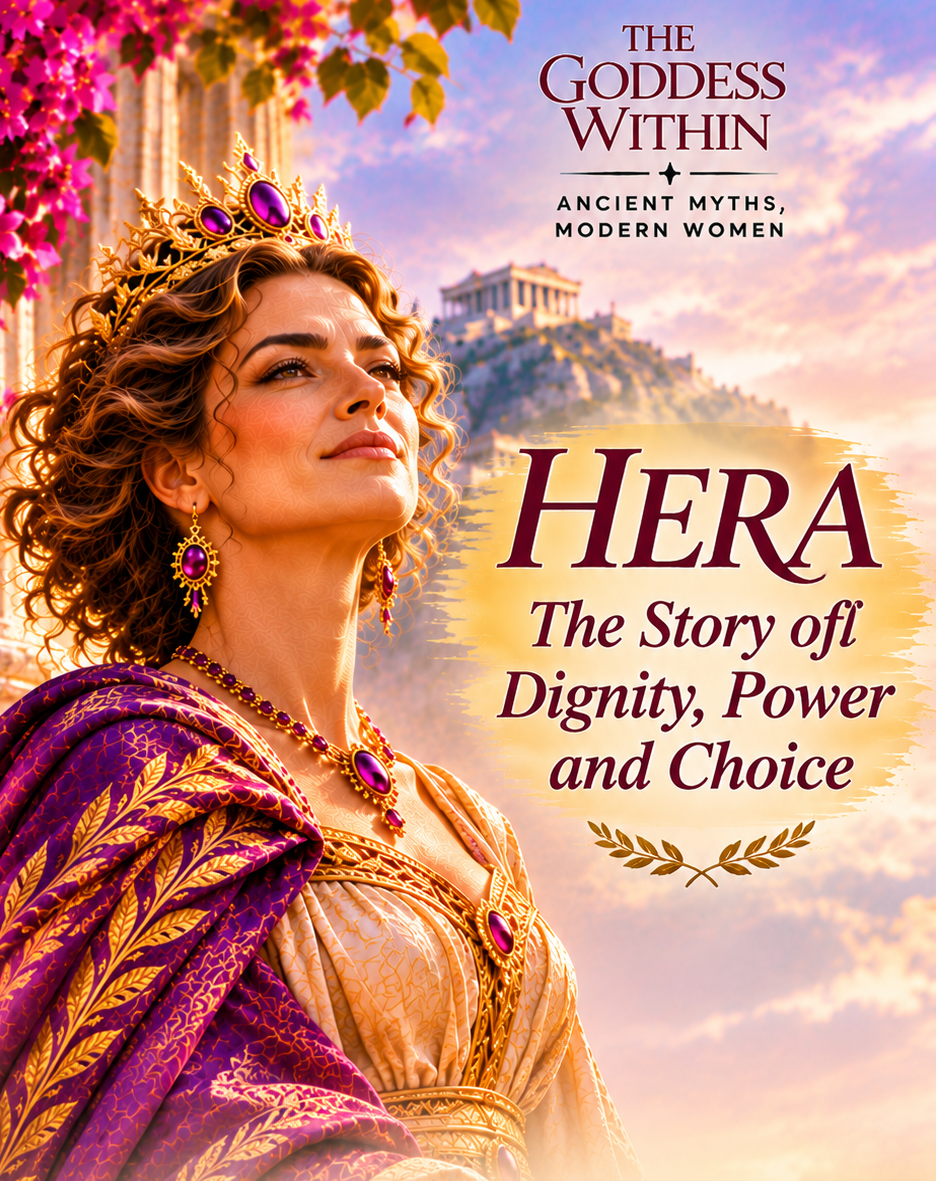
How to embrace deep love and devotion while remaining confident, free, and whole within yourself
Some women experience love and marriage as one of the deepest and most meaningful parts of life. They have a natural ability to build lasting relationships, remain devoted to their partners, stand beside them through difficult times, and create a shared life in which two people gradually become true partners.
For such a woman, marriage means much more than a social status or an official commitment. It is a promise she makes not only to the person she loves, but also to herself. It is a conscious choice to share a journey, with all its joys, challenges, achievements, and passing years.
This capacity for devotion, loyalty, and lasting partnership reflects the archetype of Hera, the great Greek goddess.
Hera is the Queen of Olympus, the wife of Zeus, and the guardian of sacred marriage. She possesses royal dignity, immense power, and the recognition of the immortal gods. She is honored in magnificent temples, and women turn to her when they wish to marry, build a family, and find happiness in their married lives.
Yet her own story contains a remarkable contradiction.
Despite all her greatness as the heavenly Queen, Hera constantly struggles for recognition, for her position, and for her husband’s faithfulness.
She rules Olympus, yet she does not feel secure in love. Her dignity is recognized by gods and mortals alike, but she seems to need constant reassurance of her own worth.
And this brings us to the central question of her archetype:
Why can a woman who possesses extraordinary strength, beauty, dignity, and power still question her own value when the man she loves does not continually affirm it?
To understand this, we need to explore Hera’s inner nature: the powerful energy that can create a sacred union, but can also turn love into attachment, devotion into demands, and feminine dignity into an endless struggle for recognition.
Hera as an Archetype: The Energy of Sacred Union
In analytical psychology, archetypes are universal patterns and images that shape human experiences, relationships, and behavior.
Within the AMOREI philosophy, we also explore goddess archetypes as expressions of divine energy, different qualities that can awaken and unfold within every human being.
Each goddess represents a particular power, a way of relating to the world, and a quality of consciousness.
Aphrodite expresses love, beauty, sensuality, and creative inspiration. Athena brings intelligence, strategic thinking, and the ability to act with clarity. Artemis represents independence, determination, and freedom.
Hera carries the energy of union.
Her power comes alive when two people choose each other and begin creating a shared life.
She helps transform falling in love into a lasting relationship, and the first spark of attraction into a deeper connection that continues long after the initial excitement has settled.
Hera brings the ability to remain beside someone not only during joyful moments, but also when a relationship requires patience, responsibility, and mutual effort.
In a woman, this archetype can awaken a deep desire to become a wife, belong to a committed partnership, and experience life as part of a couple. This desire may exist independently of social expectations about marriage. For some women, it becomes one of their strongest inner motivations.
But there is an important distinction.
Wanting to create a loving partnership is not the same as needing that partnership to prove your worth.
In the first case, a woman enters a relationship already feeling whole within herself. She chooses to share her life with another person.
In the second, she may hope that a man’s love, loyalty, and recognition will finally make her feel complete.
This is where the shadow side of Hera begins to emerge.
The Queen Who Doubts Her Own Greatness
Let us look again at Hera herself.
She is a great goddess, daughter of Rhea and Cronus, and sister to the most powerful Olympian gods. Her divine origin already gives her extraordinary dignity and status.
Yet her position as Queen of Olympus is also connected to her marriage to Zeus.
And here we find a subtle dependency: Hera possesses greatness in her own right, but much of her authority and public identity is tied to being the wife of the supreme god.
For a woman strongly influenced by Hera, marriage may become more than an expression of love. It can also serve as proof that she has succeeded in life, found her rightful place, and gained recognition.
This creates a dangerous dependency.
If my dignity comes from being a particular man’s wife, what happens if he stops choosing me?
If my position depends on his faithfulness, how can I feel secure when he gives his attention to another woman?
If I see his love as proof of my value, doesn’t every one of his actions become a test of whether I am worthy of love?
This is Hera’s inner conflict.
A woman may possess remarkable abilities, intelligence, beauty, wealth, influence, and the respect of others.
Yet all of it can suddenly seem insignificant when the man she loves makes her question her place beside him.
She begins fighting for more than the relationship itself.
She is fighting to preserve her sense of worth.
And the stronger this dependency becomes, the harder it is for her to recognize that her dignity never belonged to another person in the first place.
No one can give a woman her inherent worth, because it already belongs to her.
A man can love her, appreciate her, respect her, and share his life with her. But he is not the source of her existence or her dignity.
Hera’s mythology also reveals another side of this relationship.
When the goddess decides to leave Zeus and withdraws from Olympus, he does not want to lose her. He invents an elaborate story about taking a new bride, stages a wedding procession, and finds a way to bring his wife back.
It turns out that Hera is not the only one attached to their marriage. Zeus needs her too, and he does not want their union to end.
This is an important reminder for a woman who has become so focused on the fear of losing her partner that she no longer recognizes her own importance in his life.
She may be just as important to him as he is to her.
Her love, her presence, her individuality, and everything she brings into the relationship have value.
When a woman begins to understand this, she can stop fighting for recognition and start building a relationship based on mutual appreciation.
This realization is one of the most important steps toward the mature expression of Hera.
Love, Loyalty, and the Ability to Create a Lasting Union
Before exploring the difficulties of this archetype, we need to recognize its greatest gift.
Hera possesses an extraordinary ability to create lasting relationships.
In a world where people often chase new experiences, leave relationships at the first sign of difficulty, or confuse love with the excitement of early attraction, Hera reminds us of a different kind of intimacy.
She understands the value of time.
For her, love unfolds not only in the moment two people meet, but also through the years they share.
Through gradually getting to know each other.
Through facing changes together.
Through learning to understand their differences, accept each other’s individuality, and remain connected when life becomes difficult.
Hera helps create a space of trust where each person can rely on the other’s presence.
She has the strength to honor commitments without abandoning them at the first disappointment.
In its mature expression, this energy becomes the foundation of a deep partnership.
But one condition is essential: faithfulness must remain a free choice made by both people.
If one partner remains faithful while the other treats loyalty as an obligation that applies only to someone else, the sacred union gradually becomes an unequal relationship.
If a woman believes she must preserve her marriage at any cost, even when respect and mutual commitment are absent, her devotion can become a source of suffering.
Hera teaches us the value of commitment, but the maturity of her archetype also requires the ability to distinguish loyalty to love from attachment to the institution of marriage itself.
Because keeping a relationship together and keeping love alive are not always the same thing.
In everyday life, we sometimes see men who move from one relationship to another for years, constantly seeking new experiences without wanting to settle down. Yet meeting a particular woman can change the way they understand love.
A man may discover that he feels deeply comfortable with her, that he can be himself, and that their connection offers a level of understanding he has never experienced before. He may no longer feel the desire to seek reassurance of his attractiveness through new romantic encounters.
The woman, meanwhile, does not monitor his every move or try to keep him through fear and demands. She has her own life, interests, inner stability, and the ability to love without constant anxiety.
In such a relationship, a man may freely choose faithfulness because he values the intimacy they have created.
Of course, a woman’s inner confidence does not automatically guarantee that a man will change. Faithfulness remains his own choice and responsibility. But when two people genuinely love each other, feel free within the relationship, and find deep fulfillment together, the desire to seek something elsewhere may fade.
This is how Hera’s mature energy unfolds: a woman chooses a man who can share the depth of connection she desires, and together they create a relationship in which both feel at home.
Sacred Marriage: The Union of Two Whole Beings
In ancient mysteries and spiritual traditions, marriage is often understood as a sacred event.
It brings masculine and feminine principles together, creating a space for new life, shared creativity, and spiritual growth.
In Greek mythology, the union of Zeus and Hera represents one form of sacred marriage, known as hieros gamos.
But beyond the outward union of a man and a woman lies an even deeper possibility.
A relationship can become a space where each person discovers and develops new aspects of their own nature.
A woman does not stop being herself when she joins her life with a man.
A man does not lose his individuality when he welcomes a woman into his world.
Their closeness can help both become more complete.
The experience of sacred marriage is not limited to an official wedding or a legal partnership. It can also reflect an inner sense of harmony between masculine and feminine principles.
In this understanding, sacred union begins with inner wholeness.
A woman does not search for a man to fill an emptiness within her. She meets him as a complete human being, capable of loving and being loved.
And a man does not enter the relationship to gain power over a woman or turn her into an extension of himself.
They choose each other.
Their love becomes a meeting of two conscious beings, two life journeys, and two free individuals.
This is where Hera’s archetype can reveal its full greatness.
Her royal dignity no longer requires constant reassurance. Her loyalty no longer grows out of fear of loss. Her ability to create a lasting union becomes a free expression of love.
When Love Becomes Attachment
One of the greatest challenges of the Hera archetype appears when a woman begins to identify herself entirely with her relationship.
Her own life gradually moves into the background.
She makes decisions based on her husband’s preferences. His mood determines her emotional state. His attention brings happiness, while his distance creates anxiety.
Even if she has a career, friends, interests, and achievements of her own, she may still experience her relationship as the main foundation of her existence.
In this situation, love gradually becomes mixed with attachment.
Attachment itself is a natural part of human relationships. We need closeness, trust, and emotional connection.
But when the fear of losing someone begins to control our behavior, attachment can turn into dependency.
A woman tries to hold on to her partner.
She searches for ways to become indispensable.
She attempts to anticipate his desires, control his attention, and meet his expectations.
Sometimes she gives up her own interests, convincing herself that she is doing it for love.
But eventually a question arises: where is she in this relationship?
This is where Hera’s story becomes especially recognizable.
The Queen of Olympus possesses immense power, yet her attention remains constantly focused on Zeus.
She watches his affairs, pursues his lovers, and defends her position.
Much of her strength is directed toward fighting for something she believes is rightfully hers.
And the more she fights, the less inner peace she finds.
The Need to Prove Yourself and the Endless Struggle for Recognition
Another important aspect of Hera’s shadow is the constant need to prove something.
To prove to a man that she is better than other women.
To prove to the world that her marriage is happy.
To prove to her family that she made the right choice.
To prove to herself that the years she invested in the relationship were not wasted.
Sometimes a woman continues to hold on to a marriage that no longer brings happiness because ending it would feel like a personal defeat.
She may believe that if her husband leaves, it means she was not beautiful enough, wise enough, attractive enough, or worthy enough to be loved.
And so she fights even harder.
But there is a paradox here.
The more a person needs to prove their worth, the more dependent they become on the one whose recognition they seek.
Hera may demand respect from Zeus, punish his lovers, and defend her royal status.
But remember what happens when she decides to leave.
Zeus does not want to let her go. He tries to bring her back because she holds an important place in his life as well.
Their connection is mutual, even though each expresses that attachment differently.
A woman awakening the mature energy of Hera begins to recognize this mutual importance. She understands that her presence in the relationship is just as valuable a gift as the presence of the man she loves.
She no longer needs to behave as though he alone has the right to choose, while she must constantly earn the privilege of being chosen.
She chooses too.
She also has the right to decide what kind of relationship reflects her understanding of love, respect, and dignity.
And when a woman develops this inner foundation, her behavior begins to change.
She can protect her boundaries, make decisions, and express her needs without turning every disagreement into a battle.
Her strength is no longer consumed by endless conflict. It becomes available for love, creativity, and building a meaningful life.
Jealousy: The Fear of Losing Love or Losing Your Place?
Jealousy is one of the most familiar shadow expressions of the Hera archetype.
Yet its roots go much deeper than the simple desire to possess another person.
For a woman strongly influenced by Hera, infidelity can feel like the collapse of an entire world.
What is threatened is not only emotional intimacy, but also her vision of the future, the structure of her family, her social position, and even her sense of identity.
Yesterday, she knew who she was, whom she shared her life with, and where she belonged in the relationship.
Today, everything seems uncertain.
One possible reaction to betrayal is to direct anger away from the unfaithful partner and toward the other woman, who is seen as the immediate threat.
This is exactly what happens in many of Hera’s myths.
She persecutes Io, Leto, Semele, and other women involved with Zeus. She attempts to eliminate those she believes threaten her position.
But even defeating a rival does not solve the real problem.
Zeus remains unchanged.
In human life, this kind of struggle can continue for years. A woman compares herself with others, tries to become more beautiful, more successful, younger-looking, or more desirable. She hopes that one day her partner will finally recognize her superiority and stop looking elsewhere.
But love does not arise from winning a competition.
Faithfulness cannot be secured by becoming better than other women.
It exists when two people freely choose to honor their relationship.
Freedom from destructive jealousy begins not with eliminating every possible rival, but with restoring trust in oneself and learning to see the relationship as it truly is.
A woman can love a man while recognizing that his decisions belong to him.
She can desire loyalty and mutual commitment without turning her life into constant surveillance.
And if the relationship no longer reflects her deepest values, she retains the freedom to choose a different path.
Hera as the Queen: Leadership, Responsibility, and Feminine Dignity
The Hera archetype is closely connected with having one’s own domain, an acknowledged position, and the right to guide and care for a shared space.
This is an important aspect of her nature, and it cannot be reduced to dependence on a man.
Hera has a remarkable ability to organize life.
She creates an environment with structure, responsibilities, traditions, and meaningful relationships.
In a modern woman, this energy may appear through her ability to manage a household, organize family affairs, develop shared projects, maintain relationships between generations, and create a stable foundation for family life.
But Hera’s domain does not have to be limited to the home.
It may be a family business, a large estate, a community organization, a cultural initiative, or a project that brings many people together.
A mature Queen knows how to make decisions, care for the well-being of those around her, and take responsibility for the world she helps create.
Her leadership is based on seeing the bigger picture. She understands how different parts of her world connect, knows how to choose the right people, delegate responsibilities, establish direction, and maintain order.
This kind of leadership does not require constant involvement in every small detail.
When a woman trusts herself and the people she has chosen, she can delegate authority and allow others to fulfill their roles.
But when inner confidence is missing, the desire for order can turn into excessive control and overprotectiveness.
She may begin checking every detail, interfering with other people’s decisions, and seeing their independence as a threat to her position.
She finds it difficult to let her husband make decisions without her involvement, allow her children to choose their own paths, or accept that loved ones may have different ideas about how life should be lived.
She wants to preserve order, but her care gradually becomes pressure.
And this raises an important question: what does it truly mean to be a Queen?
Does it mean controlling every action of those around her, or creating a space where people can develop their greatest potential?
Hera’s greatness lies in her ability to see the whole, make important decisions, maintain harmony, and respect the freedom of those who share her life.
A Queen does not become less powerful because she is surrounded by strong, independent people.
Her world becomes richer because of them.
Hera and Motherhood: Love Without Expectations
Although Hera is primarily the goddess of marriage, her archetype also influences a woman’s relationship with her children.
This theme appears vividly in the myth of Hephaestus.
Hera gives birth to a son on her own, but rejects him because the child does not match her idea of perfection.
Hephaestus is thrown from Olympus.
He later becomes a magnificent craftsman, creating extraordinary works of divine art, but first he must experience the pain of maternal rejection.
In human life, this pattern can appear in different ways.
Sometimes a mother has a clear vision of who her child should become. She dreams about the child’s achievements, education, profession, and future family. When the child chooses a different direction, she may feel disappointed.
But there are also more painful expressions of this story.
Sometimes a woman gives birth under circumstances for which she is completely unprepared. The pregnancy may be unexpected, the relationship with the child’s father unstable, or her living conditions so difficult that she cannot imagine how to take on motherhood.
In some situations, a newborn is left at the hospital or placed in someone else’s care.
Here, the story of the rejected Hephaestus finds a human parallel.
The reasons behind such decisions can be very different, and no single archetype can explain every situation. Yet the myth allows us to recognize a profound human tragedy: a child enters the world, and the mother, at that moment, cannot find a way to welcome the child into her life.
Sometimes many years pass before a woman begins to see what happened differently.
She grows older, her circumstances change, and she develops a new understanding of her life. One day she may feel the desire to find her child, learn what became of them, and perhaps restore a connection that was lost.
In other cases, grown children begin searching for their biological parents, hoping to understand their origins and the story of their lives.
These reunions may bring joy, pain, forgiveness, or difficult new questions. Not every broken connection can be restored, but the possibility of meeting again reminds us that a human story may find a new chapter even after many years.
In the myth, Hephaestus eventually returns to Olympus, and reconciliation with Hera becomes possible.
This image carries the possibility of reexamining the past.
A mother may acknowledge a mistake she made long ago, while the grown child has the freedom to decide what place, if any, she can have in their life.
The mature energy of Hera helps a woman accept her child as an independent being with a unique nature, abilities, and purpose.
A child does not come into the world to prove the worth of their parents.
Every child has the right to be themselves.
When a mother recognizes this, her love becomes a source of support rather than limitation.
Maiden, Wife, and Widow: The Three States of Hera
In the ancient worship of Hera, the goddess appears in three forms: Maiden, Wife, and Widow.
These states reflect changes in a woman’s position in life, but their meaning goes far beyond literal marital status.
The Maiden represents anticipation and readiness to enter a new union.
A future opens before her, one she dreams of sharing with the person she loves. This state carries hope, excitement, the joy of choosing, and the desire to create a life together.
The Wife represents a union that has become part of everyday life.
Here, love is tested by ordinary reality. Shared responsibilities, family traditions, and joint decisions become important. A woman learns how to bring her own desires into harmony with the needs of another person.
The Widow represents the loss of a previous union and the transformation of one’s place in the world.
This state does not necessarily involve the physical death of a spouse. It may arise after separation, divorce, or the end of a relationship that has defined a woman’s life for many years.
For Hera, whose identity is deeply connected with marriage, such a loss can be especially painful.
But the ancient cycle of the goddess does not end with widowhood.
After winter, spring returns.
Remember the myth of the sacred spring of Kanathos, where Hera bathes each year and becomes a maiden again.
The water restores her sense of renewal, allowing a new cycle of life to begin.
This myth reminds us that every woman carries her own inner source of renewal.
It exists regardless of her age, relationship status, or past experiences.
Sometimes a woman becomes so absorbed in responsibilities, relationships, and familiar roles that she forgets this source exists.
But it has never disappeared.
She only needs to remember it, reconnect with her own nature, and allow herself to begin again.
She can experience the end of one chapter without losing who she is.
She can rediscover her desires, abilities, and new possibilities.
Her life does not end when a relationship ends.
And even if she chooses never to marry again, her capacity to love, create, and live fully remains within her.
Why Hera Needs the Other Goddesses
No single goddess represents the full richness of feminine nature.
Each archetype reveals a particular power. But when one energy dominates a woman’s entire life, many other aspects of her potential may remain unexplored.
This is why, in our work with goddess archetypes, we do not see women as belonging permanently to one fixed type. Instead, we explore different energies that can awaken, develop, and interact within the same consciousness.
Hera brings the ability to create a lasting union.
But to live in harmony, she also needs other strengths.
Aphrodite brings love, sensuality, beauty, and the joy of intimacy. She reminds us that relationships need more than commitment. They also need desire, inspiration, and the pleasure of being together.
Remember the myth of the Trojan War, when Hera asks Aphrodite for her enchanted girdle, which has the power to awaken love and desire. With its help, she charms Zeus and distracts him from the battlefield.
Even the great goddess of marriage turns to Aphrodite’s power when she wants to awaken passion.
The myth shows how different divine energies can work together and complement one another.
[Link to: Hera in Greek Mythology: The Great Queen of the Gods, Sacred Marriage, and Feminine Power]
[Link to the Aphrodite Archetype article]
Athena brings clear thinking and the ability to make wise decisions. She helps a woman see circumstances as they are, evaluate actions, and choose her next steps without allowing fear or jealousy to take control.
Athena’s energy can also help a woman develop her abilities through professional work, start a business, organize a project, or find meaningful work that brings her fulfillment and independence.
Artemis awakens independence, determination, and the courage to follow one’s own path. Through this energy, a woman maintains her interests, goals, and inner stability regardless of her relationship status.
Demeter brings care, generosity, and the ability to nurture life. She helps create a loving environment where family members feel supported and accepted.
Through Demeter’s energy, a woman may express her maternal nature, care for children, share knowledge, support others, and participate in creating something that will continue beyond her own lifetime.
[Link to the Demeter Archetype article]
Persephone brings openness to inner change, the ability to move through profound transformations, and the discovery of new dimensions of one’s nature.
She helps a woman accept change, release chapters that have ended, and discover new possibilities even after painful experiences.
[Link to the Persephone Archetype article]
When these energies interact, a woman can express many aspects of herself without being confined to a single role.
She can be a loving wife and an independent individual.
A caring mother and a creative woman.
A guardian of family traditions and someone open to new possibilities.
She can create a strong partnership without giving up her freedom.
This interaction of archetypes allows Hera’s energy to unfold in a more balanced and harmonious way.
From Fighting for Love to Being Able to Love
Let us return to Hera’s central contradiction.
She is a great Queen with extraordinary power, yet she constantly struggles to have her greatness recognized.
Her story reminds us that outward power and inner confidence do not always go together.
A woman can hold a respected position, enjoy recognition, possess wealth and influence, and still feel that she is not loved enough.
She can build a family, spend many years in marriage, and still fear that one day her partner will stop choosing her.
She can endlessly try to prove her loyalty, beauty, and worth, hoping to finally receive the reassurance she needs.
But no reassurance will ever feel permanent if she does not recognize her own value.
The development of Hera’s archetype therefore involves a transformation in how a woman experiences love, along with the discovery of an inner foundation within herself: her own strength, dignity, and sense of wholeness.
She begins to understand that she does not need to fight for the right to be herself.
She does not need to be better than other women to deserve love. She is already worthy of love, and that worth exists within her, regardless of anyone else’s recognition.
She can express her desires and expectations openly without turning them into demands.
She can choose a partner who shares her values of loyalty, respect, and commitment.
Most importantly, she gradually stops seeing a relationship as the only foundation of her existence.
Other inner energies can help her make this transition.
Athena awakens independent thinking, the ability to make plans, and the confidence to express herself through meaningful work.
Demeter helps her channel care and creative energy into motherhood, raising children, teaching, and supporting others.
Aphrodite restores the joy of love, creativity, sensuality, and beauty, allowing her to experience intimacy without constant fear of loss.
A woman discovers new dimensions of her own life, and her world becomes larger.
Love remains deeply important, but it no longer defines her entire identity.
Marriage can be a sacred union, but a woman does not become less complete if that union has not yet appeared or has come to an end.
Loyalty remains her free choice, not an obligation to tolerate everything simply to preserve the title of wife.
And then something important begins to change.
The energy once consumed by jealousy, control, proving herself, and endless struggle becomes available for creativity, love, and building a meaningful life.
She begins to live her own life.
And from this place of inner stability, she becomes capable of creating truly deep relationships.
Awakening the Mature Hera: Returning to Inner Wholeness
Let us return once more to the sacred spring of Kanathos.
Every year, Hera enters its waters, bathes, and becomes a maiden again.
For the Hera archetype, this ritual carries a special meaning.
The goddess whose life is so closely connected with marriage periodically returns to a state that exists independently of being a wife.
She renews her own nature.
And this ancient image offers an important reminder to modern women.
No matter how meaningful love may be, no matter how deeply a woman is connected with her husband, children, family, and the world around her, there is always a space within her that belongs to her alone.
Her own consciousness.
Her creative power.
Her ability to feel, learn, choose, and grow.
Her connection with her divine nature.
From this inner source comes a confidence that no longer depends on the approval of others.
A woman begins to understand that she does not need to become worthy of love.
She is already worthy of love. That value has been part of her from the very beginning.
She does not need to prove her greatness.
She can simply express it through the way she lives.
She does not need to struggle for power over another person.
She can take responsibility for herself, her choices, and the world she creates around her.
And this is when Hera becomes a true Queen.
Her royal dignity is expressed through calm confidence, inner strength, the ability to love, and respect for another person’s freedom.
She no longer tries to hold on to love at any cost because she understands that a genuine union exists through mutual choice.
The mature Hera is a woman who can love deeply, remain devoted, and create a sacred union while staying whole, free, and confident in her own worth.
Hera Within Every Woman
The Hera archetype can awaken in any woman, whether she is married, hopes to create a family, or chooses a different path in life.
At certain stages, Hera’s energy may become especially strong. At other times, different inner powers may take the lead.
Sometimes Hera helps a woman commit to a serious relationship, create a family, and build a lasting partnership.
Sometimes she appears through the desire to protect a relationship, care for loved ones, and remain faithful to shared values.
And sometimes her shadow side leads a woman into struggles for recognition, comparisons with others, and the search for proof of her worth in the outside world.
Becoming aware of the archetype allows us to recognize these patterns and gradually transform our relationship with them.
But the most important understanding is that no woman is limited to the story of a single goddess.
Within every woman lives a rich world of divine energies, each capable of awakening in its own time.
We can learn loyalty, devotion, dignity, and the ability to create deep partnerships from Hera.
And from the other goddesses, we can learn freedom, wisdom, creativity, sensuality, and inner renewal.
Through this process, we gradually discover a fuller expression of feminine nature.
As a woman consciously develops her own possibilities, more dimensions of her divine nature begin to emerge.
And then the sacred union protected by Hera takes on a new meaning.
It becomes a partnership between two people who each possess their own inherent worth and freely choose to share their lives.
Love is no longer a struggle for recognition. It becomes a space in which the divine nature of both people can unfold.
References and Further Reading
- Jean Shinoda Bolen. Goddesses in Everywoman.
- Galina Bednenko. Greek Goddesses: Archetypes of Femininity.
- Carl Gustav Jung. Works on archetypes and the collective unconscious.
- Homer. The Iliad.
- Pausanias. Description of Greece.